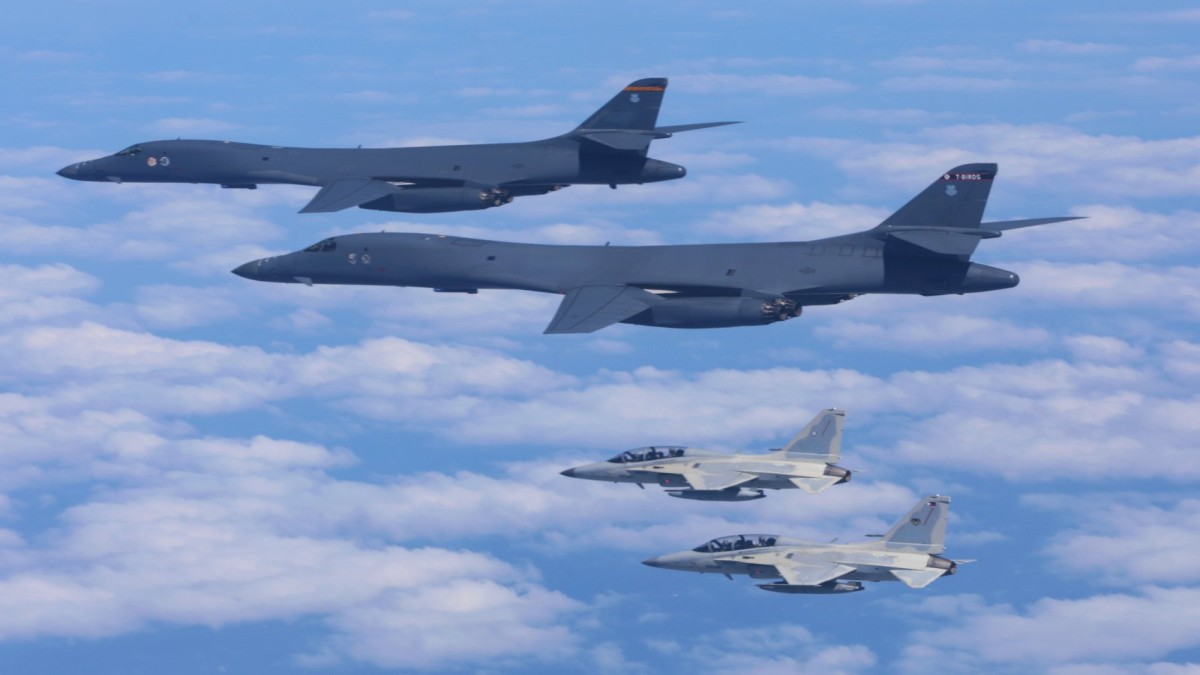
Washington connects. Beijing learns. India is exposed.
Before Beijing learns, Washington connects. Not in China. In Pakistan. In a hangar, a radar, a simulator, a mission file, a maintenance line, and a data link. The leak is not always stolen. Sometimes it is sustained, institutionalized access.
Washington asks India to anchor the Indo-Pacific against China while keeping alive Pakistan’s most sensitive American combat ecosystem. That is not balance. It is a risky exposure.
In February 2025, Washington and New Delhi defined their relationship as a comprehensive global strategic partnership. They spoke of a ten-year defense framework, advanced technologies, expanded sales, co-production, space, air defense, missiles, sea, and undersea domains. India was presented as a Major Defense Partner and a central pillar of the QUAD. The language is official: India is not a customer. It is a system pillar.
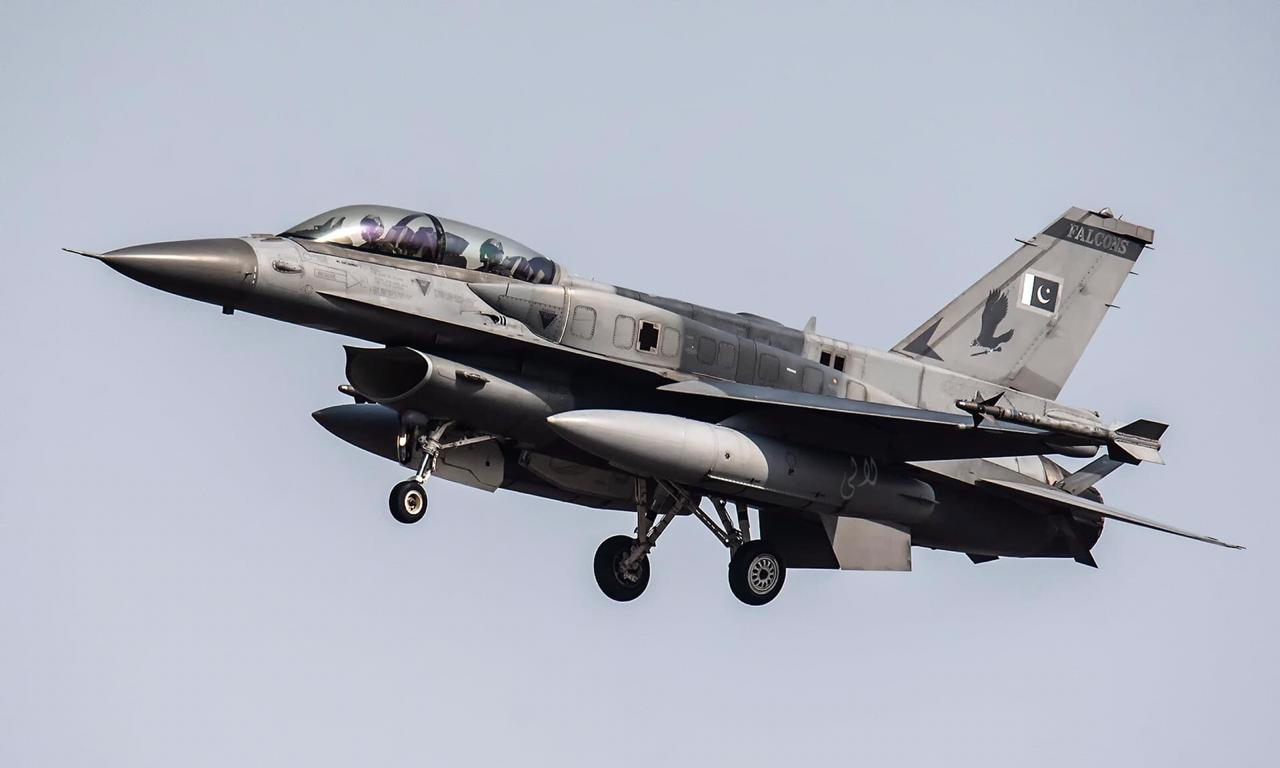
In December 2025, Washington approved a $686 million support package for Pakistan’s F-16 fleet. Not only spare parts. Not only maintenance. Link 16, cryptographic equipment, avionics updates, identification systems, secure communications, navigation tools, mission software, simulators, training, and logistical support. The official purpose: life extension, safety, communications, and interoperability.
Washington calls it interoperability. Many in Delhi see it as a double game.
Link 16 is not a radio. It is a nervous system.
It is a secure, jam-resistant tactical data link that operates in near real time. It fuses aircraft, ships, ground systems, and command centers into one battlefield picture: who sees, who is identified, who is marked, who tracks, who transmits, who receives an order, who fires, and when. It is not a pipe. It arranges a battlefield.
When Link 16 is integrated into a Pakistani F-16, America is not supplying the hardware. It is connecting Pakistan to the grammar of Western networked warfare.
Exposure is the syllabus.
No blueprint is needed to learn a system. Behavior is enough: tempo, transmission patterns, reaction times, classifications, loads, failures, maintenance, integration. The Chinese engineer does not need the aircraft. Access is enough: calibration, updates, testing, recurring faults, guarded procedures, and routine openings. He learns the system’s habits, not only its drawings.
Then he returns to Beijing.
In Beijing, every electronic signature, every cyber entry point, every radar blind spot, every behavioral quirk, every weapons bypass, and every doctrinal insight is cataloged, analyzed, and weaponized.
Beijing industrializes exposure.
It buys, copies, coerces, transfers, and hacks. It learns through students, companies, suppliers, joint ventures, supply chains, cyber, laboratories, civilian markets, and the military industry. It has done this in electronics, rail, telecoms, cyber, artificial intelligence, drones, space, and aviation. It turned exposure into a method, and method into an advantage.
Here, the risk is higher.
This is not a patent, a train, cloud software, or a chip. It is a live American combat system – connected, maintained, encrypted, and operated inside a Pakistani air force linked to China and aimed at India.
Leakage is not always a suitcase of documents. Sometimes it is an electronic signature. A radar mode. A Link 16 procedure. A mission-planning file. A simulator. A hangar. A Chinese engineer close enough to learn.
Washington knew.
Already in the 1980s, U.S. intelligence warned that sensitive F-16 technology sold to Pakistan could reach China. In 2019, Washington approved a $125 million Technical Security Team package for Pakistan’s F-16 program, designed to protect American technology through continuous U.S. presence and round-the-clock end-use monitoring.
Monitoring is confession.
Since then, Pakistan has not moved away from China. It moved deeper into it. Pakistan Aeronautical Complex and China’s Chengdu developed the JF-17 together. Pakistan operates Chinese platforms, Chinese weapons, Chinese sensors, and Chinese logic – alongside the American F-16. One air force holds both worlds. One operational space connects them.
In May 2025, that space became a classroom.
The India-Pakistan confrontation was not another round between two nuclear states. It was a laboratory.
Chinese systems operated in Pakistani service. Indian systems blocked, intercepted, and responded. Drones, missiles, radars, air defenses, command-and-control systems, and electronic signatures were exposed in real time. China did not need a full intelligence report to benefit. Pakistan provided the conditions.
Not Indian failure. Even interception teaches.
A system that blocks, jams, and responds still reveals how it does so.
Turkey supplies attrition.
It does not sustain the F-16. It feeds the cheap layer: drones, saturation, denial, measured escalation. In May 2025, India said Pakistan had sent hundreds of drones along the western border, and that preliminary findings pointed to Turkish-made Songar drones. Not fighter jets. An attrition space.
America supplies the nervous system. Turkey supplies the swarm. China takes the lesson.
F-16, Link 16, encryption, radar, IFF, software, and readiness above; drones, saturation, denial, and pressure below. Pakistan is the meeting point. India is the target environment.
Washington does not need to transfer technology to China directly. It is enough to sustain it in Pakistan, where China is close enough to learn.
America has not chosen Pakistan over India. It is doing something colder: building trust in New Delhi while preserving, for Islamabad, an American combat system within a Chinese exposure zone.
Delhi does not need American reassurance. It needs an American classification.
Pakistan is not an ordinary recipient. It is a high-risk recipient of U.S. military technology: nuclear, militarized, Chinese in depth, Turkish in part of its operational envelope, and hostile to India on land, in the air, and in the information space. Not because every component is stolen. Because the Pakistani system is a live friction zone between U.S. technology, Chinese industry, Chinese engineers, Turkish weapons, and coercion against India.
Balance is the wrong test. Exposure is the test.
Trump Called Them “Toys” — Now UK’s Aircraft Carrier HMS Prince of Wales Breaks Down Again in Norway
Link 16 exposes network logic. IFF exposes identification. Encryption exposes the security frame. Radar exposes search and tracking modes. Mission software exposes planning. Simulators expose training. Maintenance exposes routine. Each is a lesson. Together, they are a school.
Every F-16 package for Pakistan should be judged by what it teaches China: every Link 16, radar, IFF, cryptographic device, mission-software package, simulator, maintenance document, and support line. The question is not what Pakistan receives. The question is who learns from it.
If Washington wants India as a pillar of the Indo-Pacific order, it cannot connect Pakistan to an American nervous system and call it risk management.
America runs two policies. In Washington, it builds India as the balance. In Islamabad, it sustains the system that Beijing can study. One calls India a strategic partner. The other connects to the F-16.
- Shay Gal works with governments, international institutions, and national and global defense industries on strategic risk, security architecture and high-stakes decision-making. He previously served as Vice President of External Relations at Israel Aerospace Industries.
- Meet the Author on X: @ShayGal84
- This is an Opinion Article. Views Personal of the Author