A senior official from the Indian Ministry of Defense (MoD) has indicated that New Delhi is not currently planning to buy new Sukhois. The statement comes as Moscow has been aggressively pushing to export its Su-57 fighter jets to the IAF
In a recent interview with Moneycontrol, Defense Secretary Rajesh Kumar Singh stated that India has no plans to acquire a “new version of the Sukhois.”
“No, we have not thought about Sukhois. If you are asking about the new version of the Sukhois, the answer is no. But we are actively considering upgrading the existing Sukhois… It is a success story. It is a very important platform with the induction of BrahMos missiles, and we hope to further upgrade and improve it,” Singh said when asked whether there are any plans to buy a fifth-generation aircraft outside of the AMCA (Advanced Medium Combat Aircraft), India’s own indigenous fifth-generation fighter program.
While he did not name either aircraft, the remarks have been widely interpreted as referring to Russia’s Su-57 fifth-generation fighter. In fact, the statement marks a clearer official signal against a near-term Su-57 acquisition, in contrast to previous signals.
In April 2026, for instance, Chairman and Managing Director of the state-run Hindustan Aeronautics Limited (HAL), Dr. D.K. Sunil, said, “A committee of Russians has also studied and said that roughly 50% of the facilities can be used for producing this aircraft, but some new investments will be required.” Thus, hinting that, while India was neither committing to nor rejecting the offer, it was merely in a pre-decision, information-gathering phase.
Meanwhile, the Indian Air Force (IAF) chief, Air Chief Marshal A.P. Singh, indicated last year that the service might have to opt for an off-the-shelf purchase of a fifth-generation stealth aircraft.
“As far as the Su-57 is concerned, I just want to say that we have to weigh all the options, and we in the defense ministry and the Indian Air Force have a very set process for the induction of any weapon system, and that process will be followed. So what comes will depend on what meets the requirement and what is best for us,” he stated.
Singh’s latest comments also align with the IAF’s upgrade program for the Su-30MKI fleet aimed at modernizing avionics, sensors, and other systems while increasing domestic content.
“We are processing an upgrade program for the existing Su-30 MKI fleet. This will be the first time an indigenous upgrade of any fleet is being planned,” the IAF chief told Prakash Nanda, the Chairman of the Editorial Board of the EurAsian Times.
India’s Su-57 Conundrum
Russia first publicly offered the Su-57E export variant to India at Aero India in February 2025. This was followed by a “golden deal” that included the supply of off-the-shelf aircraft, the production of the Su-57 in India, and assistance in developing India’s fifth-generation Advanced Medium Combat Aircraft (AMCA).
Later, the Russian state arms exporter Rosoboronexport expanded it to include the use of existing Su-30MKI infrastructure to facilitate local manufacturing of the Su-57E in India, as previously reported by the EurAsian Times.
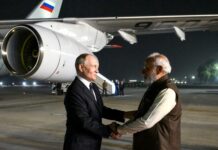
In June 2026, Russian President Vladimir Putin publicly renewed the pitch, citing the former FGFA (Fifth-Generation Fighter Aircraft) collaboration between the two allies and calling it the world’s best fifth-generation aircraft. Additionally, he stated that Russia was ready to work with India “without any issues or limitations.”
Notably, India and Russia had earlier collaborated on the Fifth-Generation Fighter Aircraft (FGFA) program under a 2007 agreement. However, India later withdrew from the program, amid shortfalls in stealth performance, engine capability, insufficient access to design data and source code, and concerns that the aircraft did not fully meet the Indian Air Force’s requirements for independent upgradeability and maintenance, as explained in a detailed EurAsian Times report you can read here.
In fact, doubts about the aircraft’s stealth characteristics and the extent to which Moscow would be willing to part with technology persist to this day, and are believed to be one of the reasons why India has been reluctant to acquire the Su-57.
Moreover, critics have expressed skepticism that the purchase or joint production of the Russian fighter may divert attention from India’s AMCA fifth-generation fighter program and put the indigenous aircraft on the back burner, as has happened in the past.
However, the situation has become increasingly complex, as AMCA appears to be farther away than initially anticipated. Defense observers and veterans predict the first flight may slip to 2032, as private manufacturers may not meet tight deadlines.
This would leave the IAF with a major stealth gap vis-à-vis the People’s Liberation Army Air Force (PLAAF), which has two operational fifth-generation fighters, the J-20 and the J-35. In fact, it has expanded its J-20 inventory to 500 fighters, according to recent reports.
Not just that, China has been testing two different sixth-generation prototypes: the J-36 and the J-50, both of which are regularly spotted in flight, suggesting that development is taking place at an unprecedented pace. In fact, Beijing may be ready to induct a sixth-generation fighter by the time India inducts its first AMCA.
The situation can become overly dangerous if Pakistan acquires the Chinese J-35A stealth fighters, as consistently noted by media reports.

Staring at a dwindling squadron strength, the IAF is currently inching closer to signing a deal for 114 Rafale fighter jets, 94 of which will be produced locally.
While this acquisition will help add the numbers needed for a large-scale two-front war, it will not arrest the growing technological gap between India and its adversaries.
Some veterans have argued that a limited off-the-shelf purchase of Su-57s could serve as an interim measure, provided it does not divert resources or attention from the AMCA.
“The 114 Rafales will address the quantitative requirement but not the qualitative enhancement requirement. That leaves only the Su-57 as the only available near-term option, though it is not perfect,” the IAF veteran and ex-Vice Chief of IAF, Air Marshal Anil Khosla, earlier told the EurAsian Times. “A deal for a limited number may be considered, provided it advances the AMCA program rather than curtails it.”
Others emphasize viewing large-scale commitment to a foreign fifth-generation platform as carrying industrial, sustainment, and strategic risks.
For example, IAF veteran, Air Marshal Anil Chopra, told EurAsian Times: “India should focus on producing the Rafale locally, advance work on AMCA and its variants, accelerate production of the indigenous Tejas fighters, and buy about 40 Su-57 fighters off-the-shelf from Russia as an interim solution instead of getting into local production.
Earlier this year, the Indian MoD informed the Parliamentary Standing Committee on Defense of its interest in joining a sixth-generation fighter. India has two options: join the UK-Japan-Italy GCAP program or team up with France for their potential 6th-gen aircraft.
- Contact the author at sakshi.tiwari13 (at) outlook.com
- Follow EurAsian Times on Google News