Ethiopia has taken delivery of the first 12 Russian Su-35 fighter jets, Prime Minister Abiy Ahmed announced on Wednesday during a visit to Moscow.
This makes Ethiopia the third export customer of the Su-35 after China and Algeria. Russia remains the biggest operator of the fighter jets and has comprehensively used the warplanes in the ongoing war in Ukraine.
PM Abiy made the announcement on X while attending the two-day third Russia-Africa Summit, where Moscow is seeking closer security and economic ties with African countries amid Western sanctions over the Ukraine conflict, which has now entered its fifth year.
Abiy wrote on X: “Our comprehensive efforts to sustainably ensure our country’s peace and security have reached a new milestone today. The state of readiness being built within Ethiopia’s defense forces is endowing the nation with the capability to preemptively deter aggression.
In accordance with our prior agreement with the Russian government, we have today taken delivery of the first twelve Su-35 4++ Generation fighter jets. Additionally, Ethiopia will receive four S-400 air defense system batteries.
I would like to express my gratitude to my friend, Russian President Vladimir Putin, for his dedication in ensuring we received these warplanes a year ahead of our agreed schedule. By equipping itself with these fighter jets, Ethiopia has taken the lead among Sub-Saharan African nations.
This historic achievement further strengthens our nation’s sovereignty, and it will serve as a massive capability boost that allows us to confidently continue our journey toward ensuring our collective security and regional stability in the future.”
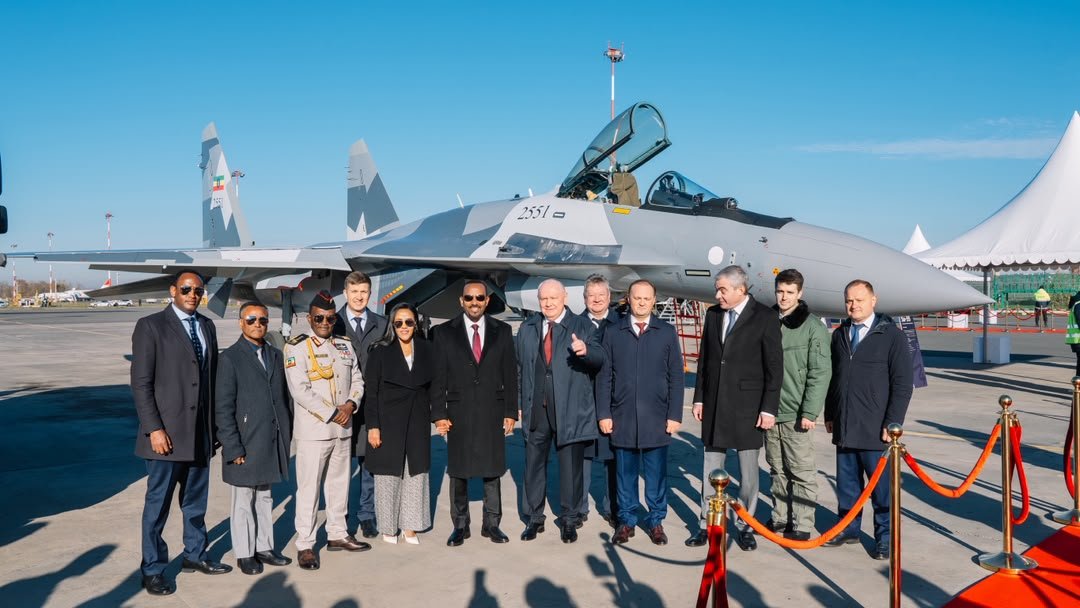
Ethiopian and Russian officials, including Abiy, attended a formal handover ceremony at Zhukovsky Airport near Moscow, and the prime minister’s office released photos showing Su-35s bearing Ethiopian markings.
The deal builds on a July 2021 military cooperation agreement that aims to boost training and technology for Ethiopia’s armed forces, which has previously relied on older Soviet-era Su-27 fighters.
Alexander Mikheyev, head of Rosoboronexport, said: “The choice of the Su-35 was not accidental. It is one of the best platforms, and it has proven itself in the conditions of the special military operation [in Ukraine], including in its interaction with air defense and electronic warfare systems. In fact, the complex is necessary in the current situation of the Ethiopian Armed Forces.”
“Ethiopia has operated Sukhoi aircraft for many years, so its pilots and technical personnel already have experience with the family. This will make the transition to the Su-35 easier. Russia will also provide specialized training for Ethiopian pilots, engineers and maintenance personnel.”
The Russia-Africa Summit, attended by delegations from 48 African countries including 22 heads of state or government, focused on trade, investment, energy, food security and security cooperation.
Interestingly, Ethiopia received two Su-30K fighter jets in January 2024. These aircraft were part of a small batch built in the late 1990s for the Indian Air Force. India later returned them to Russia after receiving the more advanced Su-30 MKI.
After India returned the early-model Su-30K fighters as part of a trade-in arrangement, Russia transferred the aircraft to the 558th Aircraft Repair Plant in Baranovichi, Belarus, for storage in 2011.
Angola signed a contract in October 2013 to buy 12 jets; they were overhauled and upgraded at the plant, with the first deliveries in 2017 and the last in 2019.
The Su-30 is a two-seat version of the same Russian “Flanker” family that Ethiopia has flown for years (the older Su-27). Pilots and ground crews already know the basic design, so the Su-30 will be a useful stepping stone to the Su-35.
Sukhoi Su-35
The Sukhoi Su-35 has basically evolved from the Su-27M air-defense fighter that first flew in June 1988.
Sukhoi refined the aircraft’s capability during the development of India’s Su-30MKI.
Sukhoi embarked on a second “deep” modernization of the Su-27 in 2003 to serve as an interim export aircraft while awaiting the development of the Sukhoi PAK FA (Su-57) program.
The aircraft’s ability to maintain a high angle of attack at near-zero airspeed has traditionally drawn considerable media and public attention.
The Su-35 incorporated technologies from the PAK FA program, with a redesigned cockpit and weapons-control system, and featured thrust-vectoring engines that eliminated the need for canards. The type made its first flight in February 2008.

Although it was designed for export, the Russian Air Force became the first customer in 2009, with the production version designated Su-35S. China’s Air Force also acquired 24 Su-35s.
The Su-35 employs the N035 Irbis-E “Snow Leopard” passive electronically scanned array (PESA) radar, a further development of the N011M radar evaluated on Su-27M testbeds and the core of the Su-35’s weapons-control system. It can detect an aerial target up to 400 km away, track 30 airborne targets, and engage eight simultaneously.
In addition, the multi-function radar can provide high-resolution ground images in synthetic aperture mode. The aircraft is equipped with an OLS-35 optoelectronic targeting system ahead of the cockpit for other tracking modes, including infrared search and track. The Su-35 is equipped with the L175M Khibiny-M electronic countermeasure system.
Radar-absorbent materials have been applied to the engine inlets and front stages of the engine compressor to halve the Su-35’s frontal radar cross-section and minimize the detection range of enemy radars.
The multi-role Su-35 can deploy air-to-air missiles with a range of up to 300 kilometers, carry the heavy Oniks anti-ship cruise missile, and carry a multitude of air-to-ground weaponry.
The Su-35 is powered by a pair of Saturn AL-41F1S turbofan engines, a highly upgraded variant of the AL-31F. The AL-41F1S is closely related to the Su-57’s Saturn AL-41F1 and produces 137.3 kN of thrust with afterburner.
The engines have thrust-vectoring nozzles with canted rotational axes; the nozzles operate in one plane for pitch, but the canting lets the aircraft produce roll and yaw by vectoring each engine nozzle differently. The Indian Su-30MKI was the first to implement this configuration.
The engine gives the Su-35 limited ability to sustain supersonic speed above Mach 1.1 without afterburners (supercruise).
The maximum take-off weight is 34,500 kg. Combat range is 1,600 km. The 12 hard points (10 on wing and fuselage stations and two on 2 wingtip rails can carry 8,000 kg of ordnance. Various combinations could be up to 12 × R-77M/P/T/-1 AAMs, or 6 × Kh-29L/TE air-to-surface missiles, or 6 × Kh-31A/AD anti-shipping missiles, among others.
The early delivery of Su-35 fighters and the acquisition of the S-400 ‘Triumf’ AD system mark a monumental leap for Ethiopia’s military arsenal. While the aircraft build on Ethiopia’s long experience with Russian Su-27 and Su-30 platforms, the new ‘Super Flankers’, though limited in number, will make Ethiopia’s air power formidable in the region.
Mail us at: editor (at) eurasiantimes.com