Defense analysts have long warned about the outsized influence of America’s “Big Five” defense contractors—Lockheed Martin, RTX (formerly Raytheon), Boeing, Northrop Grumman, and General Dynamics. These giants have dominated Pentagon spending for decades, securing roughly one-third of all major contracts.
But a new and potentially more troubling risk is emerging: the Pentagon’s growing dependence on a new, single, highly specialized player that has already evolved into a de facto monopoly in critical future technologies.
Imagine a scenario in which one company becomes indispensable across key domains, including satellite-based communications, early missile warning, satellite launch services, and satellite navigation.
In a major conflict, that single provider could theoretically dictate terms. It could delay deliveries, dramatically escalate costs, or even limit capabilities if negotiations sour.
If no viable alternatives are available, the Pentagon, and by extension America’s war-fighting ability, would be at its mercy.
Now here comes the scary part.
This is not some distant hypothetical situation. It is a scenario taking shape today, and the Pentagon, unfortunately, has no means to alter the situation, at least not in the foreseeable future.
Amid the Iran War, Starlink Forced the Pentagon To Pay Five Times More
Latest media reports suggest that the SpaceX-owned Starlink struck a hard bargain with the Pentagon during the war with Iran, forcing it to pay a much higher price for its services.
Starlink services were used for Satellite-based connection and navigation by the US military’s Low-Cost Uncrewed Combat Attack System (LUCAS) one-way attack drones.
Produced by SpektreWorks, LUCAS, a clone of Iran’s Shahed-136 kamikaze drones, made its combat debut in the Iran War and made visible gains on the battlefield.
However, “within weeks of the United States launching its bombing campaign, SpaceX executives met Pentagon officials and argued the military had been paying about US$5,000 for connection per terminal while effectively using a higher tier of service worth closer to US$25,000,” according to two sources familiar with the matter and Pentagon documents reviewed by Reuters.
Effectively, Starlink wanted to raise the prices of its services used by the Pentagon fivefold in the middle of the war.
Starlink argued that the Pentagon was paying the price for using the commercial Starlink network, while it was effectively using the more secure, military-specific version, Starshield, which is priced higher.
Unlike consumer Starlink terminals available at stores including Walmart, SpaceX sells a military-specific version called Starshield to the Pentagon under a 2023 agreement. Starshield terminals can connect to both commercial Starlink satellites and a separate, more secure constellation, Starshield.
SpaceX argued the LUCAS drones were operating under conditions that aligned more closely with its aviation-tier subscription rather than a lower-priced land or mobility service. Pentagon officials argued that the US$25,000 price tag – a monthly fee – was designed for aircraft, not kamikaze drones that used Starlink connection for a matter of minutes or hours, one of the sources told Reuters.
“The Pentagon, which was ramping up strikes on Iran, ultimately agreed to pay SpaceX’s proposed price increase,” the report added.
But here’s the truly alarming part – this price hike by Starlink almost doubled the cost of each LUCAS drone.
Each unit of LUCAS costs the Pentagon nearly US$35,000. Now, combined with the one-time monthly fee of US$25,000 per unit for these drones, the effective price per drone becomes US$60,000.
Interestingly, the increased price tag of the LUCAS drone threatens to undermine its very purpose.
The very name of the LUCAS drone, Low-Cost Uncrewed Combat Attack System, underscores that it was intended to be a low-cost alternative to high-cost precision weapons the US military has used until now, such as the Tomahawk cruise missiles, which cost around US$2 million per unit.
LUCAS was developed as a low-cost, expendable, one-way attack drone that can be deployed at scale to saturate enemy air defenses. However, if Starlink’s subscription nearly doubles its cost, it can undermine the very purpose of developing such a low-cost alternative.
Many of the LUCAS drones used in the Iran War have an in-built Starlink terminal in their rear for satellite connectivity and guidance.
For instance, on March 1, a downed LUCAS drone in Iraq was seen with a dangling Starlink terminal. After its videos went viral on social media, SpaceX CEO Elon Musk said that using the military-grade Starlink guidance system on these drones was unauthorized.
Local Iraqi residents are taking the newly deployed, nearly intact American LUCAS drone for themselves. pic.twitter.com/fbx411iAYU
— Special Kherson Cat 🐈🇺🇦 (@bayraktar_1love) March 2, 2026
“It is a violation of commercial Starlink terms of service to use the terminal for weapon systems. This applies to all users and is shut down when discovered,” Musk wrote on platform X.
“There is a separate network called Starshield, which is operated by the US government. This is not under SpaceX control,” he added.
It is a violation of commercial Starlink terms of service to use the terminal for weapon systems. This applies to all users and is shut down when discovered.
There is a separate network called Starshield, which is operated by the US government. This is not under SpaceX control.
— Elon Musk (@elonmusk) March 2, 2026
However, the Pentagon and Elon Musk have dismissed the Reuters story.
Musk said that the Reuters story is “False.”
“They made improper use of the Starlink civilian system for military purposes. Direct violation of terms of service,” he added.
In another post, Musk said that the LUCAS drones incorrectly used Starlink’s civilian-use satellites rather than Starshield satellites.
Almost everything you’re saying is false and simply copying fake news from other accounts.
There is a US government arm of SpaceX called Starshield, which has a different set of satellites than Starlink, which is for civilian use.
The company that makes the suicide drones…
— Elon Musk (@elonmusk) May 26, 2026
“The Fake News media has the story wrong, again,” top Pentagon spokesperson Sean Parnell subsequently wrote in a post on X. “The claims in this article are simply not based in reality and do not reflect the close, effective collaboration between our teams.”
These clarifications by Musk and the Pentagon seem to corroborate the Pentagon’s use of the Starshield service without authorization. They did not clarify whether the Pentagon was required to pay five times more to connect to the Starshield network.
Regardless, the story highlights how the Pentagon is entirely dependent on Starlink for many of its critical war-fighting capabilities, including guiding its one-way attack drones.
What makes this dependence worrisome is that SpaceX has a near-monopoly in this field.
SpaceX already has over 10,000 Starlink satellites in Low Earth Orbit (LEO). According to Space.com, as of May 5, 2026, Starlink has 10,296 Starlink satellites in orbit, of which 10,280 are working.
In comparison, Eutelsat’s OneWeb has just 654 active satellites, and Amazon’s Leo has around 300 satellites in LEO. Basically, the Pentagon has no alternative to the satellite-based communication and navigation services that Starlink provides.
However, the Pentagon is also dependent on Starlink and SpaceX for other critical services. The US government is also using the Starlink guidance system on a host of aircraft, drones, ships, and even aircraft carriers.
For instance, US Navy carriers, such as USS Abraham Lincoln and USS Gerald R. Ford, as well as other ships like USS Nimitz, USS Ronald Reagan, and expeditionary sea base ships like USS Lewis B. Puller, use Starlink’s services.
U.S. Marine Corps’ VH-92 Patriot presidential helicopters also use Starlink services.
The US Air Force (USAF) is also testing the integration of Starlink connectivity on its latest fighter jets, such as the F-35 Lightning II.
The US government is also dependent on SpaceX for its low-cost satellite launch services. As such, the company is set to play a key role in President Donald Trump’s ambitious Golden Dome project, which will involve launching hundreds, perhaps thousands, of space-based sensors and missile interceptors.
How critical Starlink has or could become to modern-day military operations is best understood from the example of the Ukraine War, where both sides have heavily used its services.
Musk and Starlink had faced questions after the company turned off access to its satellites for Ukrainian forces when they were about to launch a counter-offensive strike in Crimea, which ultimately led to the failure of the operation.
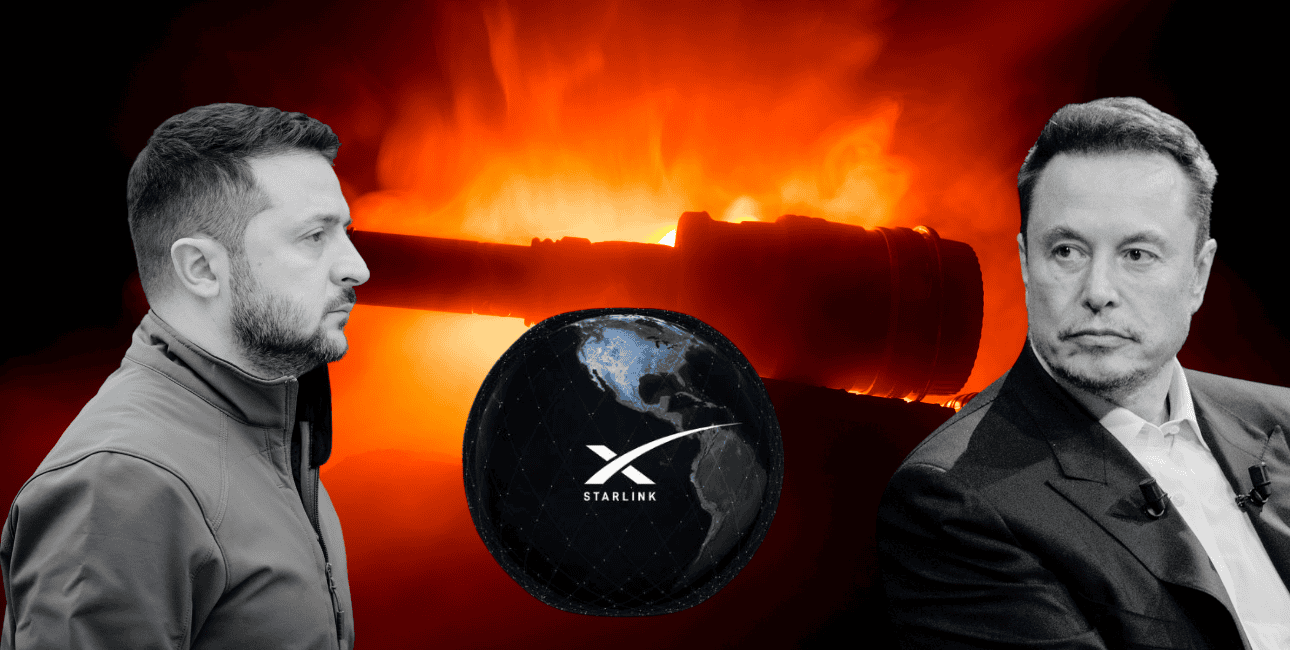
Musk later acknowledged that he had turned off access because it could have escalated the war. However, the incident highlighted how one company could influence the outcome of wars.
Again, the Russian operation was badly impacted earlier this year when Starlink blocked Russia’s access to its satellites by blocking unauthorized terminals.
Consider, for instance, a situation in which Starlink threatens to cut the Pentagon’s access to its services in the middle of a war if it refuses to pay an increased fee.
The story about Starlink demanding a higher fee in the middle of the war, even after the Pentagon denied it, should serve as a warning to the Department of War to critically analyze its increasing dependence on SpaceX for critical future technologies and military tactics.
- Sumit Ahlawat has over a decade of experience in news media. He has worked with Press Trust of India, Times Now, Zee News, Economic Times, and Microsoft News. He holds a Master’s Degree in International Media and Modern History from the University of Sheffield, UK.
- VIEWS PERSONAL OF THE AUTHOR.
- He can be reached at ahlawat.sumit85 (at) gmail.com