Russia appears to be preparing to revive and modernize its inventory of the Soviet-era Pechora S-125 short-to-medium-range surface-to-air missile system, in a move that the IAF leadership could well take note of.
S-125 is the same missile that was used to shoot down the US Air Force’s F-117 Nighthawk stealth fighter-bomber over Serbia on March 27, 1999, during the Kosovo War.
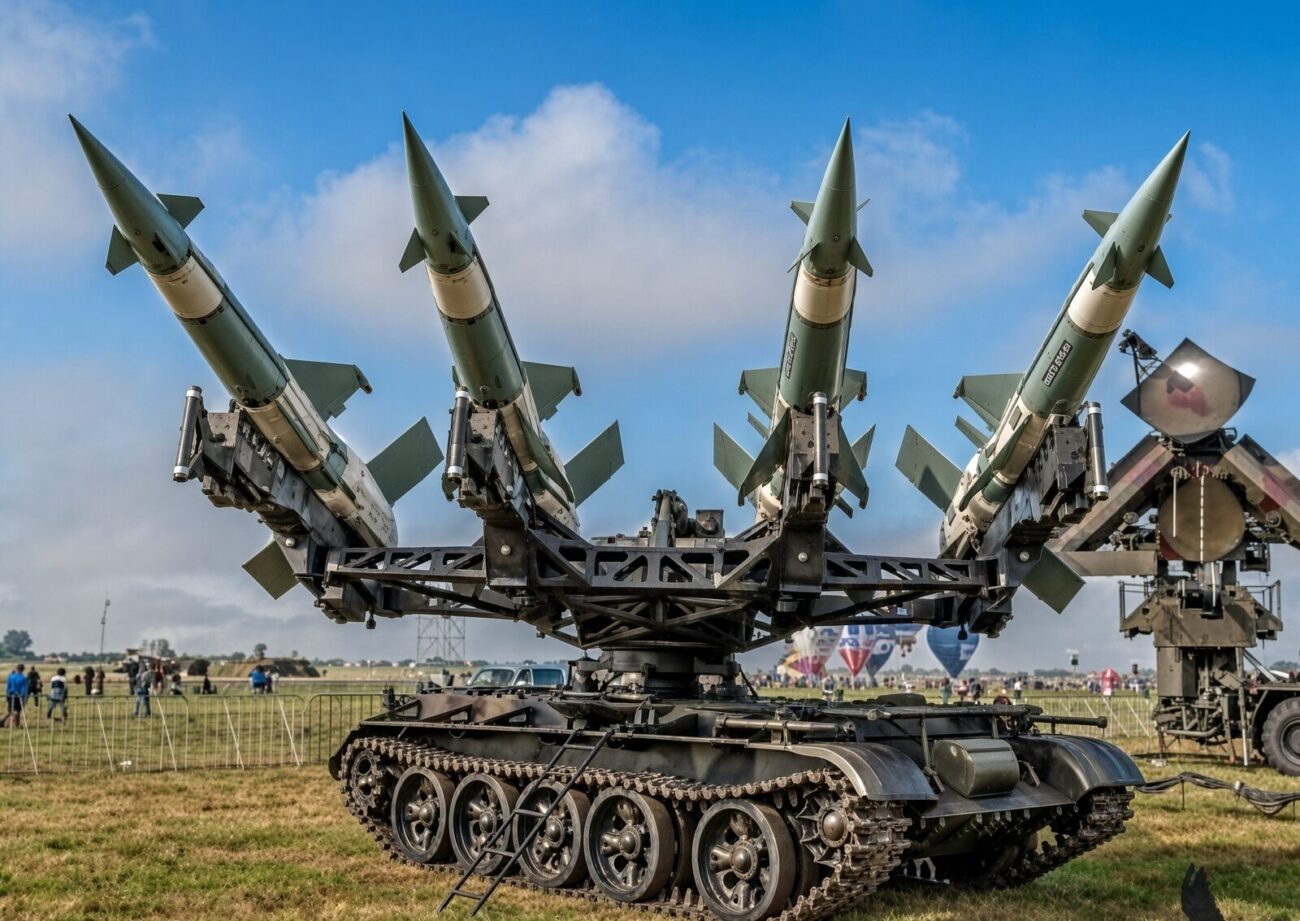
The Pechora S-125 (SA-3 Goa) is a legacy Soviet static, short-to-medium-range surface-to-air missile system developed to engage low- to medium-altitude air threats using command guidance.
The IAF also modernized its S-125 inventory to plug an operational gap that widened due to delays in procuring MRSAM and Akash air-defense systems. However, the IAF did not pursue modernization to the extent that the capability gains matched the more comprehensive modernization offered by the Russian Pechora-2M.
According to Militarnyi, a Ukrainian media outlet focused on military affairs, the Minsk Wheel Tractor Plant (MZKT) has signed a contract with Moscow-based JSC Oboronitelnye Sistemi to supply 30 specialized wheeled chassis that appear intended for components of the Pechora-2M system.
The Pechora-2M is a heavily modernized Pechora derivative with a self-propelled truck-mounted launcher, digital electronics, an extended engagement envelope, and day/night electro-optical tracking, giving the system much greater tactical mobility.
Under the terms of the contract, Russia would receive 20 MZKT-8021-021 chassis, as well as five each of the MZKT-8022-021 and MZKT-80211-021.
The MZKT-8021/8022 family of specialized chassis was developed specifically to accommodate components of the Pechora-2M air-defense missile system.
Pechora Revival
The delivery schedule extends to 2029, suggesting a planned multi-year acquisition rather than a one-off procurement to meet an immediate operational requirement.
More likely, Russia is seeking to expand its air-defense capacity in response to the heightened threat from the prolific use of drones and other low-cost aerial threats in modern warfare.
Drone warfare has increased the aerial threat severalfold, so it is logical for any nation to increase the density of its AD systems by a corresponding factor.
Russia appears to be increasing its reliance on legacy systems rather than simply discarding them.
Russian Modernisation
The modernized Pechora-2M system was developed as a deep modernization of the Soviet S-125, incorporating a self-propelled, highly mobile launcher and modernized electronics. The modernization transformed the legacy stationary S-125 into a rapidly deployable air-defense platform capable of shoot-and-scoot tactics, reducing its vulnerability to anti-radiation weapons and precision strikes.
The 2M replaces the legacy four-rail stationary ground launcher (5P73) with a twin-rail launcher mounted on a heavy 6×6 truck chassis. The reduction in launch rails was necessary to maintain launcher stability when mounted on a mobile chassis.
The legacy S-125 required considerable time to disassemble, pack onto trailers, move, and re-erect at a new site. In contrast, the Pechora-2M can reportedly be brought into action in roughly 20–25 minutes, facilitating shoot-and-scoot operations.
Besides the self-propelled launchers, the tracking/fire-control radar and other system components are also mounted on high-mobility truck chassis rather than being confined to towed equipment.
IAF Pechora Modernization
In 2016, the Indian MoD issued a $272-million tender to digitize 16 Pechora systems. The tender was restricted to Indian companies to support the government’s Make in India policy. The eventual contract, worth ₹591.3 crore, was awarded to Alpha Design Technologies Ltd (ADTL) in 2020.
Russia’s Almaz-Antey is the original equipment manufacturer of the Pechora system. At the time, Indian officials indicated that Russian defense companies preferred to work through Russian state-owned entities, limiting the scope for direct OEM participation by Indian companies.
The scope of the Indian Pechora upgrade was primarily the electronic and mechanical modernization of the existing system rather than a fundamental redesign of its architecture. It included refurbishment and digitization of the missile-guidance radar and integration of the system with the IAF’s Integrated Air Command and Control System (IACCS).
Alpha Design Technologies Ltd executed the upgrade, focusing on digitization and electronic modernization. It replaced vintage electronic components with modern semiconductor-based electronics and digital processing, while modernizing operator consoles and other system elements.
No Mobility
The system retained its original static, four-rail, ground-mounted configuration (5P73 launcher) and towed transport arrangement because the Indian upgrade scope did not include mobility.
Because it lacks mobility, the IAF has traditionally used the Pechora for point defense of fixed, high-value infrastructure such as air bases, radar stations, and other military installations.
A statically deployed AD system protecting a high-value asset made considerably more sense when precision-guided munitions were either unavailable or relatively uncommon. In contemporary warfare, where precision weapons can routinely achieve single-digit-meter accuracy, a static air-defense system defending a high-value asset can itself become a priority target.
Recall the failed PAF attempt to strike the S-400 system deployed to defend Aadampur air base during Op Sindoor. With foresight, and by leveraging the S-400’s mobility, IAF leadership relocated the system before the attack. The episode illustrates the importance of mobility and survivability for high-value air-defense assets.
A Still-Capable System
Despite its vintage, the Pechora remains a potentially useful AD system. Endowed with mobility and modern sensors and electronics, it would acquire significantly greater survivability and tactical utility.
One of its strengths is electro-optical tracking, which permits passive target tracking without radar emissions, reducing vulnerability to anti-radiation weapons. Both Russian and Indian modernization programs have improved the system’s electro-optical capability.
The Indian upgrade incorporates thermal-imaging-based fire-control equipment, while the Pechora-2M also incorporates TV and thermal/infrared electro-optical channels.
Thermal imaging provides a passive night-and-day detection and tracking capability and, unlike conventional television cameras, does not depend on visible light. However, adverse atmospheric conditions can degrade its effectiveness.
It is interesting to note that the IAF chose to upgrade its Pechora systems without fundamentally modifying the missile. Contemporary reporting on the original upgrade program indicated that the IAF considered the existing missile adequate and concentrated instead on digitization, radar, communications, networking, and other system improvements.
The 5V27 family missile has a substantial fragmentation warhead of around 70 kg and uses command guidance. Its continued availability is one possible reason why extending the life of the Pechora system remains attractive.
Russia may also be reviving and revitalizing Pechora-2M systems because it has a substantial existing inventory of 5V27-series missiles. If so, the approach illustrates an important principle of modern warfare: the value of an old weapon system can change when it is combined with modern sensors, electronics, mobility and networking.
What the IAF Should Note
In the immediate future, the IAF will need to deploy many more AD systems than it currently does in order to field a robust air-defense capability spanning the entire gamut of aerodynamic threats—aircraft, helicopters, cruise missiles, guided bombs and drones.
Developing additional AD systems may prove more challenging and time-consuming than upgrading existing legacy systems such as the Pechora.
Upgrading the Pechora to add mobility, modern electro-optical sensors and improved networking should be well within Indian technological capability. Even locally manufacturing additional upgraded systems under an appropriate OEM arrangement could be a cost-effective way to augment India’s air-defense capability.
Russia’s apparent decision to extract additional combat value from an old missile system should therefore be viewed less as a revival of obsolete technology and more as an example of how legacy weapons can be adapted to the changing economics and character of air warfare.
- Vijainder K Thakur is a retired IAF Jaguar pilot, author, software architect, entrepreneur, and military analyst.
- Views Personal of the Author
- Follow the author @vkthakur