About 15 years ago, Australia made an unusual decision to bury its US-origin F-111 strike aircraft, whose purchase had been controversial from the outset. The burial was not meant to conceal the aircraft from enemies or for artistic purposes, but simply to protect the Australians from a deadly exposure.
In late November 2011, trucks rolled out of Royal Australian Air Force (RAAF) Base Amberley carrying the stripped, wingless hulks of Australia’s once-feared F-111 strike aircraft. Over the next few days, crews lowered 23 fuselages into a pit and covered them with earth at the Swanbank landfill, a former coal mine outside Ipswich, Queensland.
The RAAF F-111, known as the “Pig” by Australian aviators for its long-snouted swing-wing design, had been the backbone of the RAAF’s long-range strike capability for nearly four decades.
This made the burial a very rare event.
The RAAF had operated the F-111 since 1973. On December 3, 2010, a crew in an F-111C (serial number A8-125) of the Royal Australian Air Force made the aircraft’s final landing at RAAF Amberley, ending the F-111’s operational service.
After the F-111s were retired, 13 of the remaining aircraft—12 F-111Cs and one F-111G—were kept in aviation museums and RAAF air bases. Meanwhile, the remaining 23 aircraft were buried at the Swanbank landfill site west of Ipswich, Queensland, between November 21 and 23, 2011.
Notably, some other countries also buried their aircraft. For instance, Iraq reportedly buried its combat aircraft in the deserts during the 2003 invasion. Meanwhile, British artist Roger Hiorns undertook an unusual art project involving burying decommissioned aircraft in the UK, the Czech Republic, and the Netherlands.
Australia’s burial of the F-111, however, remains distinctive because it was primarily driven by occupational health and regulatory requirements.
The Burial Of Australia’s Iconic Strike Aircraft
The burial of the Australian F-111 was primarily driven by a serious occupational-health problem: the widespread presence of asbestos in the aircraft’s structure.
The adhesive compounds used in the F-111 strike aircraft’s bonded structural panels contained chrysotile, commonly known as white asbestos.
These compounds bonded components and sealed small gaps between structural surfaces, reflecting common manufacturing practices at the time. However, a significant concern in Australia was that the asbestos might not have been confined to removable components, but could also have been incorporated into permanent structural sections of the aircraft.
Typically, when a military aircraft reaches the end of its service life, it is dismantled, and its parts, including engines, landing gear, avionics, aluminum structures, and other components, can be recovered, reused, recycled, or sold as scrap metal.
However, conventional dismantling of the F-111 — cutting, separating, drilling, or breaking structural components — could disturb asbestos-containing adhesive, releasing microscopic asbestos fibers and causing serious diseases, including mesothelioma, asbestosis, and lung cancer.
The Australian Defense Department had to consider not only the safety of its own personnel but also the health of contractors, transport workers, recycling employees, and anyone who might subsequently handle the recovered materials. Moreover, testing posed another challenge because establishing that an individual aircraft was completely free of asbestos would have required extensive inspections and potentially destructive testing.
A technical assessment carried out by the Australian Department of Defense concluded that completely removing asbestos and certifying an F-111 as asbestos-free was not practically achievable with the available industrial capabilities and resources. Thus, the only practical way to manage most of the airframes was to leave the asbestos-containing materials in place and dispose of them in a controlled manner that minimized disturbance.
Initially, the Australian Defense Department estimated that demilitarising an aircraft would cost approximately A$1 million, while asbestos removal and remediation could cost another A$1.5 million. This meant that preparing an individual aircraft for potential museum display could cost as much as A$2.5 million per airframe, which may have been an underestimation given that these estimates were developed before Defense understood how extensively asbestos-containing adhesives were distributed throughout the aircraft.
Moreover, US Foreign Military Sales rules required secure demilitarization and disposal of the aircraft, ruling out open sales or indefinite storage.
After considering the available disposal options, the Australian Defense Department concluded that conventional dismantling and recycling were inappropriate for most aircraft because of the risks involved. This eventually led them to the best available option: burial.
Burial offered a way to dispose of the contaminated structures without extensively cutting, breaking, or separating the bonded panels. Australia figured that it could transport the aircraft fuselages and place them in a controlled landfill instead of exposing workers to potentially dangerous asbestos fibers during dismantling.
The burial, however, was not an ordinary affair.

Australia was not simply dumping aircraft in an ordinary rubbish pit. The disposal was carried out under contract and involved 23 aircraft airframes
The operation commenced on 21 November 2011 when the first fuselage was transported to the Swanbank landfill site near Ipswich, followed by another 22 fuselages delivered and placed at the site over the next two days. Other aircraft components, including wings and tail surfaces, also filled spaces between the fuselages before the burial area was covered.
The burial stands as one of the more unusual retirements in modern air force history—for a jet that once flew low and fast across the region, the burial was akin to a final grounding.
At the same time, Australia recognized the F-111’s historical significance and set aside 13 F-111s for display, allowing the public to walk around the swing wings that once redefined strike aviation. The government ultimately allowed selected aircraft to be preserved, even though they still contained asbestos. However, preservation came with strict conditions, and the aircraft had to be managed as asbestos-containing objects.
Australian F-111 Was A Force
In the early 1960s, Australia’s principal strategic bomber was the British Canberra. While capable, the Canberra was becoming increasingly obsolete.
Australia needed a more capable aircraft to defend its extensive northern approaches as Indonesia’s military capabilities expanded during the Sukarno period. It also needed a long-range strike aircraft that could operate across the vast distances of the Indo-Pacific and protect maritime communications and sea lanes. This coincided with a strategic shift as Australia sought greater self-reliance in regional crises.
The RAAF required an aircraft that could fly supersonically, have a long operational range, and perform low-altitude penetration, with substantial weapons-carrying capacity, all-weather strike capability, and a secondary reconnaissance role. It evaluated several options, such as the American A-5 Vigilante and the British TSR-2.
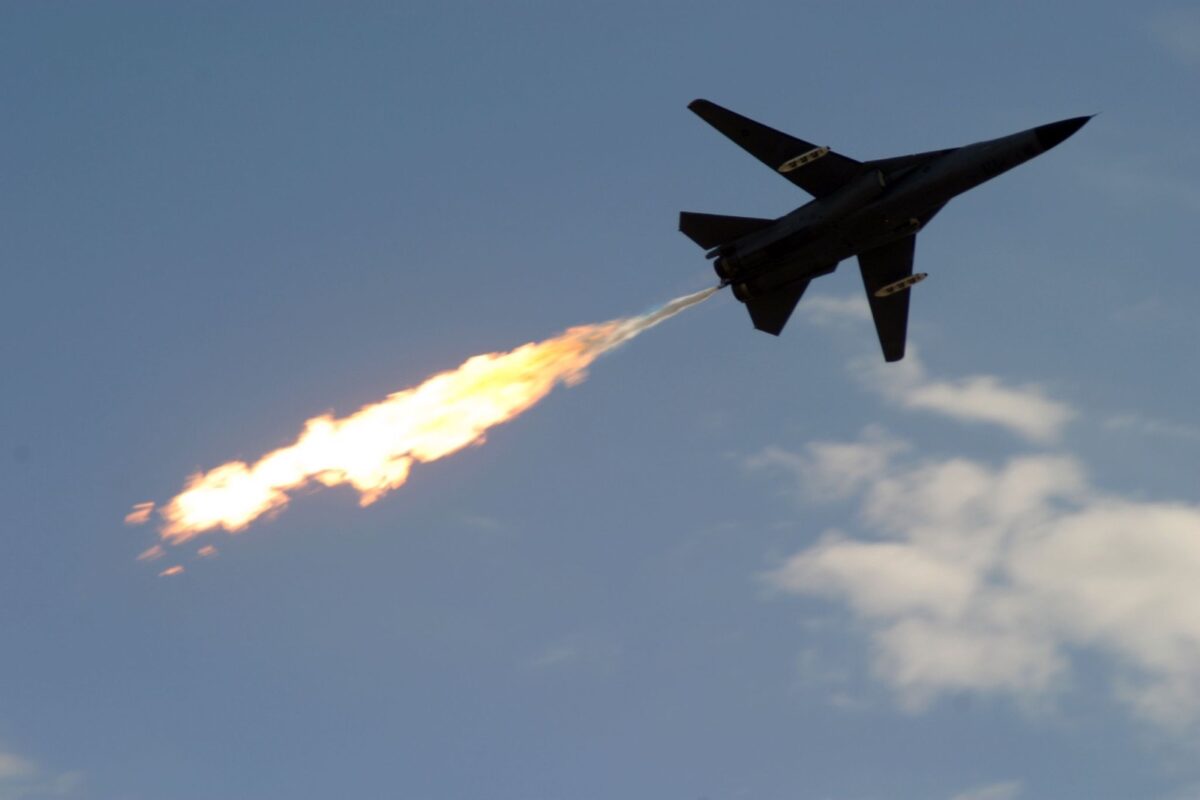
However, it ultimately selected the F-111 because the aircraft fit the requirements and allowed it to pursue closer ties with the US.
The F-111 was a supersonic, twin-engine, variable-sweep-wing strike aircraft developed in the 1960s. Designed primarily for long-range, low-level penetration and tactical bombing, it could operate in all weather conditions and carry a substantial weapons payload.
Australia’s purchase of the F-111 was controversial for several reasons. The government committed to buying an aircraft that had yet to fly, chose it over competing strategic and political interests and then endured years of delays, technical problems and rising costs. The F-111 first flew in December 1964, more than a year after Australia purchased it. At the time, critics said Canberra had committed to an expensive, technically ambitious system without the chance to evaluate a production aircraft in flight.
Subsequently, the F-111’s development encountered serious engineering problems that required structural modifications and additional testing.
This caused delays in delivery—Australia originally expected the aircraft to enter service around 1968–69. Instead, the first six F-111Cs arrived in 1973.
The acquisition also reportedly saw costs escalate rapidly, causing friction at home and sparking debate on multiple occasions.
Nonetheless, the aircraft that caused Australia so much difficulty during its acquisition eventually became one of the most celebrated aircraft in RAAF history.
Although the aircraft was maintained for high-intensity strike operations, Australia did not deploy its F-111s into combat during the Vietnam War or the Gulf War.
In fact, the most significant operational employment of Australia’s F-111 fleet occurred much later, during the 1999 East Timor crisis.
After the independence referendum in August 1999, violence broke out in East Timor. Australia then led the multinational peacekeeping force INTERFET. At the time, the RAAF used its RF-111C reconnaissance aircraft to carry out aerial surveillance of East Timor. These missions provided vital aerial intelligence to Australian commanders in a sensitive military and diplomatic situation.
By the early 2000s, the Australian F-111 fleet was approaching the end of its economical service life. And when it was finally retired in 2010, the F-111 had served Australia for 37 years, becoming the longest-serving bomber/strike aircraft in RAAF history.
- Contact the author at sakshi.tiwari13 (at) outlook.com
- Follow EurAsian Times on Google News