

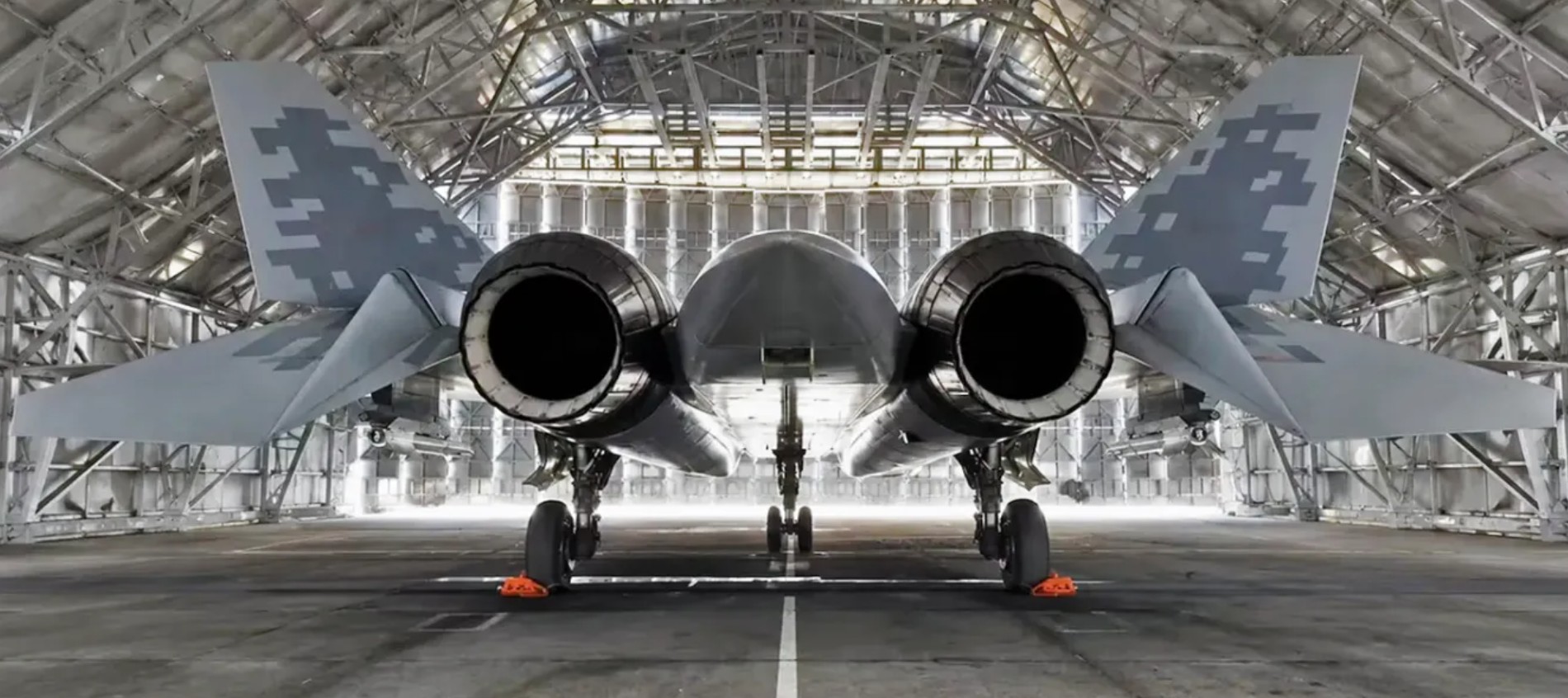
Amid the ongoing war in Ukraine, Russia has received a new batch of upgraded Su-57 ‘Felon’ fighter jets.
The United Aircraft Corporation (UAC), a subsidiary of the state defense conglomerate Rostec, “has delivered a new batch of fifth-generation Su-57 multirole fighter jets to the Russian Aerospace Forces,” Rostec’s press service said.
Rostec said the fighters completed a full cycle of factory testing, and pilots from the Russian Defense Ministry evaluated them across various operational modes before accepting delivery.
The newly delivered Su-57s feature upgraded avionics and weapon systems, including the capability to deploy some of Russia’s most advanced munitions.
“The Su-57 is our flagship aircraft in the operational-tactical aviation fleet… It can carry the most advanced weapons, including stealth cruise missiles,” Rostec stated.
How Many Su-57s Were Delivered
Rostec did not disclose the exact number of jets delivered. However, footage released by UAC shows only a single Su-57 taking off from the Komsomolsk-on-Amur Aircraft Plant airfield.
Notably, this marks the third batch of Su-57s delivered to the Russian Aerospace Forces (VKS) in 2026, following earlier transfers in February and September. According to reports, UAC delivered two Su-57 jets in February and another two in September, bringing Russia’s total deliveries for the year to five aircraft.
In its statement, Rostec emphasized that UAC is maintaining a rapid production pace to meet operational requirements.
“The Su-57 is in high demand among the troops, so our aircraft manufacturers are not slowing down production, and new batches of aircraft are already being manufactured,” the statement read.
However, assuming the Ukrainian estimate is accurate, an annual output of five Su-57s remains starkly low compared to rival fifth-generation fighter programs.
For instance, in 2025, Lockheed delivered 191 F-35 fighter jets, and according to the RUSI, China’s J-20 production rate had reached approximately 120 aircraft annually by late 2025, with around 300 aircraft already in service by mid-2025.”
One reason for the slow production rate is Western sanctions besides the Ukraine war.
In April, a fire broke out in a production workshop at the Komsomolsk-on-Amur Aircraft Plant, where Su-57 and Su-35S fighter jets are manufactured.
The fire gutted Workshop No. 46, which produces nearly 300 types of polymer composite components for the Su-57. This could also have slowed production.
In January, RUSI estimated that Russia had received around 20 Su-57 jets since 2019, when its serial production started. After accounting for five deliveries in 2026, the VKS likely operates a total fleet of around 25 Su-57s.
Su-57 Getting Upgraded
More important than the raw delivery numbers, however, is Su-57’s continuous modernization, a point Rostec emphasized in its statement.
“The aircraft transferred to the troops are equipped with modernized onboard systems and weaponry, making them even more dangerous to the enemy,” it said.
Russia has steadily upgraded the platform since it first entered operational service in 2019.
Rostec’s latest statement highlighted that the upgraded Su-57s feature modernized onboard systems and can deploy advanced munitions, including stealth cruise missiles.
The release also quoted a Su-57 pilot, who noted that the updated technical configuration will broaden the range of missions the aircraft can perform.
Designed as a fifth-generation multirole fighter, the Su-57 conducts air superiority, interception, and precision-strike missions and carries both air-to-air and air-to-ground precision munitions.
“The advanced capabilities incorporated into the aircraft’s weapons system allow for the use of new types of airborne weapons,” the pilot emphasized.
Long-range precision-guided munitions and the ability to carry such missiles internally are standout features of any fifth-generation fighter jet.
However, the Rostec statement did not specify which advanced weaponry and stealth cruise missile it could carry. Nor did it specify which onboard systems were upgraded.
In that respect, the announcement closely mirrored the press release issued in February when Rostec delivered the first Su-57 batch of 2026.
At the time, Rostec stated that the Russian Aerospace Forces had inducted Su-57 fighters featuring a “new technical profile.”
“The advanced capabilities incorporated into the aircraft armament system make it possible to use new types of aircraft weapons,” the February release added.
However, despite Rostec’s lack of official technical details, defense analysts have identified several critical upgrades introduced to the jet in 2026.
Open-source intelligence (OSINT) analysts have observed visible modifications to the Su-57’s 101KS electro-optical complex, which provides all-weather surveillance, passive infrared detection, self-protection, and missile-warning capabilities.
Complementing the jet’s radar, the 101KS detects and tracks aircraft and missile heat signatures across the infrared and visible spectra.
This passive situational awareness enables the fighter to operate without active radar emissions, boosting survivability in contested airspace.
The upgraded Su-57 also features revised sensor apertures that appear to operate across multiple spectral bands, including visible, mid- and long-wave infrared, and potentially ultraviolet, pointing to a major expansion in passive detection.
This shifts the platform closer to a distributed, passive surveillance architecture that can track airborne threats without relying solely on radar, conceptually similar to the F-35’s AN/AAQ-37 Distributed Aperture System (DAS).
Earlier this year, Russia’s state news agency TASS quoted Alexander Mikheev, Director General of Rosoboronexport, Russia’s state arms exporter, as saying the aircraft could carry the latest RVV-SDM guided missile.
The RVV-SDM is a new medium-range air-to-air missile that features fire-and-forget capabilities, active-passive radar guidance, and high resistance to electronic warfare.
In addition, the Su-57 could carry the hypersonic R-37M (NATO reporting name: AA-13 Axehead; export designation: RVV-BD), a very long-range air-to-air missile.
It has a range of 300-400 km and could reach speeds up to Mach 6.
For precision ground strikes, the jet carries stealth cruise missiles such as the Kh-59MK2/Kh-69 and the S-71K Kover. Integrated onto the Su-57 in late 2024, the S-71K Kover has a range of up to 300 kilometers. It made its combat debut late last year.
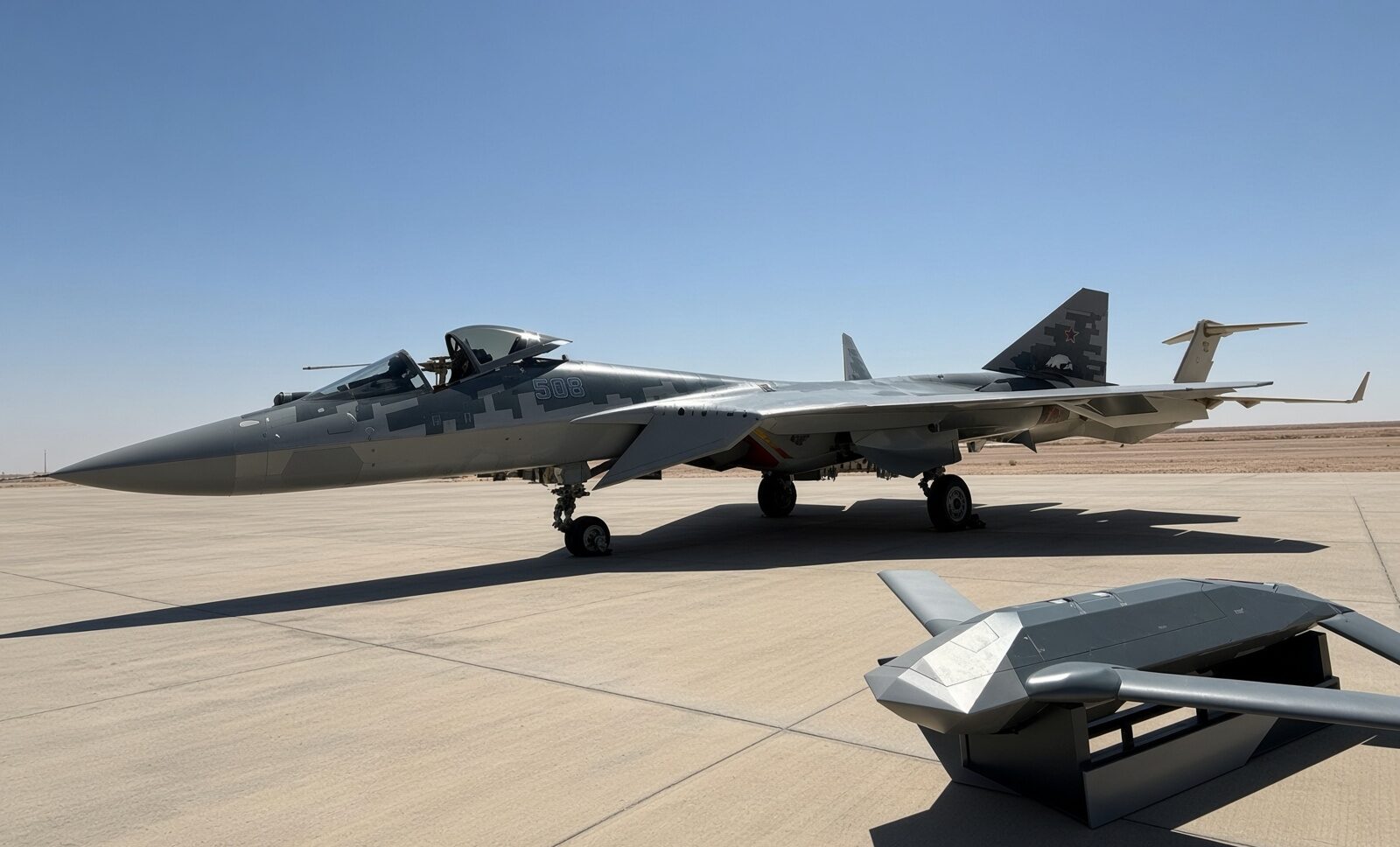
Interestingly, in September, the Su-57E, the export variant of the aircraft, was displayed in Egypt at the El Alamein International Airshow, along with air-launched S-71 family munitions, the S-71M Monokhrom and S-71K Kover, and at least one smaller unnamed weapon.
The S-71M is an air-launched stealthy UAV that can search for, detect, and engage moving targets using electro-optical sensors and onboard data, with an operator optionally remaining in the loop for validation or final guidance.
Its display alongside the Su-57E suggested that the aircraft is evolving from a fighter jet to a launch platform for stealth drones. This expands attack options and standoff range while reducing the need to expose the aircraft to heavily defended areas.
“Rostec specialists have created a family of versatile platforms designed for use with fifth-generation fighter jets and capable of performing a wide range of tasks. During the world premiere in Egypt, we will present these new products alongside the Russian fifth-generation Su-57E fighter jet,” a Rostec representative had said at that time.
Also, in December last year, UAC confirmed it had tested the Su-57 with a new Izdeliye 177 engine, a powerplant the United Engine Corporation (UEC) developed specifically for the Su-57.
According to a Rostec official, each Izdeliye 177 engine can deliver up to 16,000 kg of thrust (approximately 35,000 pounds) with the afterburner engaged.
Meanwhile, the two-seat Su-57D made its first flight in May 2026. The variant is being developed for combat operations, pilot training, and Manned-Unmanned Teaming (MUM-T).
Ultimately, the Su-57 looks impressive on paper, but its use in the Ukraine war has so far been limited. Several defence analysts have suggested that Moscow is reluctant to expose its next-generation fighter to the risks of combat, fearing that a loss could not only damage the aircraft’s reputation but also undermine its export prospects.
While protecting a high-value platform is understandable, its limited operational exposure makes it difficult to independently assess its battlefield effectiveness. Until Russia demonstrates the aircraft’s capabilities through sustained combat operations, reliable weapons integration and survivability against modern air-defence systems, the Su-57 should be regarded as a promising but still largely unproven combat asset in the Russian inventory.
- Sumit Ahlawat has over a decade of experience in news media. He has worked with Press Trust of India, Times Now, Zee News, Economic Times, and Microsoft News. He holds a Master’s Degree in International Media and Modern History from the University of Sheffield, UK.
- He can be reached at ahlawat.sumit85 (at) gmail.com