During his interaction with the press ahead of Air Force Day on October 8, 2026, the Chief of the Air Staff (CAS) stated that, in the near future, the Indian Air Force would have a “healthy mix” of LCA Tejas Mk 1A, LCA Mk 2, the French Rafale and the indigenous fifth-generation AMCA.
On the face of it, there is little to quarrel with what the CAS stated.
These aircraft will undoubtedly constitute important elements of the IAF’s future fighter fleet. However, the projection has some infirmities that are difficult to overlook.
The first question is what the CAS meant by the “near future”.
If the statement is intended to describe the fighter fleet that the IAF will field over the next decade or so, the mix is understandable. But if it projects the force structure into the 2040s—and beyond—it raises a more fundamental question.
How far into the future was the CAS extrapolating current procurement plans to arrive at the projected “healthy mix”?
Based on the past record of Indian fighter aircraft development projects, I would think at least 15 years from now, well into the 2040s.
By then, Tejas Mk 1A, Tejas Mk 2, Rafale and AMCA could indeed form the backbone of the IAF’s manned combat-aircraft fleet. But describing that combination alone as a “healthy mix” ignores a major transformation already underway in air warfare.
The manned fighter is no longer the whole equation
There is little doubt that the IAF will continue to depend predominantly on the 4th-generation fighters named by the CAS, quite possibly for the next 20 to 30 years. Fighter aircraft have long service lives, and India’s continuing dependence on legacy and contemporary 4th-generation platforms is therefore likely to persist well into the 2040s and perhaps beyond.
But the fighter force of the 2040s cannot be assessed merely by counting manned fighters across different generations.
The changing character of air warfare will demand a mix of manned and unmanned platforms, with different levels of survivability, autonomy and weapons heft.
This matters because the most dangerous missions in a future conflict will likely involve penetrating increasingly dense and sophisticated air-defense networks. A manned 4th-generation fighter, however capable, is not necessarily the most appropriate platform for every such mission.
The Unmanned Component
The IAF’s future force structure will therefore need an increasing proportion of unmanned combat aircraft.
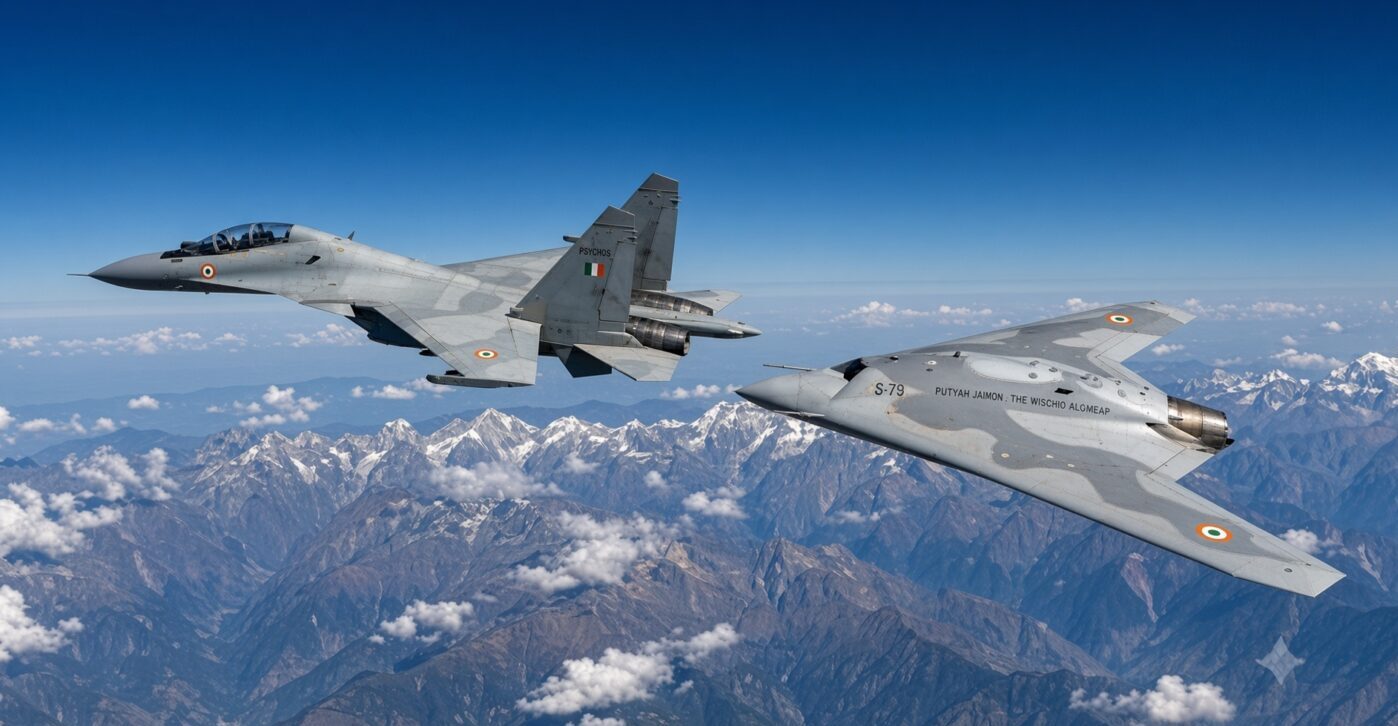
At one end of the spectrum would be relatively inexpensive unmanned systems able to perform reconnaissance, electronic warfare, decoy and weapons-truck functions. At the other end would be sophisticated unmanned combat aircraft capable of operating alongside manned fighters as loyal wingmen.
The latter could substantially increase the effectiveness of a manned fighter formation. An unmanned aircraft could carry additional weapons, extend the formation’s sensor coverage, perform electronic attack or act as a decoy, while exposing no pilot to the risk of a mission in heavily defended airspace.
There is also an important economic dimension. An unmanned platform does not necessarily have to replicate the capabilities, complexity, or cost of a manned fighter. A future air force could therefore field far more expendable or attritable unmanned combat aircraft than it could afford to field manned fighters.
This would fundamentally alter the arithmetic of air combat.
Why describe only the present procurement mix?
The “healthy mix” the CAS referred to was therefore, in my view, probably intended primarily for mainstream media consumption.
That is not necessarily a criticism of the CAS.
Mainstream reporting tends to operate at shallow depths and gravitates towards readily understood narratives. In India’s case, the Atmanirbharta (self-reliance) narrative is particularly attractive.
Tejas Mk 1A, Tejas Mk 2 and AMCA fit neatly into that narrative, while Rafale provides the foreign component of the mix.
But the full spectrum of capabilities that the IAF will require in the 2040s is considerably more complicated.
It would include manned 4th-generation fighters, 4.5-generation fighters, 5th-generation VLO aircraft and an expanding family of unmanned combat aircraft ranging from relatively inexpensive attritable systems to sophisticated loyal wingmen.
The Uncomfortable Technological Reality
I suspect that the IAF leadership understands this reality.
India’s indigenous technological capability in unmanned combat aircraft is still far short of what it would take to develop and field the full range of systems a future air force will need.
The problem is not simply the airframe. Autonomous operation, artificial intelligence, manned-unmanned teaming, secure communications, distributed sensing, electronic warfare and the ability to operate in a heavily contested electromagnetic environment all present formidable challenges.
MoD bureaucrats are unlikely to be unaware of these limitations either.
Under the circumstances, articulating the full range of what a truly “healthy mix” would entail would perhaps serve little purpose in a public interaction with the media.
But that does not make the issue any less important.
The Real Challenge
The real challenge is not recognizing that India needs a mix of manned and unmanned combat aircraft. It is developing the technologies and industrial ecosystem needed to field them in meaningful numbers.
The IAF of the 2040s will almost certainly still contain large numbers of 4th-generation fighters. There is nothing inherently wrong with that. The question is what surrounds them.
If the future force consists predominantly of today’s manned fighter concepts, supplemented by a relatively small number of AMCA aircraft, it may represent a healthy mix of India’s current procurement programs.
It may not, however, be a healthy mix for the wars India could have to fight in the 2040s and beyond.
The distinction is important. A force structure should not be called “healthy” merely because it contains a balanced selection of aircraft India can build or procure today.
It should be judged against the operational environment in which that force will actually have to fight.
- Vijainder K Thakur is a retired IAF Jaguar pilot, author, software architect, entrepreneur, and military analyst.
- Views Personal of the Author
- Follow the author @vkthakur