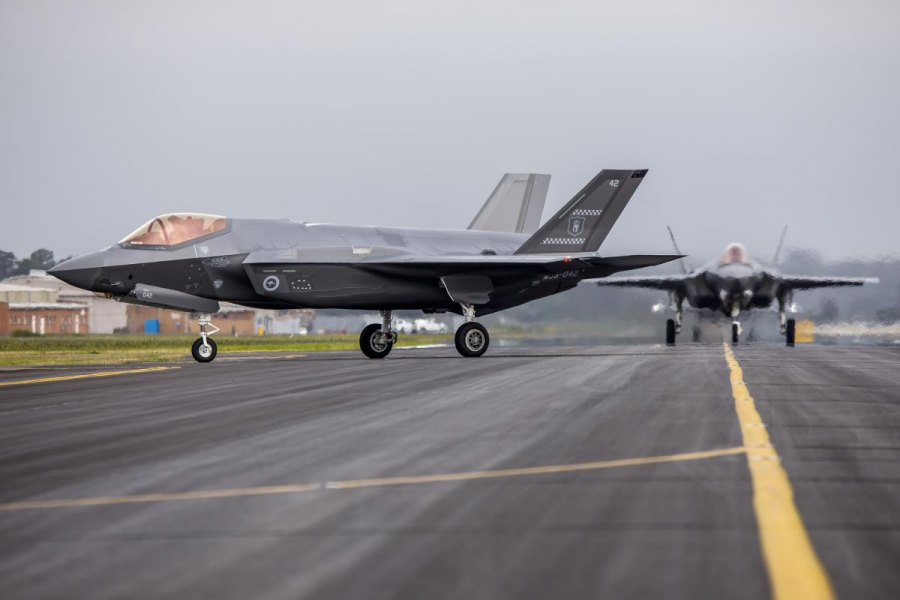
Continuing a global force-projection mission spanning 40 days and 40,000 kilometers, four Rafale fighter jets from the French Air and Space Forces arrived in Indonesia after stopovers in Japan and South Korea.
Earlier this month, a detachment of four Rafale F4s along with three Airbus A330 MRTT Phénix tanker-transports, two Airbus A400M Atlas transports, and around 300 personnel, departed Istres air base in southern France for “PEGASE 26”, the seventh edition of a long-range power-projection mission series, scheduled to run until October 15, 2026.
As part of the mission, the French Rafale package has reportedly arrived at Halim Air Force Base in East Jakarta, Indonesia, on September 20.
Although the Joint Staff of the French Armed Forces has yet to publish updates on the current leg of the deployment, plane spotters and aviation enthusiasts posted images of the aircraft on social media, showing them flying in formation and arriving at the Indonesian air base.
Additionally, some open-source reports suggested the Indonesian Air Force (TNI AU) had deployed its own Rafale fighter jets to the airbase, where they were parked alongside the French aircraft for joint interaction. According to reports, the French Rafales are scheduled to conduct joint training or military drills with the Indonesian Air Force during their stopover in the Southeast Asian country.
🇮🇩🇫🇷 @Armee_de_lair #PEGASE26 contingent has arrived at Halim AFB, East Jakarta (20/9). Indonesian Air Force @_TNIAU also dispatched at least three of its Rafale to the AFB (parked alongside French Rafale) for bilateral interaction/joint exercise
📸Halim AF https://t.co/FDbEB2clcI pic.twitter.com/Wwm3Rt5MCu
— JATOSINT (@Jatosint) September 21, 2026
Notably, the Pegase 26 mission is designed to test France’s ability to deploy and sustain combat aircraft far from home while operating alongside key partners. Therefore, flying and training with Indonesian Rafales and support aircraft will allow the French crews to practice common procedures, tactics, communications, and logistics in a real Indo-Pacific environment.
Moreover, the joint exercise will reinforce the political-military relationship, demonstrate French reliability as a defense partner, and support France’s broader Indo-Pacific strategy of maintaining freedom of navigation and balanced regional presence.
For Indonesia, which has started receiving its Rafale jets only in January 2026, the joint exercise will provide valuable hands-on experience in tactics, employment, and support procedures that Indonesian pilots and ground crews can apply directly to their own operational capability. The drills will also let Indonesian aircrews practice advanced multi-role missions, aerial refueling coordination, and combined operations with a peer force with unparalleled Rafale expertise.
#PEGASE26
Après 8h30 de vol (une pensée pour les derrières endoloris des équipages Chasse), le dispositif est arrivé à Jakarta pour la nouvelle étape du périple.
Voici une photo des Rafale en formation serrée au moment du franchissement de l'équateur. pic.twitter.com/LGUxjtmHON— Escadrons de Chasse français (@EscadronsChasse) September 20, 2026
French Rafales have made multiple stopovers in Indonesia in previous years—in 2022, 2023, and 2024—as part of earlier Pegase long-range deployment missions. However, the ongoing deployment will see the first Rafale-on-Rafale exercise between the two countries.
That said, Indonesia is the third country in the Indo-Pacific region—where China has continued to assert its military and political dominance—to welcome the Rafales as part of the ongoing Pegase 26 mission.
Gusts Roaring In China’s Neighborhood
When it started its journey, the Pegase 26 detachment moved through Greenland, then on to Alaska, where it conducted joint drills with the US Air Force’s F-22 Raptors and F-35s.
After that, the Rafales, along with their support aircraft, arrived at Japan Air Self-Defense Force (JASDF) Hyakuri Air Base on September 14 and remained stationed there until September 18, as previously reported by the EurAsian Times.
The detachment reportedly conducted joint military exercises with Japan Air Self-Defense Force (JASDF) F-2 fighter jets, which focused on joint tactical training, formation flying, and interoperability exercises in surrounding airspace. This deployment marked the third visit of Rafale jets to Japan, which France considers a principal Indo-Pacific partner.

Notably, a part of the detachment force moved quickly from Japan to South Korea on September 15, 2026, for its next stopover.
The Rafale jets and A330 tankers conducted a three-day joint exercise with the F-35A stealth fighters and KC-330 Cygnus multirole aerial tankers of the Republic of Korea Air Force (RoKAF) at an airbase in Cheongju, South Korea.
According to reports, the French and South Korean air forces conducted mutual aerial refueling to better understand each other’s refueling systems. The two sides also conducted joint tactical exercises, splitting teams into allied and enemy forces and allowing pilots from both countries to exchange ideas on aircraft operational tactics.
“The reason the French aircraft visited South Korea through the Pegase mission was to review the French air and space forces’ role as South Korea’s partner to counter regional challenges, and it serves as a stepping stone to enhance operational interoperability between the troops,” Maj. Gen. Vincent Chusseau, commander of the French Space Command, said in a written interview with South Korea’s Yonhap News Agency.

The deployments to Japan, South Korea, and Indonesia align with France’s continued emphasis on the Indo-Pacific.
France, for its part, has made no bones about its intentions for the region.
The 2025 French Indo-Pacific strategy described the region as a contested space marked by growing Chinese assertiveness, an intensifying arms race, and pressure on multilateral norms. Further, it addressed sensitive areas, including the Taiwan Strait and the South and East China Seas, and rejected unilateral changes to the status quo by force.
More importantly, though, with the Pegase 26, France seeks to prove that a nuclear state can protect distant regions and partners by strengthening air cooperation with key allies in the North, the Indo-Pacific, and the Middle East. “In practical terms, we fly together, we land together, we work together,” Alice Rufo, a deputy defense minister, said ahead of the aircraft’s departure.
“If we’re called upon to act together in the face of a threat, we need to be immediately interoperable,” Rufo said. “That doesn’t just happen. It must be prepared, and these exercises and missions allow us to prepare for that.”
The Rafales are not on an anti-China mission; they are part of a major force-projection operation France has launched amid rapidly shifting geopolitical dynamics.
Despite that, the deployment of Rafales to the region may not sit well with China, which considers the expanding military presence of Western countries such as the US and its allies—in collusion with regional states — as provocative.
While relations between China and Indonesia are smooth and South Korea is seeking closer ties with the communist country, Beijing remains on a collision course with Japan over a host of issues, including the latter’s position on Taiwan, as the EurAsian Times previously explained.
The Rafale’s presence carries added weight for several reasons. India—which shares a disputed border with China and has been involved in multiple standoffs with the Chinese People’s Liberation Army (PLA) forces—operates the Rafale. India is on course to order 114 more Rafales from France and is mulling joining the French-led 6th-gen FCAS program. Indian Navy also has 36 Rafale-M jets on order.
China has been developing capabilities specifically against the Rafale, as demonstrated by last month’s joint drills between PLAAF J-16 fighters and Egyptian Air Force Rafales in the “Eagles of Civilization 2026” exercise. This is not an official stance, but Chinese media widely covered these drills as the first major exercises against a cutting-edge Western aircraft.
After Indonesia, the Rafale detachment will move on to India, where it is expected to conduct joint drills with the IAF. Following that, the detachment will move on to the Middle East, where it will be welcomed by two key Middle East countries, Egypt and Qatar—both Rafale operators.
- Contact the author at sakshi.tiwari13 (at) outlook.com
- Follow EurAsian Times on Google News