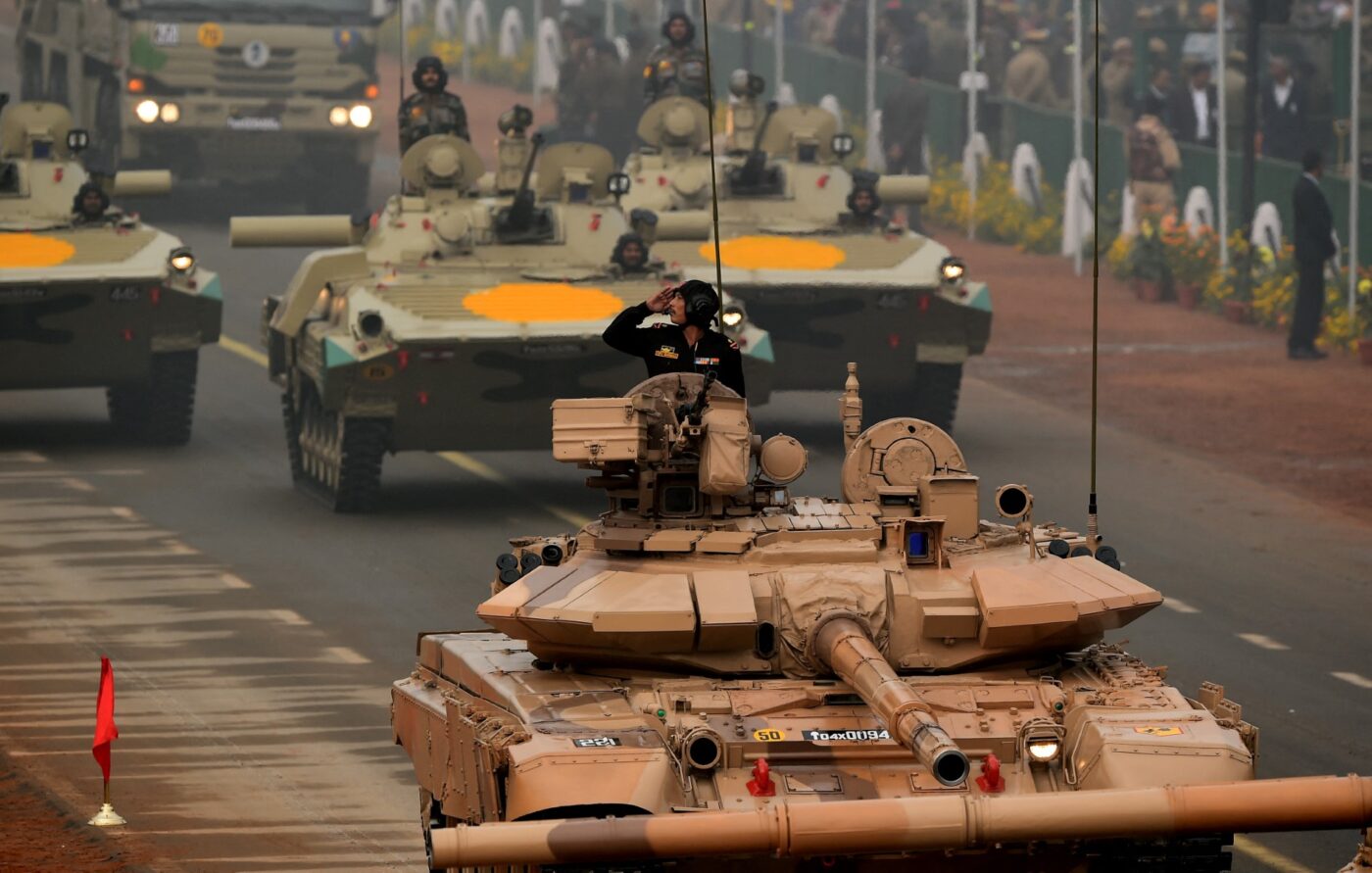
The Ministry of Defense (MoD) has signed a contract with Accurate Industrial Controls Private Limited to procure Auxiliary Power Units (APUs) for T-72 and T-90 tanks for ₹586 crore. The indigenous 10–12 kW APUs will be mounted externally on the tanks.
The MoD has not stated how many APUs it will procure through the ₹586-crore contract, or whether the procurement is intended to equip the entire fleet or a selected proportion of the tanks.
The scale of the contract is significant when viewed against the Army’s T-72 and T-90 fleet. Open-source inventories put the combined fleet at roughly 3,700–3,800 tanks, comprising about 2,400 T-72s and 1,300-plus T-90s, although exact operational numbers are not publicly disclosed.
Based on the contract value, it is unlikely the procurement covers the entire fleet. It most likely covers a relatively small proportion of the fleet. Follow-up orders could equip a larger proportion, but it is highly unlikely that the entire fleet would eventually receive APUs. The reason why will become clear in the subsequent paragraphs, where I discuss the rationale for the upgrade.
APU Explained
An APU is an alternate source of electrical power for the tank’s fire-control system, firing circuit, gun-stabilization system, and other ancillary systems.
It can operate independently of the main engine, allowing the tank to remain stationary with its electronic systems powered for extended periods without running the main engine — a capability commonly referred to as “silent watch.”
The Indian Army’s earlier requirements specified that the APU should be able to run the tank’s systems in silent mode with the main engine switched off. The MoD says the APUs are intended to provide power for the fire-control system, firing circuit, gun stabilization and other ancillaries.
APUs were not standard equipment on most Russian-manufactured T-90 variants, including the T-90 and T-90A, and the capability was not a standard feature of the earlier T-90 family as it is on many modern Western tanks.
Such tanks primarily relied on their main diesel engine and batteries for electrical power when stationary. Some later Russian variants and experimental or upgraded tanks, however, have been fitted with auxiliary power units, so the distinction should not be treated as absolute.
Most Western main battle tanks, such as the M1 Abrams, Leopard 2, Challenger 2 and Leclerc, have been fitted with or upgraded to incorporate auxiliary power arrangements.
Their implementations vary: some are integrated within the powerpack or hull, while others use a separately mounted, armored external unit. The external APU India is procuring is therefore not unique in concept, although its external mounting is more visually conspicuous than the integrated arrangements found on many Western tanks.
Is an APU Necessary?
There are some logical reasons why APUs were not traditionally standard equipment on Russian-designed tanks.
Russian tanks are typically more compact than their Western counterparts and have lower internal volume. They use a crew of three, with an automatic loader replacing the fourth crew member, which facilitates a more compact design. Finding protected internal space for an APU is therefore more difficult.
Russian tank designs have also traditionally been optimized around compactness, relatively high mobility and large-scale production. An APU becomes particularly valuable when a tank must remain stationary while its sensors, communications, fire-control system, and other electrical equipment continue operating.
Historically, Russian tanks also had lower continuous electrical demands than many modern Western tanks. Consequently, running the main diesel engine to provide electrical power was a more acceptable solution, although it consumed fuel, produced considerable noise, and increased the tank’s thermal signature.
Russia has also developed and deployed command variants and upgraded versions of its tanks with auxiliary power arrangements. The absence of a standard APU from earlier T-90 configurations should therefore be viewed as a design choice rather than an indication that Russian tank designers considered APUs unnecessary in all circumstances.
Low-Mobility Use
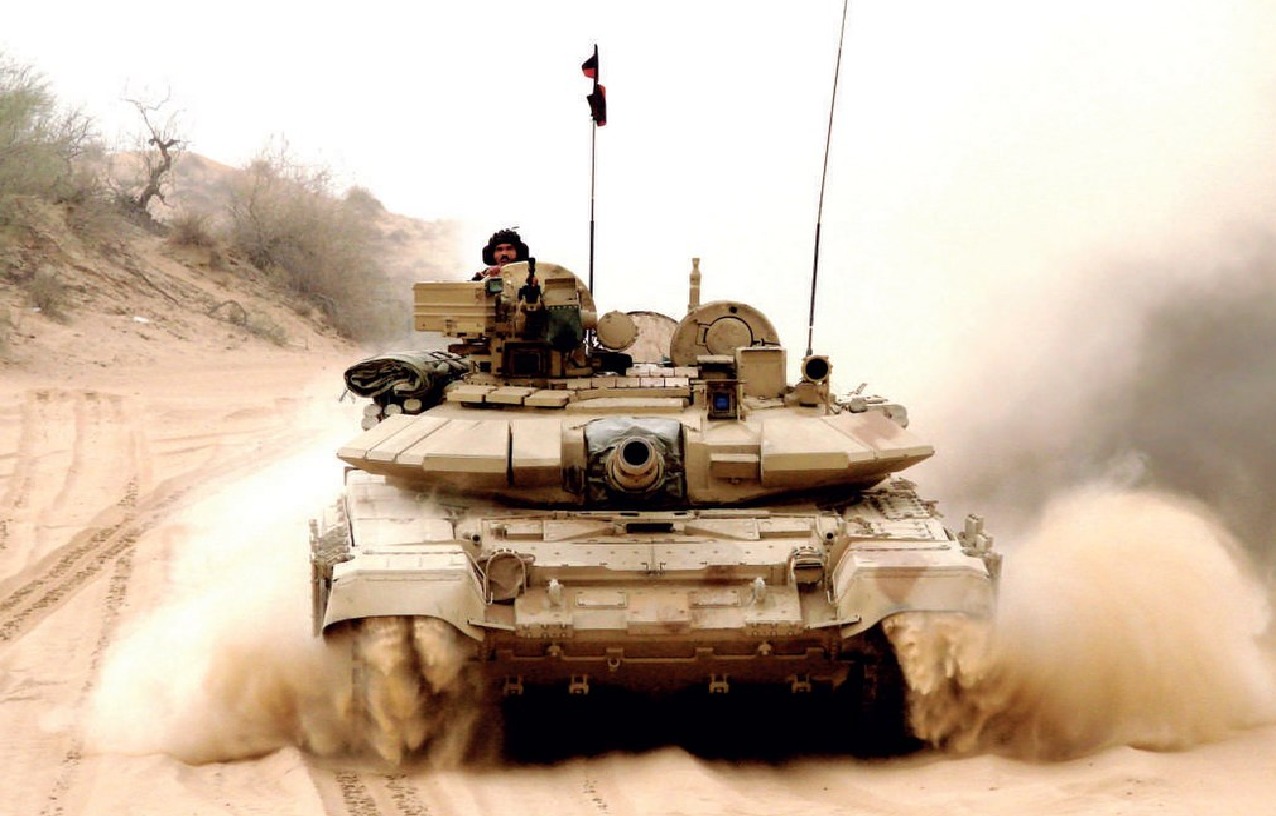
The Indian Army’s decision to equip at least some of its T-90 tanks with externally mounted APUs has a particular operational rationale. A significant part of India’s borders with its principal adversaries runs through mountainous, high-altitude terrain, where tanks may need to occupy prepared positions or remain stationary for extended periods.
In such circumstances, continuously running the main engine to power the tank’s electronics is undesirable. An APU lets the main engine shut down while still providing electrical power to the fire-control system, sights, communications, gun stabilization, and other essential equipment.
A T-90 occupying a well-concealed position, with its main engine switched off but its sensors and weapon systems fully operational, would therefore have a much lower acoustic and thermal signature than an otherwise identical tank with its main engine running. It could remain alert and ready to engage while conserving fuel and reducing wear on the main engine.
This is particularly relevant in mountainous terrain, where mobility may be constrained and remaining concealed and maintaining a low signature can be more important than continuous movement.
Arjun MBT
It is interesting to note that the Arjun MBT was designed with an APU from the start, unlike the baseline T-72/T-90. It could operate in silent-watch mode with the main MTU diesel engine switched off.
The Arjun Mk1A, the current production upgrade, has a new APU with roughly double the power-generation capacity of the earlier unit. Open-source sources put its output at around 8–8.5 kW. The Mk1A is also substantially heavier, weighing 68 tonnes, according to the Armored Vehicles Nigam Limited (AVNL), compared with roughly 46–47 tonnes for the T-90 Bhishma.
Although the Mk1A has a respectable power-to-weight ratio of about 20.6 hp per tonne, its much greater weight and larger dimensions make it relatively less suitable for mountain warfare than the considerably lighter T-90.
The 68-tonne weight imposes significant constraints on strategic and tactical mobility, particularly in mountainous terrain where road, bridge and terrain limitations can restrict the movement of very heavy armored vehicles.
- Vijainder K Thakur is a retired IAF Jaguar pilot, author, software architect, entrepreneur, and military analyst.
- Views Personal of the Author
- Follow the author @vkthakur