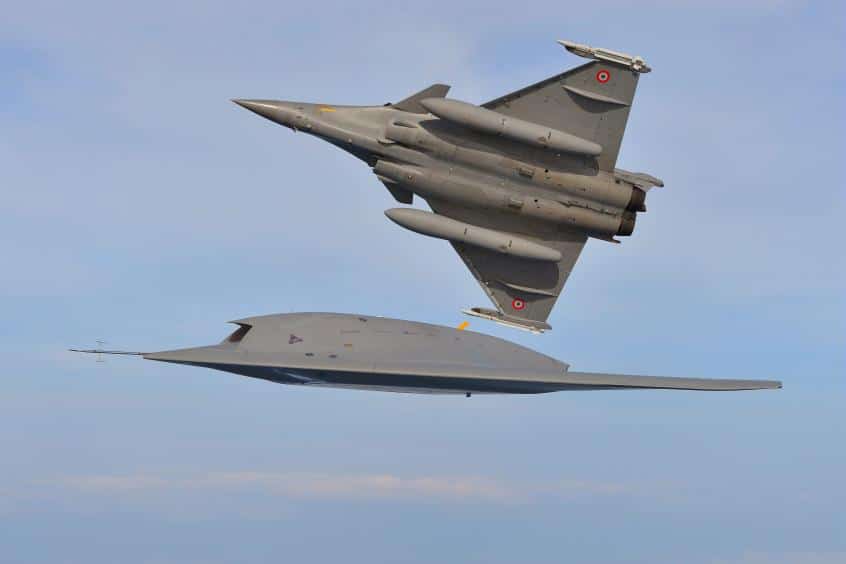
The French Dassault Rafale fighter jets have arrived in Japan as part of a global force-projection mission spanning 40 days and 40,000 kilometers.
The detachment of four Rafale F4s, supported by three Airbus A330 MRTT Phénix tanker-transports, two Airbus A400M Atlas transports, and around 300 personnel, departed Istres air base in southern France last week for “PEGASE 26”, the seventh edition of the French Air and Space Force’s long-range power-projection mission series, which is reportedly scheduled to run until 15 October, 2026.
For the first time, the mission has followed an unprecedented northern route designed to validate an alternative pathway to the Indo-Pacific while testing operations in extreme Arctic environments, where the security threat from Russia and China has multiplied.
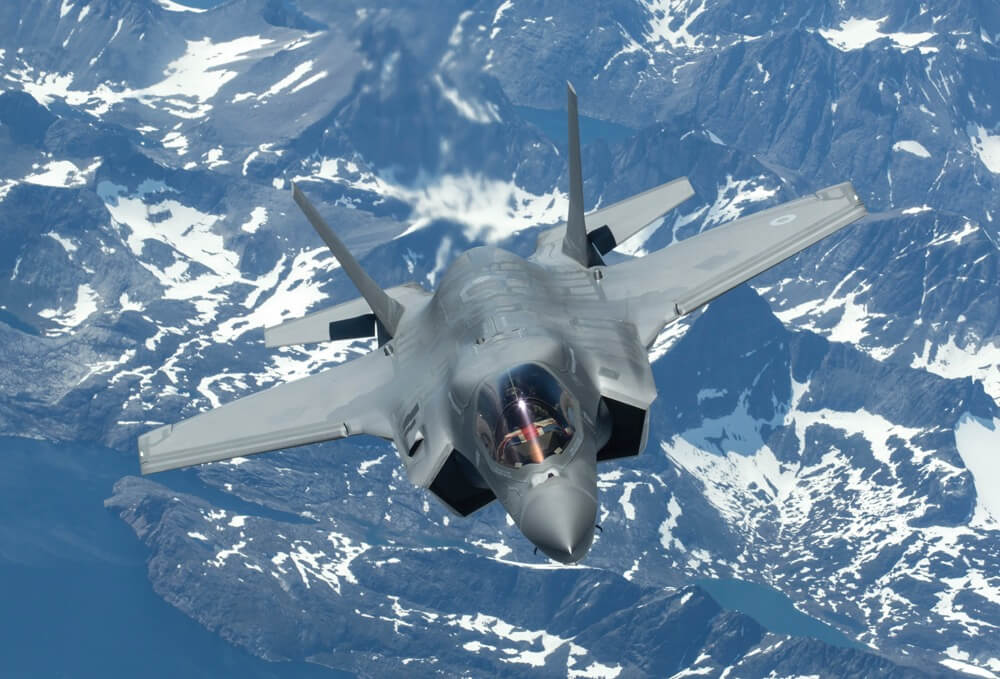
Initially, the detachment moved through Greenland, then on to Alaska, where it conducted joint drills with the US Air Force’s F-22 Raptors and F-35 fighters.
Following the joint training in Alaska, the Rafales, along with their support aircraft, arrived at Japan Air Self-Defense Force (JASDF) Hyakuri Air Base on September 14. There, the package will participate in joint drills with the JASDF from September 15 to 18.
According to reports, about eight JASDF F-2 fighters, one KC-46A tanker-transport, and Central Air Defense Control units will participate in drills that are expected to include tactical training, formation flying, and interoperability in surrounding airspace.
Bienvenue a la base aerienne de Hyakuri!ようこそ百里基地へ!フランスの疾風がついに日本に到着です!#百里基地#フランス航空宇宙軍#ラファール #Rafale pic.twitter.com/pMC8lDDOlH
— 航空自衛隊百里基地 (@jasdf_hyakuri) September 14, 2026
The deployment of a French fighter jet package to Japan is noteworthy for several reasons.
For one, it underscores France’s continued emphasis on the Indo-Pacific. Paris’s 2025 Indo-Pacific strategy described the region as a contested space marked by growing Chinese assertiveness, an intensifying arms race, and pressure on multilateral norms.
It addressed sensitive areas including the Taiwan Strait and the South and East China Seas, and rejects unilateral changes to the status quo by force, as the EurAsian Times explained earlier.
Perhaps for this reason, Beijing may not take well to the joint training between France and Japan, particularly since it remains embroiled in a major territorial dispute with Tokyo and has significantly expanded its military activity in the East Asia Seas amid opposition.
Moreover, China–Japan relations have been in a downward spiral, with Beijing frequently accusing Tokyo of provocation by purchasing new arms and enhancing collaboration with Western allies.
Meanwhile, France regards Japan as one of its principal Indo-Pacific partners, and this is the third visit of Rafale jets to the Asian country.
In 2023, two Rafale fighters arrived at Nyutabaru Air Base as part of the PEGASE 23 power-projection mission to the Indo-Pacific. This marked the first time French combat aircraft had operated from Japanese soil, with both sides describing the deployment as historic.
The short stopover included joint tactical training and formation flying with JASDF F-15 and F-2 fighters, pilot exchanges, and a water-cannon salute for the Rafales.

The Rafales returned to Japan’s Hyakuri Air Base for Pegase 24. At the time, the French package conducted a joint aerial interaction with JASDF F-2s, US Navy EA-18G Growlers, and a P-8 surveillance aircraft.
Notably, the small size of the current Rafale detachment means it is unlikely to alter the regional military balance on its own, or draw China’s ire. However, the Rafale’s presence carries additional resonance for several reasons.
India operates the Rafale jets, and it has an unresolved border dispute with China. The Indian Air Force (IAF) deployed the Rafales during the 2020 border crisis.
China, for one, has been building capability against the Rafales, as recently demonstrated by joint military drills between the PLAAF (People’s Liberation Army Air Force) J-16 and the Egyptian Air Force Rafale as part of the “Eagles of Civilization 2026” exercise last month.
A further reason the deployment of Rafales to Japan would draw Beijing’s attention is that the aircraft is viewed as a competitor to China’s J-10C in the export market.
China has marketed the J-10C as a more affordable, unrestricted alternative to the Rafale and other Western fighters.
Beijing has repeatedly amplified Pakistan’s claims of downing multiple Rafale jets using the J-10C+PL-15 missile combination during the four-day conflict with India in May 2025. In fact, French intelligence officials accused China of running a smear campaign last year following the India-Pakistan conflict.
Nonetheless, it is worth emphasizing here that the Rafales are not on an anti-China mission; they are participating in a major force-projection mission that France has launched amid rapidly evolving geopolitical dynamics.
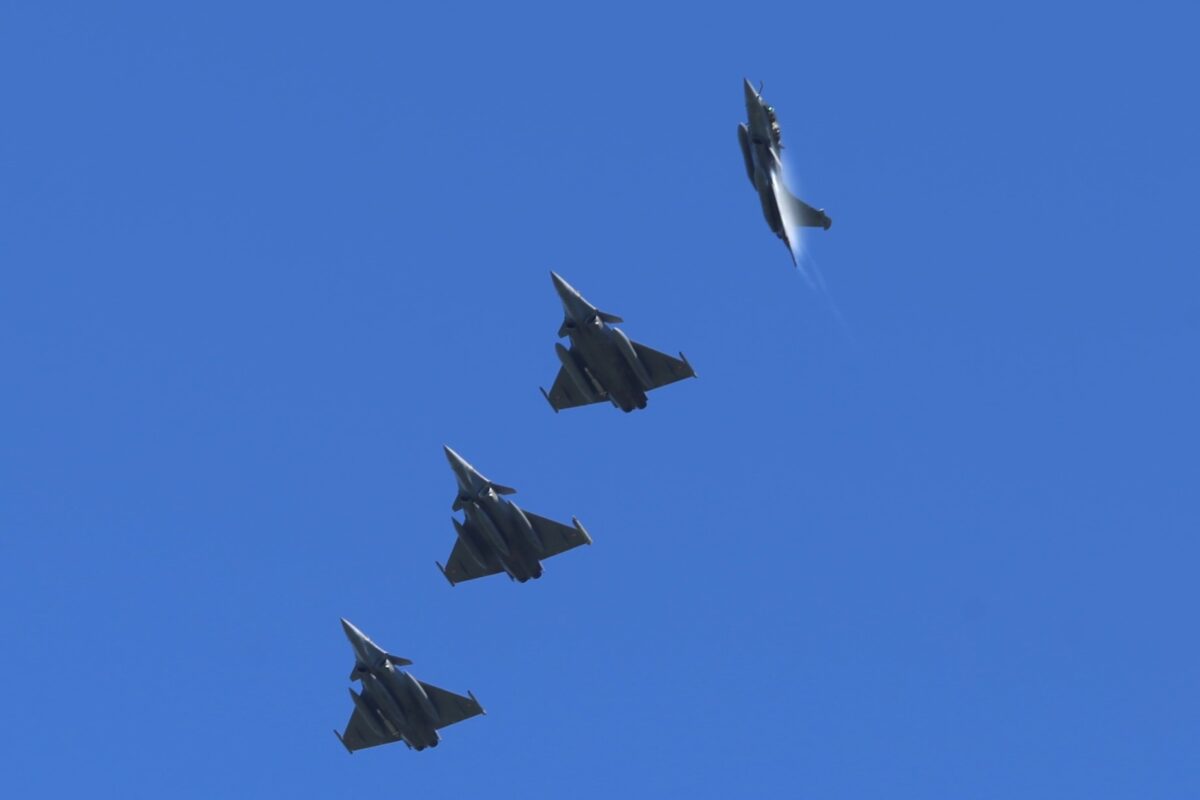
Rafales On Force Projection Mission
Through the ongoing Pegase 26, France seeks to project military force and show that a nuclear power can defend distant regions and partners by strengthening French air collaboration with key partners in the North, Indo-Pacific and the Middle East.
“In practical terms, we fly together, we land together, we work together,” Alice Rufo, a deputy defense minister, said ahead of the aircraft’s departure last week. “If we’re called upon to act together in the face of a threat, we need to be immediately interoperable,” Rufo said. “That doesn’t just happen. It must be prepared, and these exercises and missions allow us to prepare for that.”
En route to Alaska, the twin-engine French aircraft flew across Greenland, where an Airbus A400M support plane that could land on ice was stationed. The jets had to refuel five times in midair to complete the enormous distance without stopping during the roughly 11-hour journey from Istres to Alaska.
https://twitter.com/Armee_de_lair/status/2099521441636946053
The passage over Greenland comes amid repeated threats of invasion by US President Donald Trump and collective pushback from NATO allies, including France.
The Pegase 26 commander, General Julien Sabréè, told The Associated Press that although the flight exercise has been conducted every year since 2018, this is “the first time we are heading up north, over Greenland, toward Alaska.” “It’s important for us that we explore different routes,” he was quoted as saying. “We never know in case we need to go in the Indo-Pacific region, and there are thermals, and it’s difficult to go the other way around. That gives us another option, going up north.”
The Arctic leg specifically tested high-latitude and extreme-cold operations, validating an alternative, shorter path from Europe to Northeast Asia and the Indo-Pacific that could be used if traditional routes are constrained, as well as long-duration flights.
After Japan, the French Rafale is expected to make short but very significant stopovers in South Korea, Indonesia, and India, where it will conduct joint training. After that, the French fighters will visit two key Middle East countries, Egypt and Qatar—both Rafale operators amid increased volatility in the region.
With this long trip, France is demonstrating its ability to maintain operations from French bases while quickly moving combat aircraft between possible battle zones in the Arctic, Pacific, and Middle East, where several US refueling planes are involved in the Iran war.
- Contact the author at sakshi.tiwari13 (at) outlook.com
- Follow EurAsian Times on Google News