

After a not-so-impressive combat debut against Indian strikes on Pakistani bases during the May 2025 clash, China has claimed that its HQ-9B surface-to-air missile system successfully intercepted two ballistic missiles, including one that abruptly changed course mid-flight.
On November 2, China’s state-owned China Central Television (CCTV) reported that an air-defense unit of China’s Central Theater Command Air Force had intercepted two missile targets simultaneously during a weapons-verification exercise.
Footage showed the ‘Shenwei Missile Battalion’ responding to warnings of incoming missiles from multiple directions. The targets included a ballistic missile and one missile that suddenly changed direction during flight.
The unit successfully intercepted both targets, it said, adding that this was the first time the battalion simultaneously intercepted two new missile targets.
While the CCTV report did not mention the air defense battery involved in the weapons-verification exercise, a subsequent report in state media, the Global Times, said that it was an HQ-9B surface-to-air missile system.
“On the day of the mission, we hadn’t yet been assigned which targets we would engage. We knew there were several types of targets, including ballistic missiles, but we didn’t know that our unit would be the one tasked with intercepting them,” Shi Shidong, a member of the battalion, was quoted by CCTV as saying in the report.
When one of the incoming missiles suddenly changed direction and rapidly descended, personnel from the Central Theater Command Air Force’s ground-to-air missile force reacted within seconds and launched an interceptor before the engagement window closed. “It suddenly descended sharply. If you fail to act for two seconds, or even one second, and do not launch in advance, you could miss the window,” Shi said.
While HQ-9, a clone of the Russian S-300 system, was initially designed and developed as a long-range anti-aircraft system, China later modified the HQ-9 program to give it anti-tactical ballistic missile capability. However, stronger terminal-phase ballistic missile defense was mostly associated with more advanced variants, such as the HQ-9C and even the HQ-19.
China’s claims about HQ-9B defense capabilities are noteworthy, as it is the People’s Liberation Army’s (PLA’s) primary long-range air defense system and has already been exported to multiple countries, including Pakistan, Azerbaijan, Uzbekistan, and others.
Maneuvering ballistic missiles are difficult to intercept as they can perform unpredictable, complex maneuvers during their terminal phase. For instance, according to a Financial Times report based on Ukrainian Air Force data compiled by the Center for Information Resilience, Patriot interceptors’ ballistic interception rate reached 37% in August 2025 but fell to a low of 6% in September after Russia modified its ballistic missiles to add terminal-phase maneuvering capability.

Intercepting such missiles is challenging even for advanced air defense systems like the Patriot PAC-3 MSE, the most advanced Patriot variant, and that could be why Lockheed is developing PAC-3 Edge, a new advanced interceptor that could offer improved performance against maneuvering ballistic missiles and hypersonic threats.
A Chinese military commentator told the Global Times that the response time of less than two minutes showcased an integrated command structure that could share missile warnings and tracking data with various units and assign interception responsibility to the nearest available interceptor.
At the same time, the claims of intercepting two missiles cannot be verified due to the absence of independent data or technical detail. State-media reports have furnished no data on the targets’ speed, altitude, range, maneuver profile, or use of countermeasures, nor do they clarify whether the engagement was fully unscripted.
Interestingly, China supplied HQ-9B AD systems to Pakistan, which were reportedly employed during the clash with India in May 2025. While China-supplied Pakistani jets performed impressively, the AD systems, as per open-source reporting, failed to prevent Indian air dominance when attacking Pakistani military sites deep inside the country.
Analysts pointed to radar vulnerability to Indian electronic warfare, limited numbers of batteries, and difficulty against fast, low-flying, or maneuvering missiles.
This clash raised questions about how effective the HQ-9 family is against a well-equipped opponent like India, with strong electronic warfare and stand-off weapons like BrahMos, which were launched from Su-30MKI jets.
HQ-9B AD System
HQ-9B is the PLA’s primary long-range air defense system. While China has developed and operationalized more advanced variants, such as the HQ-9C and HQ-19, the HQ-9B remains the PLA’s staple air defense system.
So far, a dedicated anti-ballistic missile defense capability has been associated with more advanced HQ-9 variants, such as the HQ-9C and HQ-19.
The HQ-9, a road-mobile long-range surface-to-air missile system, was first developed in the 1990s by the China Aerospace Science and Industry Corporation (CASIC). It is believed to be a hybrid design, inspired primarily by Russia’s S-300, which Beijing started importing in the 1990s, with some Western elements, such as track-via-missile (TVM) guidance concepts.
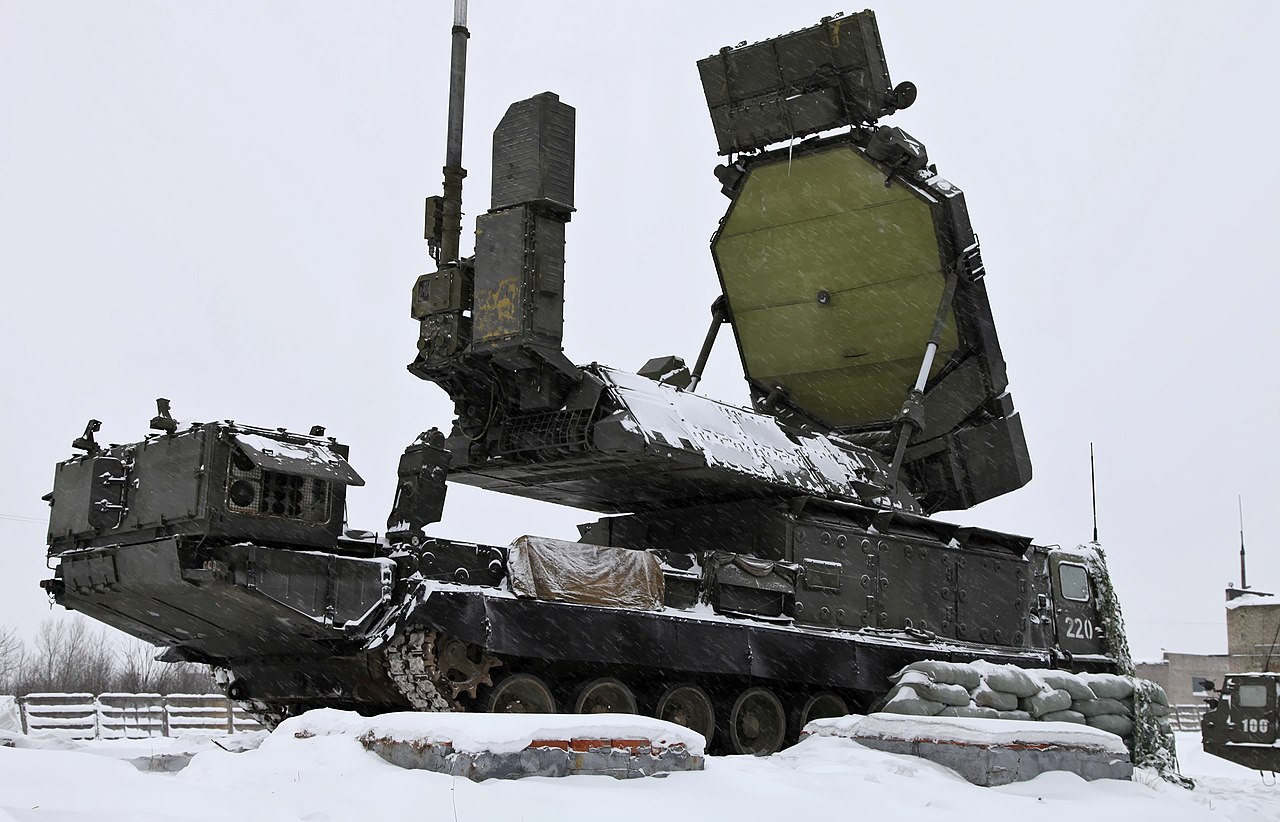
In a TVM system, a ground-based radar illuminates the target and launches the interceptor missile. The interceptor missile carries a radar receiver (seeker) that detects radar signals bouncing back from the target surface and downlinks this data to the ground station.
The ground station computes the incoming missile’s trajectory based on its own radar data and the data sent by the interceptor. This data helps the interceptor determine its path to intercept the incoming target during its terminal phase.
Since the ground-based radar tracks the incoming threat through the interceptor missile’s seeker, this guidance system is called the track-via-missile (TVM) guidance concept.
This system offers better terminal accuracy. Notably, the Patriot air defense system also uses TVM guidance.
In 2001, China launched the HQ-9A, and then the HQ-9B around 2015. The HQ-9B enhanced the interceptor’s range and added a passive infrared (IR) seeker for dual-mode (radar + IR) guidance, improving performance against low-observable targets.
HQ-9C added dedicated anti-ballistic missile capability, incorporating active radar homing (ARH) and hit-to-kill technology.
Therefore, a public acknowledgment that the PLA has successfully intercepted two ballistic missiles, including a maneuvering one, underlines that China has upgraded its HQ-9B systems, which first entered service around a decade ago.
This will strengthen China’s layered air defense network, as it can prioritize more advanced variants like the HQ-9C and HQ-19 as the first layer of defense against ballistic threats, and even if some incoming missiles penetrate, second-tier HQ-9B variants can still intercept them.
However, we do not have details on the profiles of the two ballistic missiles it intercepted, including what maneuvers one of the missiles was executing and how complex they were; still, the PLA’s official claim of this capability for the HQ-9B is significant.
If the claim is accurate, it could boost export orders for the HQ-9B, which has already been exported to countries like Pakistan and many in Central Asia, such as Azerbaijan, Turkmenistan, and Uzbekistan.
The Chinese AD system could find a ready market in former Soviet Central Asian republics, which have relied on Russian AD systems, especially as Moscow struggles with production delays due to the ongoing war in Ukraine and Western sanctions on its military complex.
Further, because the HQ-9 shares a lineage with the Russian S-300 air defense system, these countries could easily integrate HQ-9 systems into their existing air defense networks.
The successful interception also raises the possibility that, with further upgrades, software updates, and new interceptor missiles, the HQ-9B could also intercept hypersonic threats, including hypersonic glide vehicles (HGVs), which combine very high velocity and unpredictable paths.
The maneuvering ballistic missiles, re-entry vehicles, and HGVs represent a new frontier that challenges traditional air defense systems, as illustrated by Lockheed’s investment in building PAC-3 Edge interceptors.
China’s claims suggest that its traditional air defense systems can also handle these evolving threats.
- Sumit Ahlawat has over a decade of experience in news media. He has worked with Press Trust of India, Times Now, Zee News, Economic Times, and Microsoft News. He holds a Master’s Degree in International Media and Modern History from the University of Sheffield, UK.
- He can be reached at ahlawat.sumit85 (at) gmail.com