

The People’s Liberation Army Air Force (PLAAF)—the world’s second air force to field an indigenous, fifth-generation stealth fighter—is actively expanding the capabilities of its J-20 Mighty Dragon.
Photos of a J-20 flying in “beast mode” with eight long-range PL-15 air-to-air missiles surfaced on social media on November 4, 2026.
Posting the image to X, a Chinese military aviation expert said these were the clearest and the “most distinctive images” of the J-20 flying in beast mode. The missiles, with a reported operational range of 150–200 kilometers, were mounted in pairs on four underwing pylons.
“Beast mode” is an informal term popularized by Lockheed Martin for the F-35 and has since been applied more broadly to a fifth-generation fighter carrying weapons externally.
This is not the first time the J-20 has been spotted flying in beast mode.
A similar spotting occurred in February 2025, as the EurAsian Times reported at the time, and again in September 2025. The latest images, however, offer higher resolution and have drawn renewed attention because they show Beijing is willing to accept a substantial reduction in the aircraft’s primary advantage, i.e., stealth, in exchange for heavier missile loads.
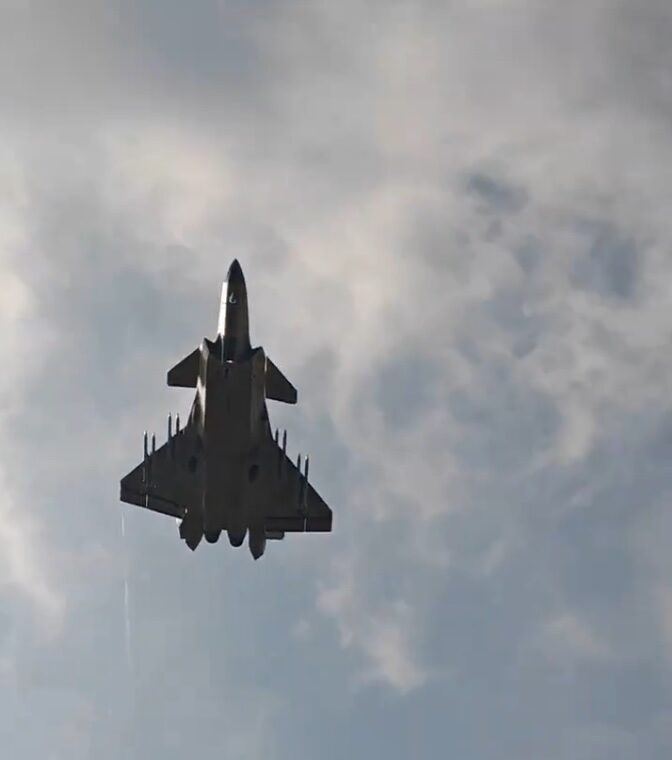
In standard low-observable configuration, the J-20 carries weapons internally, including four PL-15 beyond-visual-range missiles in the main ventral bay and one PL-10 short-range infrared missile in each of the two side bays. However, China has lately been experimenting with integrating long-range air-to-air missiles that could be carried on external pylons.
Typically, stealth aircraft carry their missiles in the weapons bay to conceal them within their fuselage. This reduces radar cross-section and improves aerodynamics, making detection more difficult. While an aircraft carrying eight missiles externally, in addition to several others in the weapons bay, has more firepower, it drastically loses stealth and becomes vulnerable to hostile radars.
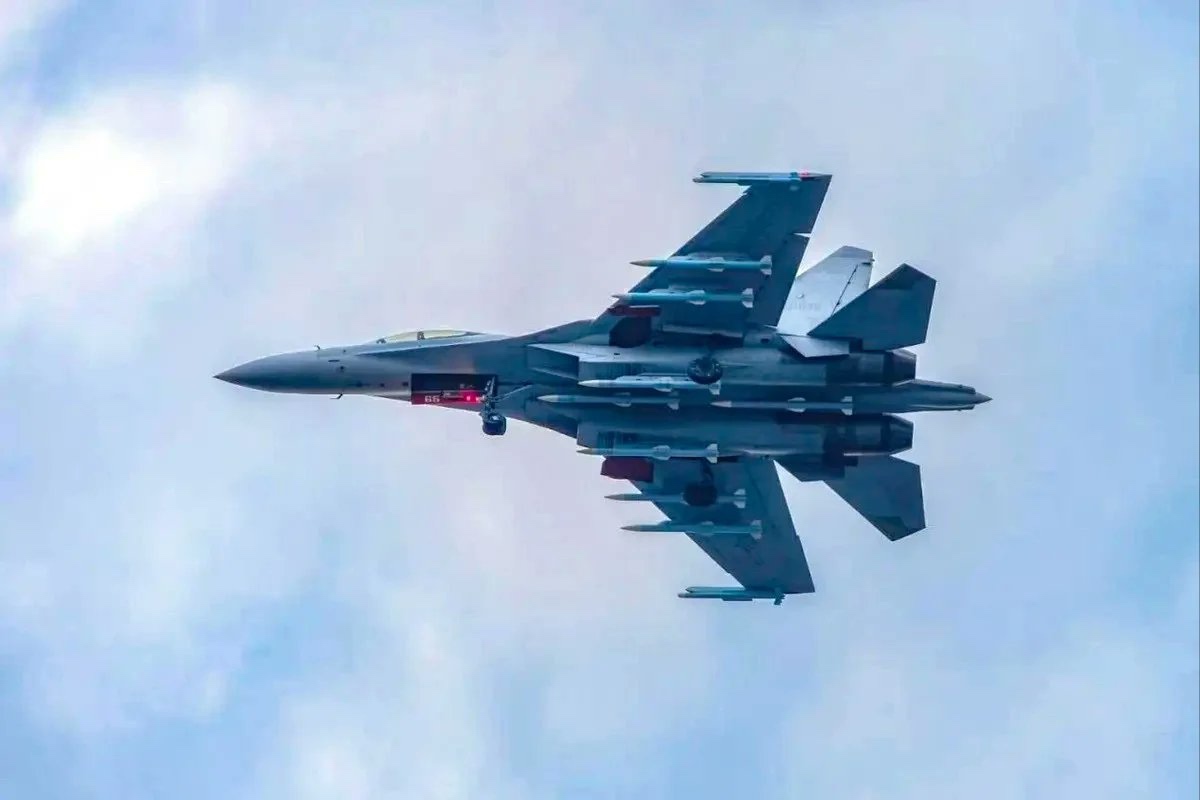
Nonetheless, this configuration could allow the J-20 to assume roles previously dominated by larger, non-stealthy aircraft such as the J-16 multirole fighter.
Although the J-16 can carry heavy external loads and fields a powerful radar, it lacks the J-20’s low observability, advanced sensors, and networking. Therefore, a beast-mode J-20 could partially bridge air-superiority stealth platforms and high-capacity, non-stealthy missile trucks, broadening the PLAAF’s combat options.
Notably, fifth-generation stealth fighters are typically optimized for the opening phases of high-intensity conflict, when surviving against dense integrated air defenses and enemy fighters is most critical. However, once those threats are degraded, the operational priority shifts and higher firepower becomes a priority.
J-20 Fighter Jets Are Being Upgraded
Chinese state media disclosed new information about the development of China’s J-20 stealth fighter family earlier this month. The report highlighted upgrades in the J-20A’s engine technology, aerodynamic design, and sensor systems, as well as the development of the twin-seat J-20S to expand the aircraft’s role in future air combat.
In a CCTV News broadcast, military affairs analyst Wang Mingliang pointed out that the aircraft can reach higher speeds, maintain supersonic cruise, and execute high-G maneuvers because the locally built engines provide more thrust.
“The transition also ensures greater independence and control over the aircraft’s engine system,” Wang said, as reported by the Global Times, adding that the technological advancement lays the groundwork for even more sophisticated fighter jets.
Early production variants of the J-20 were powered by the Russian AL-31 series, while the main production variant used the Chinese Shenyang WS-10C. Now, the more advanced J-20A variant is powered by the WS-15, the engine it was originally envisioned to use. The WS-15 offers higher thrust with afterburner, better supercruise capability, and improved overall performance.
The J-20A is an improved single-seat model with upgraded sensor systems and an improved aerodynamic design, as state media recently noted.
According to Wang, the aircraft’s modified cockpit profile improves aerodynamics and enables higher-speed flight.
Wang highlighted two obvious modifications that military observers have particularly been drawn to.
One is the elevated area behind the cockpit—compared to the previous iteration, the transition between the aircraft’s fuselage and cockpit is now smoother and more gradually curved.
“The change is likely intended to improve aerodynamic performance and increase flight speed,” Wang was quoted as saying. Meanwhile, another upgrade that has drawn attention is a protruding component beneath the aircraft’s nose. According to the Chinese expert, the upgraded variant features eight optical lenses, indicating improved detection capabilities compared with the six in the previous version.
Wang said the J-20A would be better equipped to detect and track stealth aircraft and perform networked, coordinated operations, thanks to the enhanced sensor system.
Furthermore, he noted that the introduction of the J-20S, a two-seat variant, is another noteworthy advancement that expands the conventional operational role of the fighters. The J-20S is intended to overcome some of the mission constraints of single-seat aircraft.

The EurAsian Times wrote a detailed report on the J-20S at its unveiling at the September 3, 2025 parade.
The twin-seat configuration would allow the fighter to perform tasks where a second crew member manages sensors or communications, such as electronic warfare, aerial command and control (C2), or precision-guided weapons coordination. The J-20S could leverage its twin-seat capability to coordinate long-range strikes, and the second pilot could control drones in networked operations.
Nevertheless, sophisticated aircraft can reach their full potential only when integrated into a successful combat system, the state media stated emphatically.
Additionally, it emphasized that from its original small-scale deployment to service with multiple units and regular missions in different regions, the J-20 has progressively been incorporated into the PLA Air Force’s larger operational structure. It now participates in combined exercises, combat-oriented training, and regular patrol missions in addition to individual aircraft training and formation flights.
To create a more cohesive air combat network, the aircraft now flies with other domestically designed systems, such as the KJ series of airborne early warning aircraft, YY-20 aerial refueling aircraft, J-16 multirole fighters, and J-10C fighters, the report stated.
The report also said the J-20 has increased its operational presence in recent years, carrying out regular operations in the Taiwan Straits, East China Sea, and South China Sea, which are flashpoints due to overlapping territorial claims.
At the same time, the aircraft has also continued to improve its capabilities in all-domain operations, deterrence, and quick response while operating in challenging airspace, weather, and electromagnetic settings.
“The large-scale deployment and integrated use of the J-20 have helped accelerate the PLA Air Force’s strategic transformation toward a force capable of conducting both offensive and defensive operations across air and space,” the report noted.
China has reportedly produced more than 500 J-20 stealth fighters and is poised to induct 1,000 by 2035.
- Contact the author at sakshi.tiwari13 (at) outlook.com
- Follow EurAsian Times on Google News