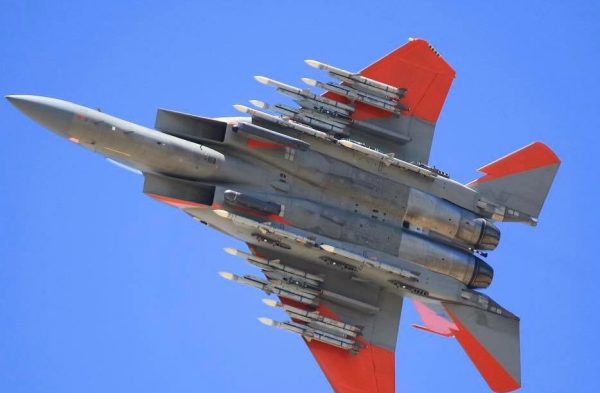
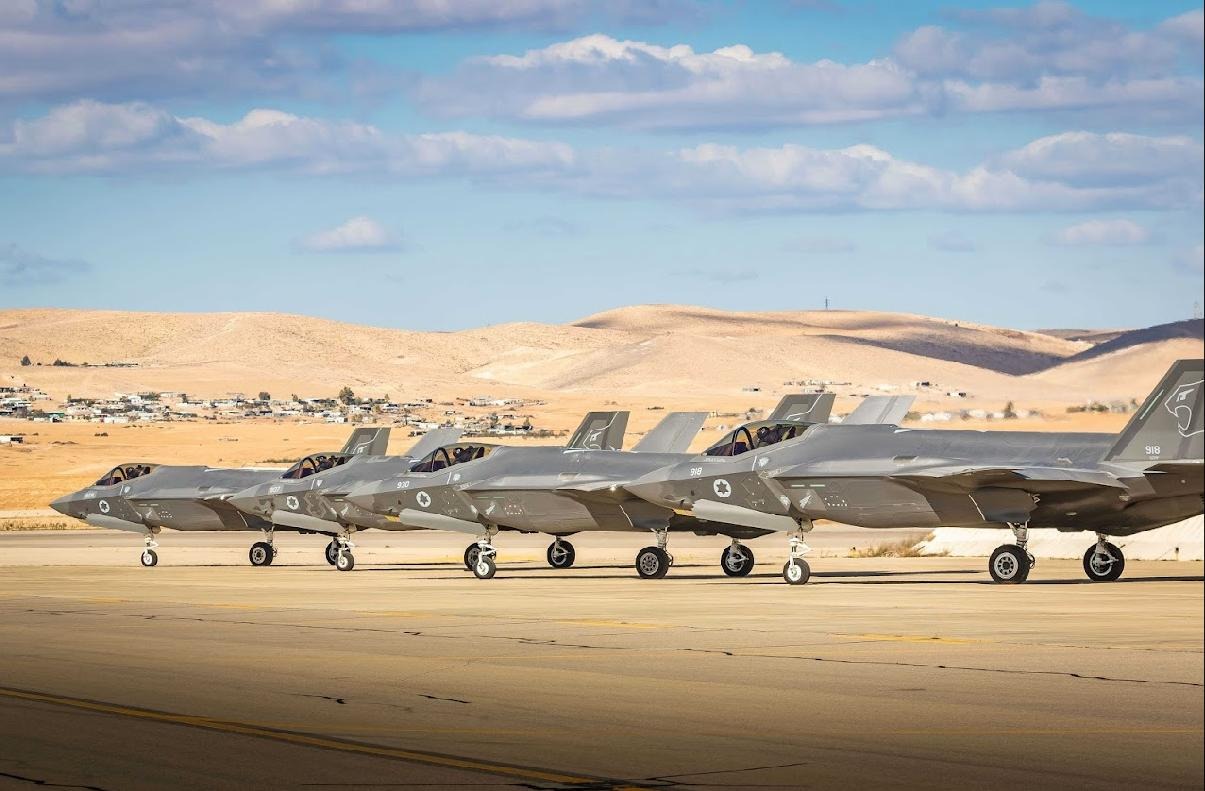
The Israeli Air Force F-35-I (Adir), an Israel-specific version of the US-origin stealth fighter, will now carry SPICE 1000 bombs, adding another indigenous standoff capability to its arsenal. Interestingly, Israel’s key military ally, India, is also looking to acquire the Spice-1000.
Israeli company Rafael Advanced Defense Systems announced at the AFA Air, Space and Cyber Conference on September 15, 2026, that it is “integrating its SPICE 1000 air-to-surface munition on the F-35 fighter aircraft” for the first time. SPICE 1000 is an advanced air-to-surface munition, equipped with an electro-optical seeker, and capable of striking fixed and high-value targets at ranges of more than 120 kilometers, Rafael wrote on X.
Much like the US-origin JDAM (Joint Direct Attack Munitions) already integrated with the F-35I Adirs, the SPICE-1000 is a glide-cum-navigation kit that can be fitted to a dumb 1,000 lb general-purpose penetrator bomb, turning it into a long-range precision-guided missile.
Rafael highlighted in its announcement that it will perform the integration work with F-35 manufacturer Lockheed Martin at the American giant’s US facilities.
Notably, plans for equipping the F-35I Adir have been around for a long time.
In 2019, for instance, Rafael and Lockheed signed a cooperation agreement to develop, market, manufacture, and support the SPICE smart bombs. At the time, Gideon Weiss, deputy general manager of Rafael’s marketing and business development, air and C4I systems division, said the “Americanization” of the SPICE bombs would allow Lockheed Martin to offer them to all its customers, primarily “operators of F-16 and F-35 fighter aircraft.”
“Now the Americans use the high-end weapons systems like the AGM-158 air-launched cruise missile, and the low-end systems, like the Paveway LGB bombs — these require a laser designator to illuminate the target. In the gap between those two types of weapon systems, the SPICE is a very good solution,” Gideon was quoted as saying.
More recently, the Pentagon’s F-35 Modernized Selected Acquisition Report, released in early August, highlighted the project’s pace. The “integration of Israel-unique Smart, Precise Impact, Cost-Effective 1000B [aka SPICE 1000B] continues to progress with a strategy to accelerate the implementation via a SPICE Lite process,” the report stated.
SPICE is an acronym for Smart, Precise, Impact, and Cost-Effective, and refers to a vast family of electro‑optically guided tactical stand-off strike weapons.
The SPICE 1000 has been operational with the Israel Air Force (IAF) since around 2017 on its F-15s and F-16 fighter jets and has been used extensively on long-range missions, including against targets in Iran and Yemen. According to Israeli media, the Israeli Air Force used the SPICE family of bombs to attack targets in Iran in last year’s 12-day war and in strikes this year.
Announcing the SPICE 1000’s integration on the F-35, Rafael said that it will pave the way for other operators of the American stealth fighter to equip their own aircraft with SPICE bombs. “At a later stage, F-35 operators worldwide will be able to field SPICE 1000,” the company stated, although it may be subject to several checks.
While the F-35 Lightning II stealth fighter has been ordered by about 20 countries, Israel was the first state to use the aircraft in combat when it launched offensive operations against targets in Syria in 2018. Israel initially ordered 50 F-35 Lightning II fighters from Lockheed Martin, supplemented by another order for 25 in 2023.
In fact, Israel is one of the few countries allowed to modify the US-made fifth-generation fighter aircraft, provided it does not change anything inside the aircraft; the Israelis were allowed to add capabilities to the existing infrastructure. Adirs are modified in these main areas: command, control, communications, computers, and intelligence (C4I), electronic warfare, and weapons integration, as previously explained by the EurAsian Times.
The Israeli F-35I is currently modified to carry the Python-5 air-to-air missile, also produced by Rafael. The SPICE 1000 will further enhance the Israeli F-35I “Adir” by adding a long-range, highly precise, GPS-resilient stand-off strike capability that complements the aircraft’s stealth and sensors.
The SPICE 1000 bomb is set to be acquired by India. In December 2025, the Indian Defense Acquisition Council (DAC) approved the procurement of SPICE-1000 for the Indian Air Force, which already uses SPICE 2000 and SPICE 250.
In 2019, the Indian Air Force deployed its Mirage 2000 to drop the SPICE 2000 bombs on a Jaish-e-Mohammad terror camp in Pakistan as part of the Balakot strikes. After Balakot, the IAF successfully tested and integrated SPICE-2000 on the Su-30MKI as part of an attempt to expand the number of aircraft that can employ the weapon.
SPICE 1000
The SPICE 1000 is an Israeli-developed precision guidance kit produced by Rafael Advanced Defense Systems. The system converts standard 1,000-pound (about 453-kilogram) general-purpose or penetration warheads—such as the Mk-83, BLU-110, MPR1000, or RAP-1000—into autonomous, long-range precision-guided munitions.
The kit attaches to existing bombs and features deployable wings that give it a gliding trajectory, substantially extending its reach. Rafael states that it has a stand-off range of more than 120 kilometers. Furthermore, the SPICE 1000 features a mid-body fold-out wing assembly and a rear cruciform tail control fin set for gliding; INS and SATNAV for mid-course navigation; and electro-optical/infrared (EO/IR) guidance for target acquisition and terminal homing, as previously explained in detail by the EurAsian Times.
SPICE 1000, like the SPICE 2000 and 250, is equipped with Automatic Target Acquisition (ATA)—an autonomous electro-optic scene-matching technology designed to overcome GPS jamming, navigation errors, and target location inaccuracies when engaging fixed targets.
As the missile approaches the target, its scene-matching algorithm compares the real-time electro-optical image received by the weapon seeker with mission reference data stored in the weapon’s onboard computer.
This allows the munition to compare the real-time view of the target area against pre-loaded imagery, achieving a circular error probable (CEP) of 3 meters.
Since the final homing relies on visual or infrared scene matching rather than continuous satellite signals, the weapon remains effective even in GPS-jammed or denied environments. In fact, the operators can also program specific attack and impact angles, which may be useful for striking hardened or buried targets with steeper dive profiles.
The seeker is two-way data-linked to the launch or control aircraft (which may be different platforms).
The SPICE-1000 can be programmed—either on the ground or while airborne—with up to 100 distinct mission profiles. These profiles incorporate target coordinates, preferred terminal glide and azimuth angles, terrain data, and imagery of the intended target.
Before release, the pilot chooses the appropriate profile, and the weapon can be launched from distances of up to 125 km from the target depending on release altitude and the selected profile.
Once released, it glides autonomously toward its objective. Through the datalink, either the pilot or the weapons systems officer can monitor the seeker feed on the cockpit’s TV/IIR display and steer the bomb manually toward the target with a joystick.
It operates as a fire-and-forget weapon once released, though some versions or modes have allowed man-in-the-loop control via datalink.
The SPICE 1000 design emphasizes cost-effectiveness by upgrading existing bomb stocks rather than requiring entirely new munitions, and it supports multiple simultaneous attacks from a single sortie.
Unlike standard F-35 variants, which rely exclusively on internal weapons bays, the Israeli F-35I Adir is configured to mount JDAMs (the analog of the SPICE 1000) on external pylons, significantly expanding the aircraft’s combat flexibility. However, the Jerusalem Post reported that the SPICE 1000 will likely be carried in the internal weapons bay of TR-3 platforms to preserve the aircraft’s stealth characteristics.
Adding the SPICE 1000 to the F-35I turns the jet into a more flexible long-range precision-strike platform.
More importantly, though, integrating the SPICE 1000 on F-35I jets will reduce Israel’s reliance on US-supplied munitions for certain missions, support Israel’s self-reliance goals, and pair well with the Adir’s indigenous electronic-warfare suite and software modifications.
- Contact the author at sakshi.tiwari13 (at) outlook.com
- Follow EurAsian Times on Google News