

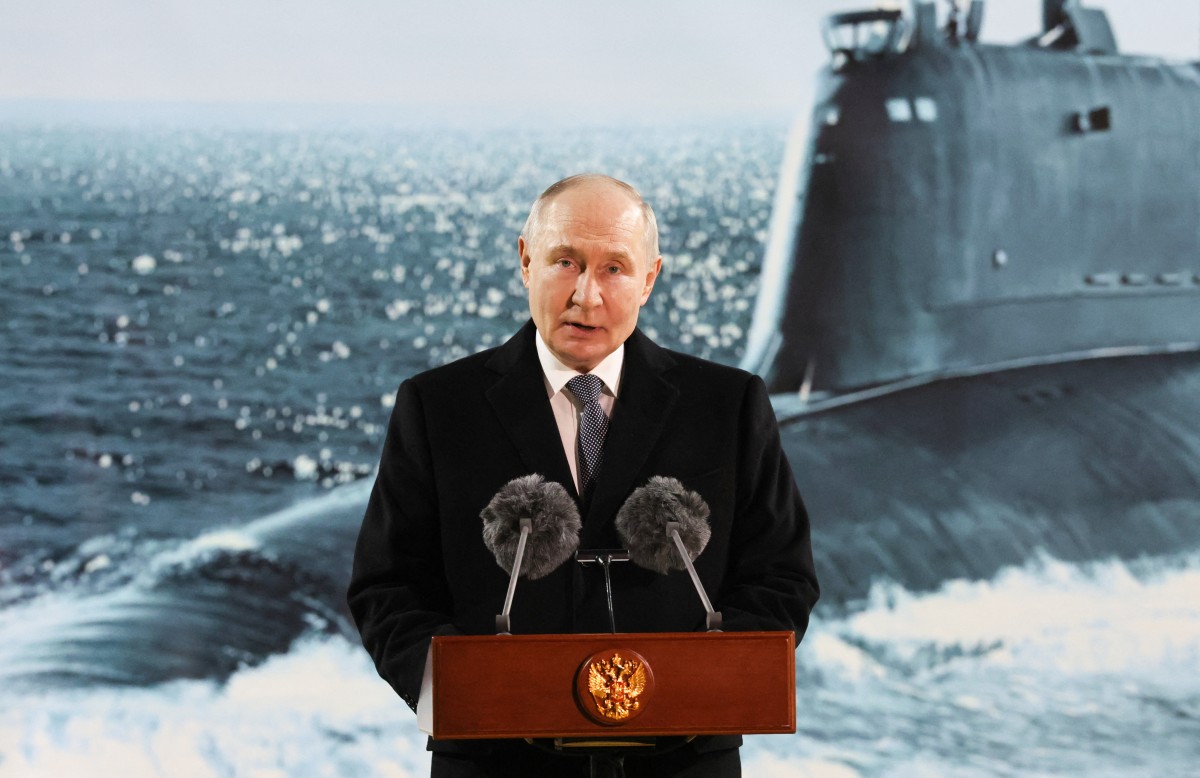
Russian President Vladimir Putin unveiled a new Yasen M-class nuclear-powered submarine, Pern, on Friday. He said Moscow would add five more to the country’s fleet by 2030.
At the Sevmash shipyard in the northwestern city of Severodvinsk, Putin attended a flag-raising ceremony aboard the Pern submarine, marking its formal transfer to the navy.
“Russia is one of the few countries in the world capable of building powerful nuclear submarines of this kind, weapons with global reach and significance,” he said.
Putin said the navy would receive five more by 2030, including three vessels from the Yasen-M class, the same class as the Perm. The submarines can operate in “any part of the world’s oceans” while carrying a range of cruise missiles, he added.
Earlier, as EurAsian Times reported, during 2026 Navy Day celebrations, Russia projected an optimistic outlook by confirming plans to launch the nuclear submarine, armed with hypersonic Zircon missiles.
The Russian Navy Commander-in-Chief, Admiral Alexander Moiseyev, presented a status report on inducting new vessels into service. Moiseyev reported to President Vladimir Putin that 20 ships, vessels, and boats had already been commissioned in 2026, with plans for another 21 by the end of this year.
The most noteworthy of these upcoming inductions is the Perm nuclear submarine, armed with the Zircon (or Tsirkon) hypersonic missile.
Perm is the fifth boat in the Yasen-M series. The keel was laid in 2016, and the submarine was launched in March 2025 at a ceremony Putin attended remotely.
Designed by the Malakhit Design Bureau and built at Sevmash, it features a partial double-hull configuration, a rubber coating to reduce its acoustic signature, modern navigation, communication, and hydroacoustic systems, high-precision weapons, and robotic equipment.
The Perm submarine’s mast housing includes a rescue chamber that can hold the entire crew. During the launch ceremony, Putin described it as the first multipurpose submarine equipped to carry Zircon hypersonic cruise missiles.
Zircon is a sea-launched hypersonic missile that Russia claims can reach Mach 8–9 and has a range of 500–1,000 km. It is intended for both anti-ship and land-attack roles
Zircon’s high speed is designed to compress defender reaction times and complicate interception compared with conventional subsonic or supersonic cruise missiles. Analysts believe that since kinetic energy is the best predictor of lethality against large surface targets, the missile’s extraordinary speed would make it a great attack vector against larger warships, such as an adversary’s aircraft carrier groups.
The missile has been used to launch devastating strikes on Ukraine on several occasions. In fact, Boris Obnosov, CEO of Tactical Missiles Corporation, earlier said in an interview with Rossiya-24 television that the missile can defeat nearly all air defense systems.
Speaking at the Navy Day event, Putin said ongoing work is improving its accuracy, noting that “its latest combat use shows that it is becoming increasingly accurate” and that few countries field comparable weapons. Additionally, he boasted that few countries in the world possess weapons like Zircon.
Arming a nuclear attack submarine with Zircon would allow relatively close approaches to high-value targets, such as aircraft-carrier groups, major surface combatants, or coastal infrastructure. Launching hypersonic missiles would thus leave defenders little warning and time to react.
The Perm submarine will carry a mixed load of Zircon, Oniks, and Kalibr missiles, as well as torpedoes, enabling it to switch between anti-ship, land-attack, and anti-submarine roles.
Inducting a modern Yasen-M submarine would boost the multipurpose nuclear attack submarine force, support sea-denial and power-projection objectives, and complement the strategic ballistic-missile submarine force that forms part of the nuclear triad.
Moreover, it would be a shot in the arm for the overall combat posture, especially as Ukraine has hammered Russia’s Black Sea Fleet (BSF) in the ongoing war, signaling vulnerability in Russia’s naval forces.
- Contact the author at sakshi.tiwari13 (at) outlook.com
- Follow EurAsian Times on Google News