

As cheap drones change the rules of warfare, the British Royal Air Force (RAF), which operates some of the world’s most advanced combat aircraft, is turning to protective netting to defend its bases amid burgeoning security threats that have forced the withdrawal of several US aircraft.
The RAF is moving aircraft to hangars and hardened shelters at night to protect them from possible drone threats. Additionally, it is erecting anti-drone nets around aircraft that cannot be housed in these shelters, according to reports in the British media.
The nets are reportedly intended to provide an additional physical barrier against small unmanned aerial vehicles (UAVs), which could otherwise approach parked aircraft and damage them.
Although some British airbases have hardened aircraft shelters dating back to the Cold War, there are not enough to accommodate every aircraft. Moreover, larger aircraft, such as transport planes, aerial refueling tankers and surveillance aircraft, are particularly difficult to protect because they require considerably more hangar space.
Against that backdrop, protective nets offer a relatively inexpensive additional layer of physical protection for aircraft that cannot be moved into hangars.
Although they are not a substitute for hardened shelters or sophisticated counter-drone systems, they could complicate attempts to approach exposed aircraft with small drones.

The reported measures have attracted considerable attention, prompting concerns about the vulnerability of Britain’s military airbases.
However, retired RAF Air Marshal Greg Bagwell tried to assuage some of these concerns and wrote: “No need for panic, our smaller fighter aircraft have always been placed under cover at night – much of it hardened. It’s more challenging for larger aircraft, for which we don’t have enough hangarage, so other measures are necessary. But we are clearly in different times.”
The new measures come against the backdrop of an increasingly complicated security environment, with the UK facing potential threats from Iran and Russia.
Earlier, Britain received a rude shock when three suspicious vans and five men were spotted near the RAF Fairford base, potentially preparing to attack the facility. The incident has since been linked to Iran, and two men have been charged with serious security offenses and assisting a foreign intelligence agency.
Although Tehran has denied its links to the incident, the US pulled out all its B-1B Lancer bombers from RAF Fairford after the incident, as the EurAsian Times reported.
Earlier this month, the US also evacuated several KC-135 aerial refueling aircraft from RAF Mildenhall in Suffolk amid reported concerns about potential Iranian threats. Being a massive aircraft, the KC-135 is harder to protect.
In addition to the alleged Iranian threat, the MI5 and British Ministry of Defense (MoD) have already warned of potential sabotage attacks from Russia, which has repeatedly accused London of overstepping by aiding Ukrainian forces.
Drones Are Changing Warfare & Defenses
The Royal Air Force’s reported move to install anti-drone nets at its bases is more than a precautionary measure. In fact, it points to a fundamental shift in modern warfare amid a rapid and linear proliferation in the use of drones.
The RAF operates an impressive inventory of advanced military aircraft, including F-35B Lightning II stealth fighters and Eurofighter Typhoon. Its wider fleet also includes the P-8A Poseidon maritime patrol aircraft, E-7 Wedgetail airborne early warning aircraft and RC-135W Rivet Joint electronic intelligence platforms.
For strategic airlift and transport operations, the service operates the C-17A Globemaster III, Airbus A400M Atlas, and A330 Voyager; the latter also serves as an aerial refueling tanker and transport aircraft.

These platforms provide Britain with sophisticated combat, intelligence-gathering, surveillance, logistics, and force-projection capabilities. However, these aircraft cannot escape threats when parked in the open at an airbase, especially from cheap drones.
This creates a key vulnerability because an adversary — whether a state or a non-state actor — does not need to defeat an aircraft in aerial combat to neutralize its military contribution. Damaging it on the ground, disrupting its maintenance infrastructure or threatening the airbase supporting its operations could achieve a similar operational effect.
As for military bases, they were traditionally protected against conventional threats such as air strikes, missiles, sabotage and ground attacks. Their security arrangements, including perimeter fencing, patrols, radar systems and hardened aircraft shelters, were largely designed around these established threats. However, the proliferation of small drones has complicated this security equation and forced militaries to adopt solutions like nets.
The RAF has reported several drone incursions in the past two years. Earlier this month, for instance, the US Air Force reported “suspected unauthorized drone activity” over RAF Lakenheath in Suffolk. Although no aircraft or base infrastructure was damaged, reports said sirens went off at the base.
Before that, multiple drone sightings were reported in 2024 over multiple British military bases, including RAF Lakenheath, RAF Mildenhall, RAF Feltwell and RAF Fairford, with a potential Russian link. Earlier this year, an investigation by the International Institute for Strategic Studies suggested the 2024 drones may have been launched from Russian-linked commercial vessels in the North Sea.
Unlike conventional aircraft, small drones are cheap and cost only a few thousand dollars. This creates an asymmetric cost problem because an attacker could employ a relatively inexpensive drone to threaten an aircraft worth millions of dollars.
The Ukraine war, for instance, has shown time and again how cheap drones are a threat to sophisticated platforms.
One of the most striking examples of this was Ukraine’s June 2025 “Operation Spiderweb,” which involved coordinated drone attacks against multiple Russian military airbases, with drones concealed inside modified containers used to strike aircraft at several locations.
“This Russian air base attack is a crimson-letter warning to every major power, a visceral demonstration of how a seemingly low-tech, high-impact assault can achieve strategic objectives,” Indian Air Force veteran Group Captain M.J. Augustine Vinod (retd) wrote in an article for the EurAsian Times following Operation Spiderweb. “It exposes a gaping chasm in traditional defense paradigms, a vulnerability that demands immediate, radical re-evaluation. The very notion of secure borders and impregnable airspaces has been challenged, not by intercontinental ballistic missiles, but by something far more insidious – a container-borne threat, silently deployed, striking at the heart of military might.”
The West Asian region, during the US-Iran war, also provided another important example of how drone warfare is changing the security requirements of military installations.
In response to the US and Israeli strikes, Iran employed drones and missiles against American military facilities across the Gulf region, inflicting painful losses. For example, Tehran claimed in March 2026 that a Shahed-136 damaged a US Air Force (USAF) E-3 Sentry Airborne Warning and Control System (AWACS) aircraft in a strike at Prince Sultan Air Base in Saudi Arabia.
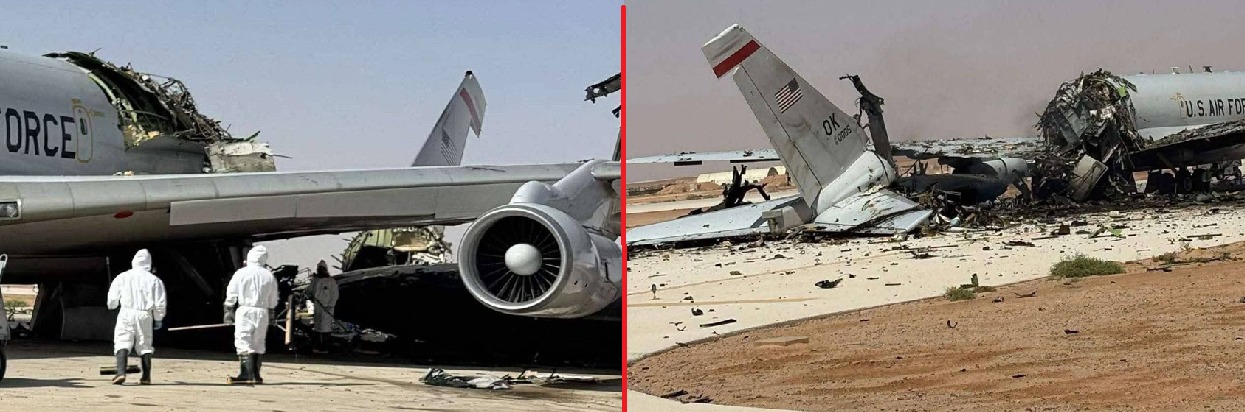
Hence, for countries with advanced air forces, protecting aircraft on the ground is directly connected to retaining operational readiness and combat capability.
The RAF’s reported use of protective nets demonstrates that militaries are increasingly considering relatively simple, passive defensive measures alongside sophisticated counter-drone systems. Both Ukraine and Russia have used these protective nets to secure their assets, as evident in images published on social media over the past five years.
The US military is also examining protective netting, cables, and other physical barriers as part of a broader approach to countering small unmanned aerial systems.
In January 2026, the Pentagon’s Joint Interagency Task Force 401 (JIATF-401) published guidelines recommending increased use of cables, netting, and other physical barriers for critical infrastructure. Later, in March 2026, base officials considered adding nets to F-16 aircraft sunshades to block small-drone intrusions.
These measures are not meant to replace advanced air defense, but to add another layer of protection against an evolving threat.
To that end, physical barriers such as nets can serve as a passive defense without the constant operation of costly detection and interception systems.
Much like the US and other countries, the RAF’s decision to install protective nets is meant to offset the threat posed by cheap, expendable drones that could target an aircraft, hangar, or other critical military infrastructure worth millions of dollars. The measure aims to address the growing asymmetric threat and the changing economics of modern warfare.
- Contact the author at sakshi.tiwari13 (at) outlook.com
- Follow EurAsian Times on Google News