North Korea may have recently tested a truck-mounted Multiple Launch Rocket System (MLRS) that bears an uncanny resemblance to the US HIMARS (High Mobility Artillery Rocket System), which has demonstrated remarkable combat effectiveness in the war in Ukraine.
In a grand show of force on May 26, the Democratic People’s Republic of Korea (DPRK), popularly known as North Korea, tested a mix of lethal weapons, including tactical ballistic missiles, artillery rockets, and AI-guided precision cruise missiles under the supervision of the Supreme Leader Kim Jong Un, as reported by the state-owned KCNA News Agency.
The tests featured a truck-mounted multipurpose missile-launching system, which observers and media reports have likened to the Lockheed Martin HIMARS (High Mobility Artillery Rocket System). The North Korean missile launch system is reportedly designed to emphasize precision and rapid deployment, much like the HIMARS.
The launch system can fire both guided 240mm rockets and Hwasong-11Ra short-range ballistic missiles, according to reports.
The launch “analyzed and estimated the power of special mission warhead of tactical ballistic missile, the reliability of 240mm controlled artillery rocket with expanded firing range which employed an ultra-precision autonomous navigation system,” KCNA stated.
The state media also released photos of the tests. In one picture, a missile launches from a mobile launcher, surrounded by a cloud of smoke and a bright exhaust flame. Meanwhile, another photo shows Kim Jong Un standing near a mobile launcher, flanked by his military officials.
While little is known about the new rocket launch system, reports suggest it is modular, meaning it can carry different pod types, such as rocket artillery or ballistic missile pods, on a wheeled chassis for high mobility and shoot-and-scoot capability like the HIMARS.
The Supreme Leader said that the tests demonstrated that the weapons and automated launch systems have been successfully upgraded to “suit the proper conditions of modern warfare so as to enhance their application to combat,” as noted in the KCNA report.
Notably, North Korean forces have used the 240mm artillery rockets for a long time, deploying several launchers capable of firing the rocket, particularly near the Demilitarized Zone (DMZ), putting much of the Seoul metropolitan area within easy range. However, the older versions of the launch systems fired unguided rockets, which are effective for area saturation and overwhelming defenses in large salvos, but lack precision.

In contrast, the newly tested variant adds an ultra-precision autonomous navigation system, transforming it into a guided rocket capable of engaging specific point targets with much higher accuracy and expanding its firing range. This upgrade significantly increases its military value — shifting it from a blunt, mass-fire weapon to a more surgical tool that can better support North Korean tactical operations near the border.
At the same event, the North Korean troops test-fired an AI-guided cruise missile with a range of about 100 kilometers—confirming the development and testing of the first-ever missile integrated with Artificial Intelligence. Kim Jong Un said the missiles will be stationed at artillery units close to the South Korean border, adding that the tests specifically verified the combat readiness of cruise missiles with precision navigation and AI-guided control.
There is currently no evidence to prove whether the characteristics of the North Korean system match those of the HIMARS, or whether its mere physical resemblance is sufficient. Nonetheless, the new system adds impetus to North Korea’s efforts to expand tactical conventional firepower alongside its nuclear program to create more flexible “non-nuclear” options for pressuring and deterring South Korea and the United States.
For instance, Kim Jong Un had earlier inspected the production of a “new-type 155mm self-propelled gun-howitzer” with a claimed range of over 60 kilometers. These are scheduled for deployment to frontline artillery units along the southern border this year.
The Supreme Leader has vowed to deploy all these at the border with South Korea amid sustained tensions, according to local media reports.
Notably, the development of the new launch system may have been inspired by the excellent combat performance of the HIMARS in the Ukraine War and during Operation Epic Fury against Iran, which ended in a ceasefire last month.
The Battle-Proven HIMARS
The Ukrainian military has used the HIMARS to hit Russian targets hard and deep with devastating effects.
The HIMARS can fire GMLRS (Guided Missile Launch Rocket System), which can hit targets over 70 kilometers away, and long-range ATACMS (Army Tactical Missile System) can strike targets 300 kilometers away.
The HIMARS and Guided Multiple Launch Rocket Systems (GMLRS), which were first used by Ukrainian forces in 2022, destroyed Russia’s artillery dominance and showed that Ukraine could hit previously unattainable Russian targets, including ammunition depots and command and control centers. They were also used to attack Russian troops and aircraft.
The HIMARS attack at the time caught the Russian forces off guard, forcing them to retreat 70 to 80 kilometers from the front line and reduce shelling intensity.
The Ukrainian forces used HIMARS to target critical infrastructure, including bridges, rail hubs, and convoys, which helped them isolate Russian units in areas like Kherson and disrupted supply chains, as previously explained in detail by the EurAsian Times.
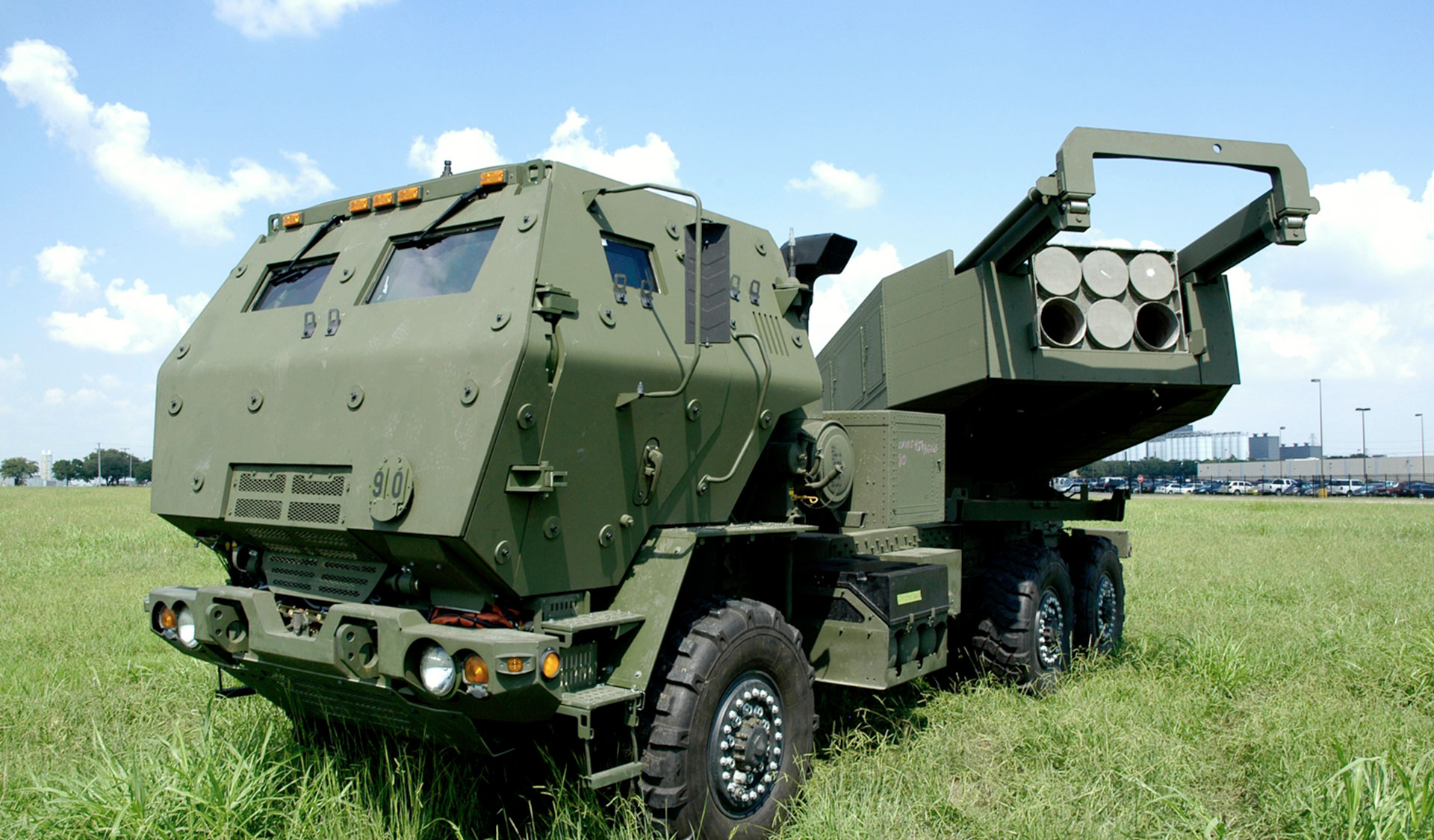
This, in fact, contributed to Ukraine’s successful 2022 counteroffensive in Kherson.
Following the profound effect of HIMARS on the battlefield, Ukraine persuaded the US to provide the long-range ATACMS for months in order to inflict more damage on the Russian armed forces. The Biden administration initially hesitated amid concerns of escalation, but later relented and transferred the long-range missiles to Kyiv, which were then used to wreak havoc on targets far behind the frontline.
The US military deployed HIMARS to strike Iranian ships during Operation Epic Fury. The launchers reportedly fired the long-range ATACMS and the Precision Strike Missile (PrSM) at targets at the Bandar Abbas naval base, as well as other military assets, including ports, infrastructure, and possibly facilities on Kharg Island.
HIMARS provided mobile, deep-strike capability to complement air and naval strikes. Its advantages include rapid shoot-and-scoot mobility, high precision, and the ability to operate from dispersed locations, which made it harder for Iran to target.
The US Central Command (CENTCOM) publicly highlighted its “unrivalled deep-strike capability” against the Iranian regime.
The combat success, versatility, and mobility of HIMARS have made it the most sought-after rocket artillery system in the world.
- Contact the author at sakshi.tiwari13 (at) outlook.com
- Follow EurAsian Times on Google News