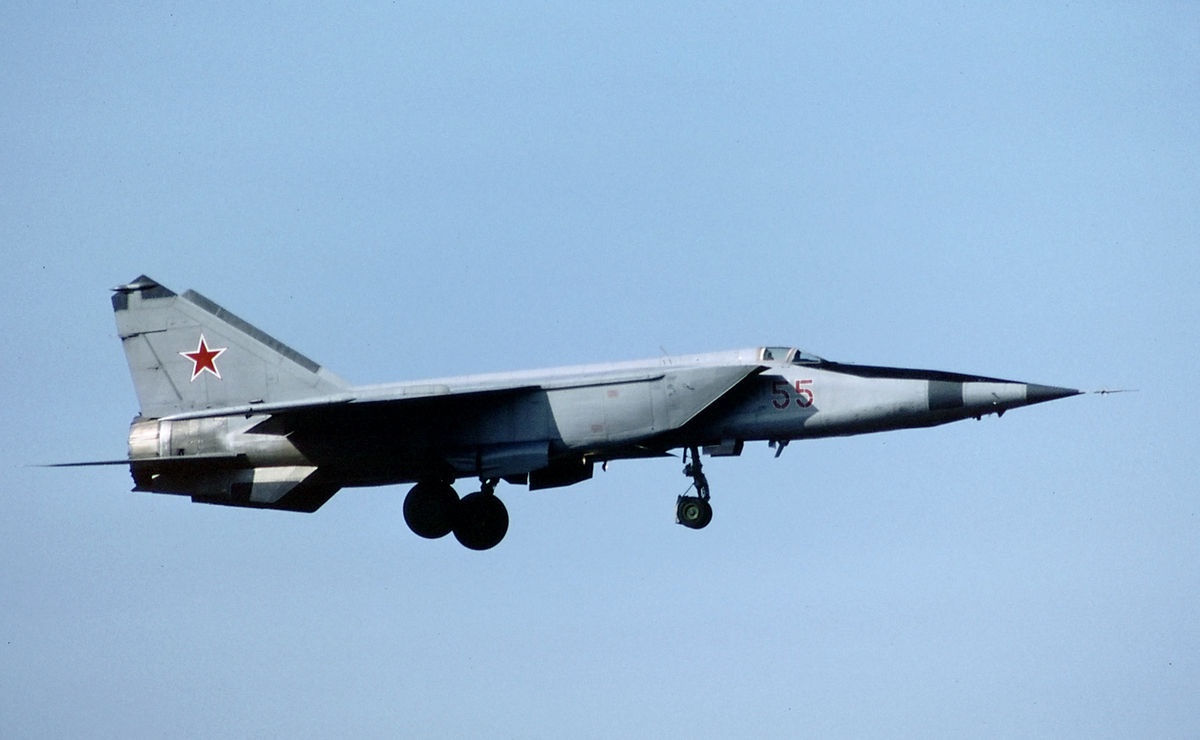
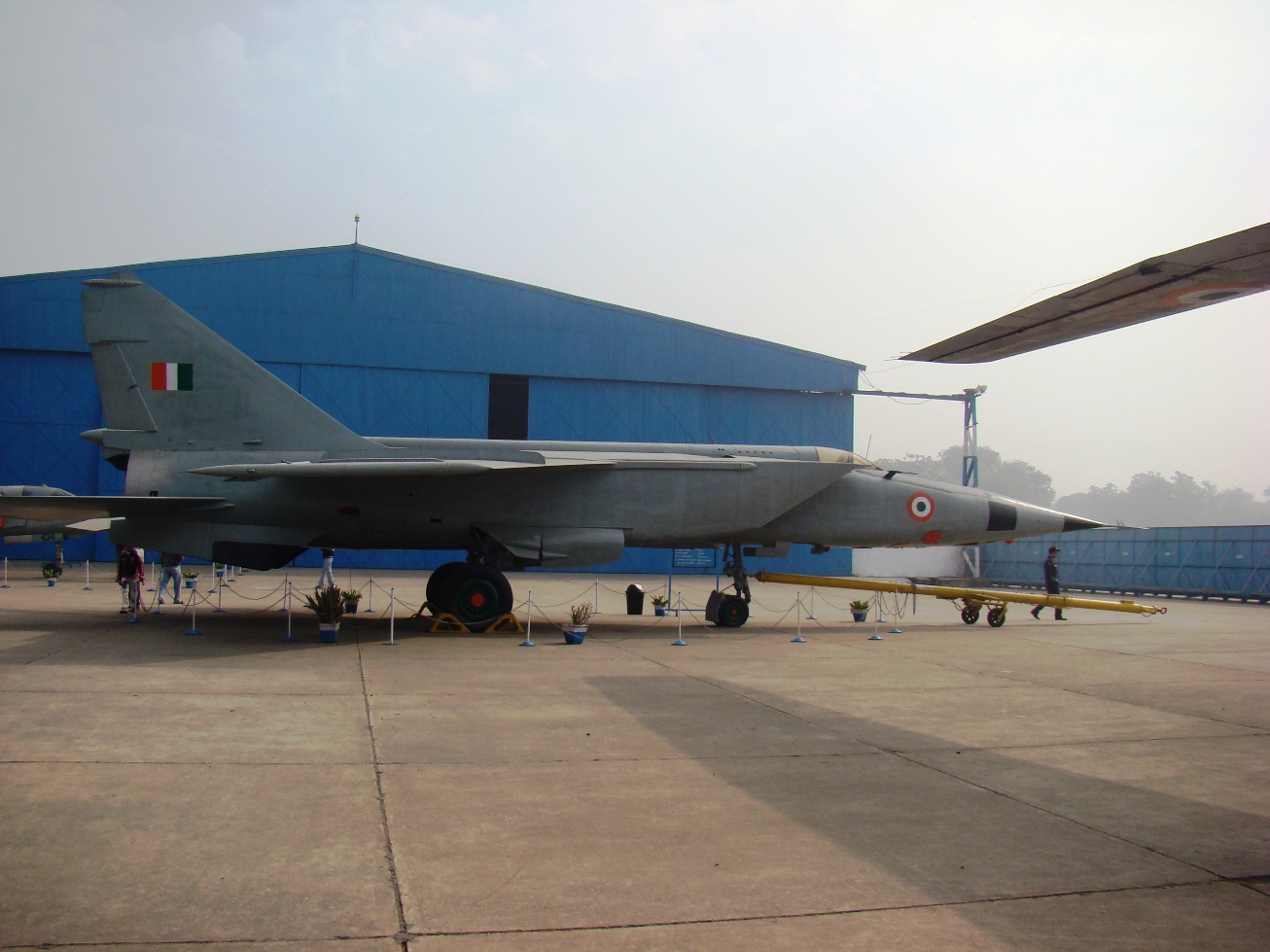
The Indian Air Force (IAF) has operated several cutting-edge fighter jets acquired from the Soviet Union and, subsequently, from Russia. However, the MiG-25 Foxbat—remembered as one of the fastest combat jets of its time—has left an enduring legacy.
During the height of the Cold War, the Soviet Union produced the MiG-25, an unarmed reconnaissance platform that was extremely fast and capable of reaching high altitudes.
It took to the skies for the first time in 1964 and quickly earned the nickname “Loneliness at Mach 3” because of its ability to attain supersonic speeds and reach the stratosphere, the second layer of Earth’s atmosphere, in a matter of seconds.
Combining extreme speed and altitude with versatile sensor packages that allowed it to gather intelligence with relative impunity, the MiG-25R is remembered today as one of the highest-speed reconnaissance platforms of the Cold War.
The US gained access to the aircraft only when Soviet pilot Lieutenant Viktor Ivanovich Belenko defected and flew his MiG-25 Foxbat fighter jet to Hakodate Airport in Hokkaido, Japan, on September 6, 1976, as earlier explained in detail by the EurAsian Times. The US described the aircraft as “unsophisticated” upon inspection, claiming it lacked the agility required to fulfill its intended role as an interceptor.
The IAF inducted 10 of these aircraft into its fleet in its newly raised 102 Squadron, also known as the Trisonics, although their existence and operations remained classified.
The IAF inducted the MiG-25R ‘Foxbat’ on August 17, 1981, 45 years ago.
“Capable of operating above 60,000 ft and at speeds beyond Mach 3, the Foxbat served as a high-altitude reconnaissance platform. During Op Safed Sagar, it undertook vital reconnaissance missions, providing valuable imagery and intelligence,” the service recalled in a post on X on the 45th anniversary of the aircraft’s induction.
Retired Air Marshal Sumit Mukherjee, who flew the mighty MiG-25s, echoed American pilots’ sentiments about the jet’s maneuverability.
“Like other fighters, MiG-25 pilots could not do aerobatics on this jet. The aircraft was first designed to take down SR-71 Blackbird,” Air Marshal Mukherjee told the EurAsian Times in a previous interaction.
“The aircraft was not maneuverable. However, it did not have to engage in a dogfight with any aircraft because there were none of that caliber. It was a dud in air combat,” the veteran quipped at the time.
Primarily a reconnaissance aircraft, the MiG-25R was unarmed.
“Our only weapon was height and speed; we used it to avoid any potential threat. MiG-25 flew above the radar lobe. Unless the enemy was aware that we were incoming and turned their radars upward, we could always penetrate the enemy territory undetected,” Mukherjee previously explained to the EurAsian Times.
In one incident, an IAF MiG-25 breached the sound barrier close to Islamabad in May 1997 while flying over Pakistan, with the ensuing sonic boom prompting the Pakistanis to scramble their jets to intercept it. However, the Pakistani Air Force could not match its speed of Mach 2.5 and operational altitude of over 60,000 feet.
MiG-25: The Unsung Hero Of Operation Safed Sagar
Although the latest Netflix India show, “Operation Safed Sagar,” omitted any mention of the MiG-25R, the aircraft played an instrumental role in the aerial operations during the Kargil War of 1999, whose 27th anniversary was marked by the Indian Armed Forces this year.
18 years after it was inducted into service, the jet was called upon to address one of the most pressing issues facing the IAF in Kargil: precisely locating targets, as military aviation historian Anchit Gupta explained in his latest post.
When the war broke out in May 1999, the Indian Armed Forces faced the challenge of finding Pakistani locations and determining their exact coordinates.
A major operational obstacle was that the Indian Army’s maps were out of date and inadequate for pinpointing coordinates, and troops were not expected to receive the most recent Survey of India maps until the end of June 1999. Ultimately, it was determined that vertical aerial photography was the sole method of locating the targets.
The IAF had a host of combat jets available for the task, including the Avro 748, Jaguar, Canberra, and MiG-25, but each had major shortcomings.
“The Avro was unsuitable for a hostile environment. Jaguars with Vicon cameras produced excellent low-level imagery, but operating low over Kargil meant exposure to SAMs. A No. 106 Sqn Canberra had already been struck by an Anza missile on its first reconnaissance sortie,” states Anchit. “That left the MiG-25.”
Typically, the Foxbat flew at about Mach 2.4 over a distance of 20 kilometers. MiG-25R’s 72-inch focal-length cameras provided extensive photographic coverage, and the Peleng-DM navigation system could associate precise positional information with the imagery.
Nevertheless, at its usual altitude, the resolution was insufficient to identify small bunkers, sangars, and hidden positions in Kargil. This meant that to obtain high-quality pictures, the Foxbat had to descend.
Although the imagery was excellent at about 8 kilometers, the aircraft would be at risk from shoulder-fired missiles. Meanwhile, at 13 to 14 kilometers, the aircraft was relatively safe but would require minimal reheat, pushing it to about Mach 1.3, as Anchit explained.
The final compromise reached by the IAF—roughly 10 kilometers and Mach 0.9—was impressive for a Foxbat. It enabled an efficient fighter escort and provided approximately 5 kilometers of vertical separation from the missile belts.
The MiG-25 lacked chaff, flares, and a radar warning receiver RWR. So, another solution was reached: two MiG-29s provided top cover, with two Mirage 2000s accompanying the MiG-25Rs. The basic Foxbat escape strategy was to use maximum afterburner, rise to 20 kilometers, accelerate to Mach 2.4, and get out if there was a real threat.
The historian notes that, “Navigation accuracy was equally critical. The Peleng-DM, like any inertial system, could drift. Its feed was integrated with the RSBN beacon system, and Wg Cdr P.J. Thakur went a step further, borrowing a handheld GPS from No. 7 Sqn to verify that the positions being generated were accurate.”
Finally, on 21 June 1999, Wg Cdr P.J. Thakur flew the first operational photo-reconnaissance mission over the Drass–Kargil sector. Mirage 2000s flown by Wg Cdr S. Chhabra and Wg Cdr Rohit Verma accompanied the mission, while MiG-29s led by Wg Cdr S. Harpal Singh provided top cover, as documented by Anchit in his post.
Two Pakistani F-16s approached the MiG-25s during the photo mission, but were effectively deterred by the MiG-29s.
“The exposed film was then flown back to Bareilly for processing. When the photographs reached Western Air Command and Air HQ, the impact was evident. Tololing. Muntho Dhalo. Tiger Hill, states Anchit. “Positions that had been difficult to locate with confidence were now clearly visible. Enlargements revealed bunkers, sangars and camouflaged positions. Crucially, the imagery could be tied to accurate coordinates.”
This mission allowed the strike crews to study their targets before take-off, see how they would appear from release height, fix their coordinates and plan the direction of attack. In the Kargil mountains, where locating a small position could be almost as difficult as attacking it, imagery of this quality mattered enormously. The MiG-25 went on to fly four more missions over Kargil–Drass, in addition to reconnaissance over Rajouri–Poonch and a sortie to assess the situation around Gultari.
Speaking of the MiG-25’s role during the Kargil War, Retired Air Marshal Sumit Mukherjee, who flew the mighty MiG-25s, earlier told the EurAsian Times, “The aircraft did the finest photography of the Line of Control between India and Pakistan. This helped in better planning of missions.”
Separately, explaining the appeal of the jet, Mukherjee said, “We did not have air-to-air refueling, and fuel consumption was high. We were limited in how far we could go.”
The IAF retired the Foxbats in 2006 as technology advanced.
“The satellites were able to give us photographs of less than a meter in resolution. One can even pick a football from a satellite. Also, satellites are much safer, and you don’t have to make yourself vulnerable by going into enemy territory,” Air Marshal Mukherjee said while explaining what brought the era of Foxbats to an end.
- Contact the author at sakshi.tiwari13 (at) outlook.com
- Follow EurAsian Times on Google News