
“War is men’s business,” Hector tells his wife Andromache in Homer’s Iliad.
Centuries later, in Aristophanes’ comedy Lysistrata (411 BC), an Athenian magistrate dismisses a woman trying to end the war with the same words: “Just weave your web… War is men’s business!”
Yet the four-day India-Pakistan war of May 2025 placed women at the very heart of the conflict.
India named its military campaign Operation Sindoor — after the bright red vermilion powder worn by married Hindu women as a symbol of marital status and auspiciousness.
The operation was framed as retribution for the brutal Pahalgam terror attack on 22 April 2025, in which over 20 women were reportedly widowed after terrorists killed their husbands in front of them.
Against this backdrop, it is particularly unfortunate that both sides released overtly sexist and misogynistic military patches after the conflict.
The Pakistan Air Force (PAF) led the way by releasing an AWACS squadron patch depicting a nude woman attempting to cover her modesty with a small Indian flag. The patch featured a PAF AWACS aircraft and the slogan: “Peekaboo — I See You.”
The clear message was that Pakistani radars had tracked Indian fighter jets. Yet Islamabad chose to convey operational superiority through the degrading image of a naked, vulnerable woman, holding to the last piece of cloth available to her to cover her modesty.
In fact, even during the conflict, openly sexist and misogynistic comments were circulating on Pakistani social media channels about a female Indian Air Force fighter pilot, Shivangi Singh.
Shivangi Singh is an IAF Rafale pilot. During the May conflict, Pakistani handlers circulated a video of a female fighter pilot ejecting from an aircraft and landing in a hilly area and being arrested by a soldier.
Pakistani accounts falsely claimed that the female pilot was IAF pilot Shivangi Singh.
See your Shivangi Singh getting disgraced and being a Mal e Ghanimat for us now. pic.twitter.com/onIDcg7Mxm
— Shark 🇵🇰 🇵🇸 🇨🇳 (@SharkO2C) May 10, 2025
The commentary on these posts was extremely disgusting and objectionable.
She was described as Mal-e-Ghanimat.
“Maal-e-Ghanimat is an Islamic theological term that translates to “spoils of war” or “booty.” It traditionally refers to weapons, property, assets, and wealth seized from defeated enemies after battle.
By comparing a female Indian soldier to maal-e-ghanimat, these posts revived deeply objectionable medieval notions in which women themselves were treated as legitimate war booty, objects to be captured, possessed, and humiliated.
Even more worryingly, the commentary persisted even after India rejected claims that Shivangi Singh had been captured.
However, as the old proverb warns, one bad apple spoils the whole barrel. In the same way, misogyny is dangerously contagious; once tolerated, it could quickly spread to other institutions and armies as well.
Regrettably, it seems that even the IAF has now resorted to a tit-for-tat patchwork.
On June 8, multiple accounts showed images of a reportedly new patch used by the IAF’s S-400 squadron.
The IAF patchwork shows an S-400 launcher and a PAF AWACS, with the caption “the long shot.”
The patch is a reference to the longest surface-to-air kill in history. India had claimed that it shot down a Pakistani AWACS at a distance of more than 300 km with its S-400 air defense system.
Just like the PAF patch, the IAF patch also features a naked woman, barely covering herself with the Pakistani flag.
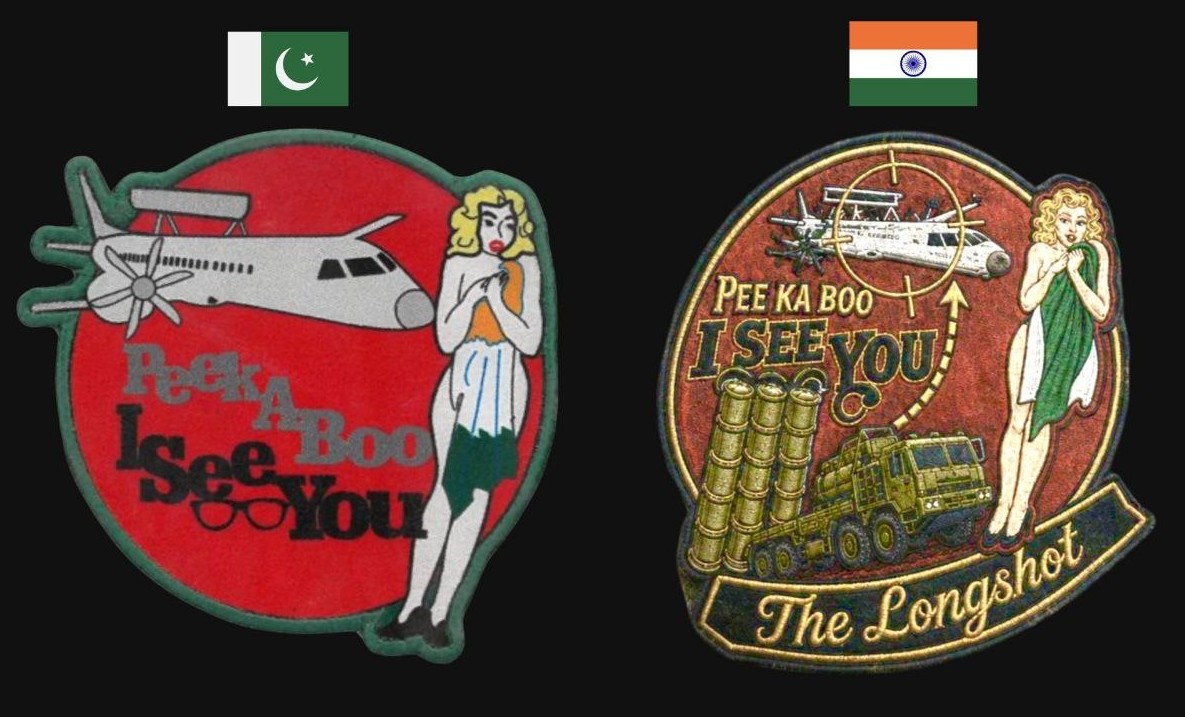
However, according to The Tribune, the patch is not an official IAF issue; however, such patches are ordered by young officers at the unit, on their own.
“These ‘unofficial patches’ can be worn on the upper arm near the shoulder within the unit, and that has been the practice for decades. These are not allowed on official events or in operations,” the sources told the newspaper.
Of course, Indian netizens can claim that the patch is only a cheeky comeback to the PAF’s patch. However, both the patches are sexist, misogynistic, objectify women, and needlessly use the imagery of helpless, vulnerable women to celebrate their claimed victories.
Though such overtly sexist imageries are not unique to the India-Pakistan War.
In fact, sociologists have long observed that the language of the armed forces, defense analysts, and security experts is steeped in overtly sexist and sexual imagery.
This should come as no surprise. As ancient Greek writers declared more than two millennia ago, “War is men’s business.” For most of history, the military, defense establishments, and strategic studies have been almost exclusively male domains.
It is hardly coincidental, then, that even their most “academic” discussions remain saturated with phallic metaphors, sexual innuendo, and misogynistic undertones.
The Long History Of Using Sexual Imagery Among Defense Experts
In her influential 1987 feminist essay “Sex and Death in the Rational World of Defense Intellectuals“, Carol Cohn, a linguist and feminist scholar, described her year-long immersion in the world of US nuclear strategists, defense analysts, and arms control experts.
The first thing she noticed was how all of these defense experts and strategists were exclusively male. She entered this ‘male world’ of defense experts, former military officials, and nuclear strategists with a female gaze and a feminist perspective.
Cohn analyzed how their specialized technostrategic language enables them to discuss plans for mass destruction and nuclear holocaust in calm, rational, even playful terms.
In the essay, Cohn noted how “nuclear bombs are not referred to as bombs or even warheads; they are referred to as ‘reentry vehicles,’ a term far more bland and benign, which is then shortened to “RVs,” a term not only totally abstract and removed from the reality of a bomb but also resonant with the image of the recreational vehicles of the ideal family vacation.”
However, Cohn also noted something much more nuanced. How their so-called ‘technostrategic language’ is steeped in sexual imagery, patriarchal metaphors, and makes a critique of the phallocentric language around rockets and missiles.
For instance, Cohn noted that the US military dependence on nuclear weapons was explained in these expert circles as “irresistible, because you get more bang for the buck.”
Disarmament, Cohn noted, was often compared with emasculation.
“If disarmament is emasculation, how could any real man even consider it?”
“A professor’s explanation of why the MX missile is to be placed in the silos of the newest Minuteman missiles, instead of replacing the older, less accurate ones, was “because they’re in the nicest hole–you’re not going to take the nicest missile you have and put it in a crummy hole.”
The vocabulary of these defense experts, Cohn wrote, was filled with discussion of
Vertical erector launchers: Missiles standing upright, ready to launch.
Thrust-to-weight ratios: Discussed as a measure of missile/aircraft performance.
Soft lay downs: Gentle or precise delivery of warheads.
Deep penetration: Referring to a weapon’s ability to get past enemy defenses.
“One military adviser to the National Security Council has called ‘releasing 70 to 80 percent of our megatonnage in one orgasmic whump,” she noted in her paper.
One expert said there was serious concern about the need to harden our missiles and that we needed to “face it, the Russians are a little harder than we are,” Cohn recalled.
Cohn concluded that the imagery itself does not originate in these particular individuals, but in a broader “cultural context”.
“Both the military itself and the arms manufacturers are constantly exploiting the phallic imagery and promise of sexual domination that their weapons so conveniently suggest.”
In her paper, Cohn also drew attention to some advertisements for weapons in mainstream US magazines of the time to illustrate her point.
An ad for the BKEP (BLU-106/B) read:
The Only Way to Solve Some Problems is to Dig Deep.
THE BOMB, KINETIC ENERGY
PENETRATOR.
She also noticed explicit sexual imagery in nuclear tests.
The French, for instance, assigned a woman’s name to each of the craters they gouged
out of the Earth due to nuclear tests.
Similarly, a US professor spoke of India’s nuclear tests as “losing her virginity.”
The question of how the US should react was posed as “whether we should throw her away,” raising the imagery of whether a woman is still worth anything to a man once she’s lost her virginity.
An angry column by USAF General Ross Milton in Air Force Magazine after New Zealand refused to allow nuclear-armed or nuclear-powered warships into its ports was entitled, “Nuclear Virginity.”
In it, General Milton laments that “after all, this is a woman we’ve paid for, who still won’t come across.”
These instances show that the language of defense and military experts is infused with sexual imagery.
Furthermore, nuclear weapons are also gendered, and as the ultimate destructor, they could only be male.
In 1952, Edward Teller’s exultant telegram to Los Alamos announcing the successful test of the hydrogen bomb, “Mike,” at Eniwetok Atoll in the Marshall Islands, read, “It’s a boy.”
In the end, the crass patches designed by both the Indian and the Pakistani Air Force officials, even if they are not official patches and are ordered only by young officers, expose a timeless truth: war is still seen as exclusively men’s business, where women’s only role is to be won as ‘spoils of war’.
The crude depictions of naked women clutching the flags of their enemies again highlight that even in the 21st century, victory is measured not just in destroyed assets, but in the imagined sexual humiliation of the other side. And establishing domination on the battlefield is seen as synonymous with establishing domination over enemy women.
- Sumit Ahlawat has over a decade of experience in news media. He has worked with Press Trust of India, Times Now, Zee News, Economic Times, and Microsoft News. He holds a Master’s Degree in International Media and Modern History from the University of Sheffield, UK.
- This is an Opinion Article. Views Personal of the Author
- He can be reached at ahlawat.sumit85 (at) gmail.com