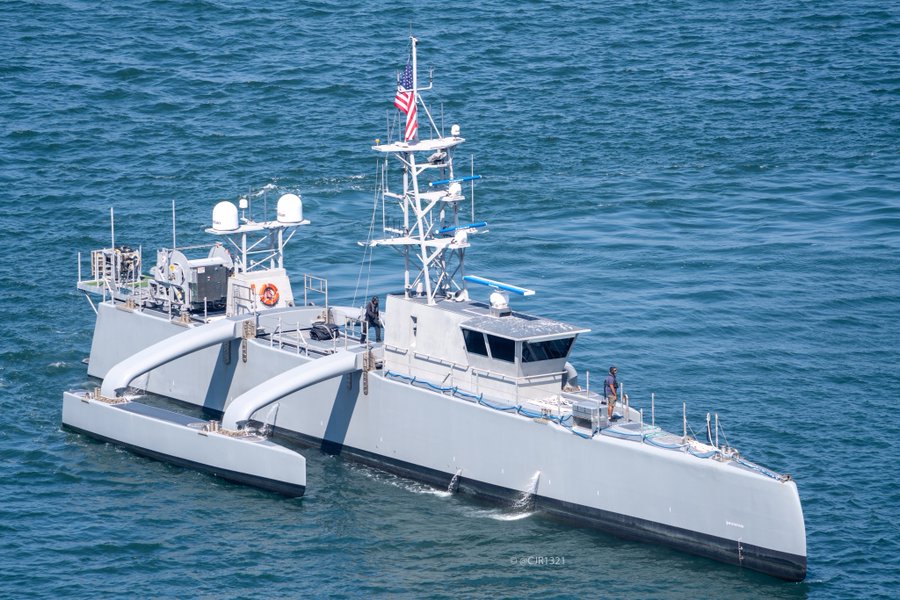
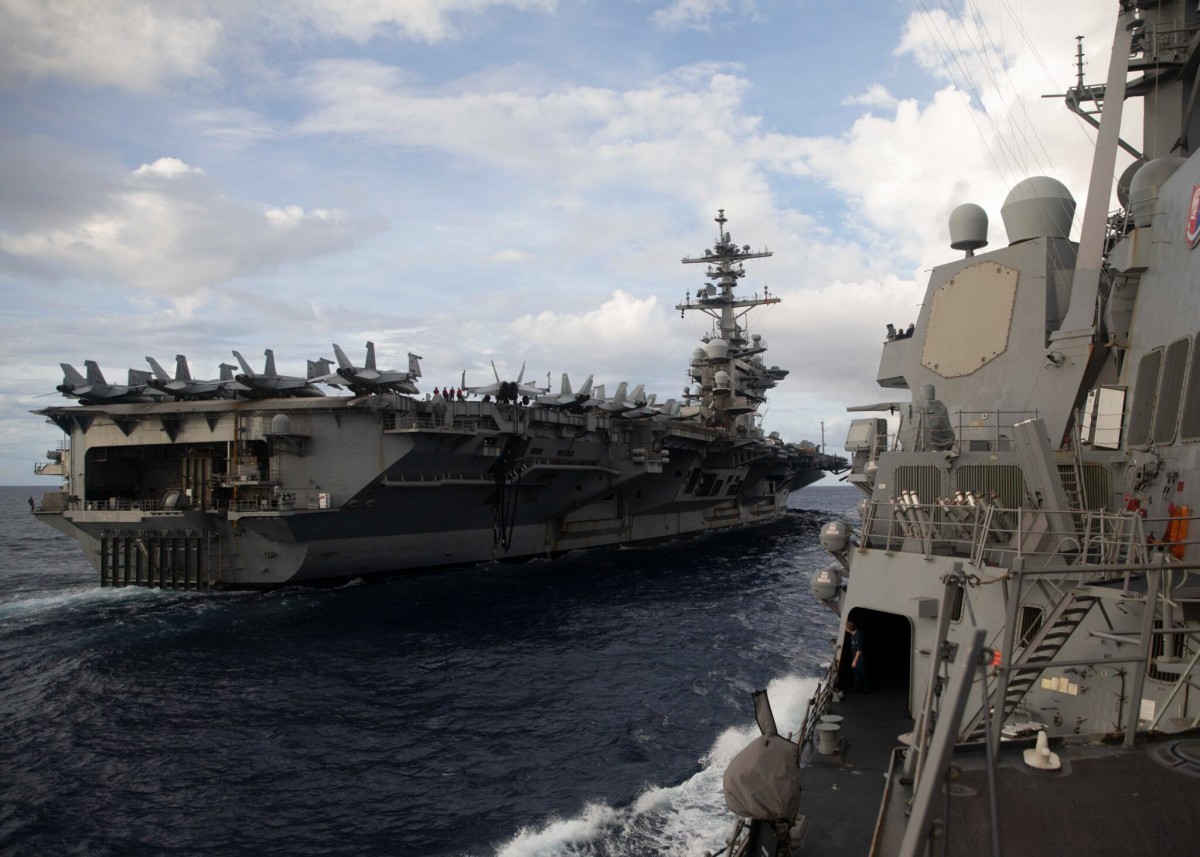
With US aircraft carrier Theodore Roosevelt about to deploy a Seahawk medium unmanned surface vessel (MUSV) as part of its strike group for the first time, the day does not seem far off when the modern navies of the world redefine doctrine, design, and the economics of sea control.
At a time when the idea of having aircraft carriers, which are too valuable to lose and too visible to hide in this age of submarines, missiles, and drones, has come under increased scrutiny, unmanned surface vessels (USVs) could extend a carrier’s reach, reduce risk for sailors, and complicate enemy targeting.
The deployment of the Seahawk MUSV is “a milestone as it could lay the foundation for how the Navy develops its concept of operations (CONOPS) for integrating unmanned into the rest of the fleet, at a time when the Navy is still struggling to articulate how and when it will make autonomous vessels a core part of its arsenal”.
It may be noted that Vice Adm. Brendan McLane had announced in February this year that a medium unmanned surface vessel (USV) would be deployed alongside the aircraft carrier Theodore Roosevelt and its strike group “to evaluate how that pairing works, and then assess what other mission packages can be partnered together for the next carrier strike group”.
The US Navy named seven defense firms on May 22 that submitted designs for the new medium unmanned surface vessel (MUSV) market in April; these firms will advance to the prototype sea-testing phase, beginning this month and ending in October.
These companies were Leidos, Huntington Ingalls Industries (HII), Sea Machines, Saronic Technologies, Galliano Marine Services, PacMar Technologies, and Birdon. If qualified in October, they will reportedly receive $15 million and qualify for follow-on production.
In other words, if the deployment of the Seahawk MUSV turns out to be a success story, other US aircraft carriers will also follow, implying that the US Navy now wants unmanned systems to supplement primary forces and become force multipliers for the carriers.
The Seahawk vessel is one of Leidos’ unmanned vessels. An upgraded design of the firm’s Sea Hunter autonomous vessel, the Seahawk, is said to support anti-submarine warfare and maritime domain awareness.
Incidentally, Leidos has several MUSV designs, including the Seahawk. According to Conrad Chun, Leidos Defense Communications vice president, “Leidos brings more than a decade of investment and operational experience in maritime autonomy, including Seahawk, which joined the Navy’s operational fleet in April”.
The US Navy previously deployed four unmanned ships — including a Seahawk and a Sea Hunter — to the Western Pacific in 2023. But the announced deployment with Theodore Roosevelt shows the Navy wants unmanned systems to supplement its primary forces as it develops new tailored force packages for specific mission sets and geographies, Bryan Clark, a retired submarine officer and senior fellow at the Hudson Institute, told Breaking Defense.
Many analysts see the above development in the context of US Chief of Naval Operations Adm. Daryl Caudle unveiling in February what he said “Fighting Instructions” framework, which included the plans to utilize a “hedge force strategy” that seeks “to capitalize on unmanned systems and create a range of tailored options that fall outside the traditional carrier strike group model where an aircraft carrier, a destroyer, and several other assets go out to sea together.”
A major advantage of the MUSV is its minimal manning requirement and ability to operate autonomously for months on end. And this is a big help when the American naval fleet is otherwise shrinking and facing a decline in the number of personnel.
Apparently, the US Navy is short of 10,000 sailors, and there is a strain on the defense budget. Against this situation, analysts say that unmanned systems like Seahawk promise more “teeth” with less “tail.”
Secondly, these unmanned systems remove humans from the most dangerous missions while multiplying the carrier’s sensors, weapons, and fuel.
For instance, MUSVs like Seahawk carry advanced ISR, EW, and ASW payloads, acting as the strike group’s eyes and ears far forward, extending the carrier’s sightline by hundreds of miles without risking a manned ship.
Its modular payload bays mean it can switch between mine countermeasures, sub-hunting, and electronic warfare during deployment. For carriers, Seahawk is, thus, the “skirmish line” — detecting submarines and missile threats early so the carrier has time to maneuver or launch aircraft.
However, it is not that MUSVs have no challenges, something the US naval leadership is well aware of. There is the challenge of logistics and maintenance. A robot ship doesn’t eat or sleep, but it does need fuel, code updates, and spare parts.
The Navy is therefore testing at-sea reloading of LUSV (Large Unmanned Surface Vessel) Vertical Launch System (VLS) cells using supply ships and ‘robot tenders.’ While this reduces the need for traditional maintenance crews, it increases demand for the IT crew.
Secondly, there are also technical and tactical challenges. MUSVs must navigate crowded seas, rough weather, and potential collisions with minimal human oversight. They also remain vulnerable to adversary jamming of satellite communications, which could sever links to the carrier strike group.
Thirdly, and this is most important, there is the big question of command and control. Who commands them? The carrier strike group commander, the air wing commander, or an AI? All told, now it is the humans, the commanding officials, who approve weapons release. But can that be the case with the robot ships that are supposed to react in milliseconds if confronted with hypersonic missiles?
After all, a robot cannot be court-martialed. So, how to decide how much lethal autonomy is legal and ethical?
Given these challenges, it is understandable why Admiral Caudle’s “Fighting Instructions” issues some key tasks for the Navy to develop. Specifically, it orders the Navy to detail how fleet commanders and the joint force will integrate unmanned capabilities, known as robotic autonomous systems (RAS), into “service decisions like strategic laydown, dispersal, and global force management.” At the moment, there is no model in place for RAS capabilities.
Even US lawmakers on the House Armed Services Committee want the Navy to verify to congressional defense committees that CONOPS for unmanned systems have already been developed before accepting a USV. Some of them want a provision requiring the Secretary of the Navy to develop and execute a strategy for USV integration into the fleet and joint maritime operations.
In other words, in the ultimate analysis, to become force multipliers of the Carriers, MUSVs like Seahawk need a “doctrine” to be guided or controlled. But that is a story in progress.
- Author and veteran journalist Prakash Nanda is Chairman of the Editorial Board of the EurAsian Times and has been commenting on politics, foreign policy, and strategic affairs for nearly three decades. He is a former National Fellow of the Indian Council for Historical Research and a recipient of the Seoul Peace Prize Scholarship.
- CONTACT: prakash.nanda (at) hotmail.com