Impressed by the Australian MQ-28 Ghost Bat’s performance during the recent Valiant Shield military exercise, the US Air Force’s Pacific commander said the service is “threaded in tight” with the Ghost Bat’s work and signaled that closer operational control between the two air forces.
The unmanned MQ-28 aircraft flew in formation with a US Air Force F-15EX Eagle II and participated in agile combat employment operations, as EurAsian Times reported at the time. It also reportedly operated alongside other platforms, including F-35.
The exercise tested human-machine teaming in realistic scenarios that included defensive and offensive counter-air missions.
Ahead of the drills, the Pacific Air Forces (PACAF) said the deployment would assess the MQ-28’s potential as a force multiplier, extending the reach, awareness, and survivability of crewed aircraft in contested environments. However, we could not determine during the course of the exercise if the Ghost Bat received any direct command from any of those manned platforms it flew with during the test.
Speaking at a webinar hosted by the Mitchell Institute for Aerospace Studies on July 27, Gen. Kevin Schneider, commander of PACAF, said he was “impressed” with the Royal Australian Air Force’s collaborative combat aircraft (CCA) program.
“Grateful that we were able to incorporate some of this in Valiant Shield, or to be a part of it. I’d say most of the interaction in Valiant Shield was within our test community,” Schneider said about the MQ-28’s participation in the exercise. “The experimental operations squadron that we have looking at US Air Force CCA platforms was really threaded in tight with what the Australians were doing. So the cross flow of information within the test and development effort is really strong,” he added.

Notably, most of this interaction involved the US Air Force’s Experimental Operations Unit (EOU) at Nellis Air Force Base, which develops CCA concepts of operations, tactics, techniques, and procedures.
The MQ-28 is not formally part of the US Air Force’s own CCA program. The Increment 1 of the USAF’s CCA program is proceeding with the General Atomics FQ-42 and Anduril FQ-44. The service has, however, used at least one Ghost Bat for advanced autonomy testing in the past, and lessons from Valiant Shield are said to be informing broader CCA thinking.
For now, the MQ-28 is not part of the USAF’s CCA plans. So, the key question is: how does the USAF plan on exploiting the Australian platform?
Schneider indicated that as the current test partnership matures, the next step could involve examining how US operators could control the MQ-28s.
“As that continues to play out and evolve, then we can start looking at operator-to-operator, between the RAAF and the PACAF and USAF, to look at command and control architectures, authorities, and exactly how we would use this,” General Schneider said at the webinar. “I’m really impressed with how that program, the Ghost Bat program, is going, and what it sets as an example for others that are going down this road with CCAs.”
Simply put, a US pilot or controller could directly command an Australian MQ-28 Ghost Bat during real missions, bolstering interoperability and interchangeability in combat.
When asked about the MQ-28’s potential participation in the USAF CCA plans in the future, Schneider said, “I absolutely do see value and opportunity. There’s discussion about what are the specific use cases and how we would employ them. But I would say the better people to pose those questions to are probably sitting in the Pentagon and sitting in Headquarters A5/7 right now.”
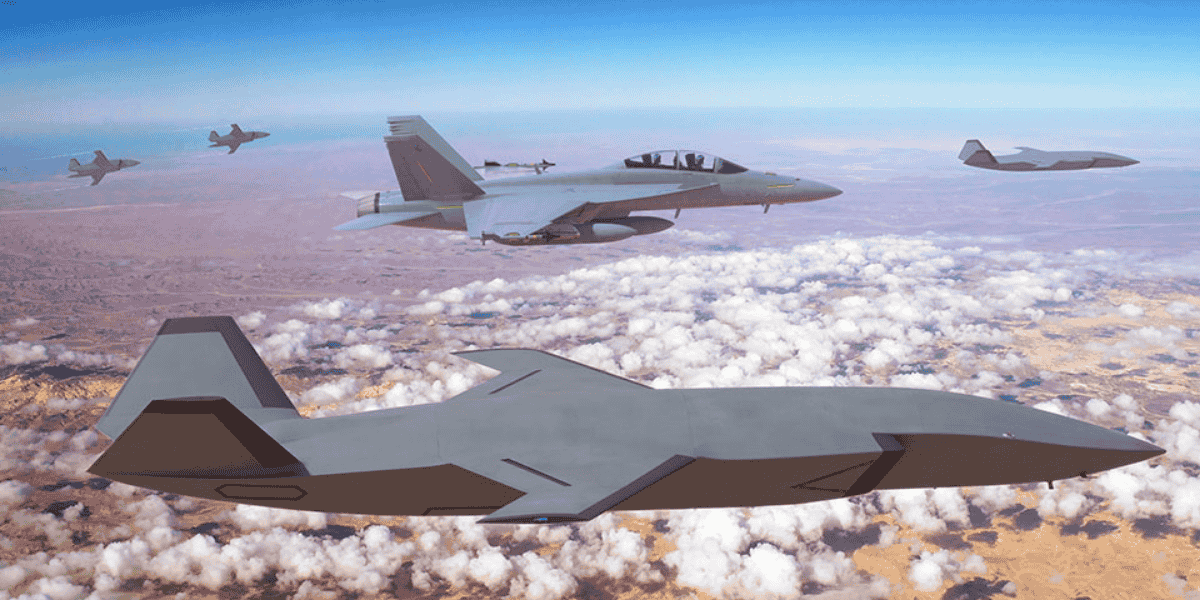
At the same webinar, however, General Schneider indicated that the US military may not deploy CCAs in the Pacific or elsewhere for a few years.
“I am somewhat trapped in the present and the here and now,” Schneider stated when asked how PACAF is laying the groundwork for the incorporation of the next-generation drones into its forces. “My sight picture is from today to about three to five years in the future. And where CCAs are sitting right now in terms of their development, that’s kind of the edge of my radar scope. But Headquarters Air Force is thinking long and hard about this, and especially as they look at future design for the US Air Force.”
Nevertheless, the comments come as a direct endorsement for the Ghost Bat at a time when Boeing is pushing to secure new export orders for the drone, and has proposed setting up new production facilities in more countries as part of that effort.
“I think we’d rather have many smaller factories building them, localized for countries to meet their own local needs, than having one mega factory,” Glen Ferguson, MQ-28 global program director, said during a press briefing last week.
What Do We Know About The MQ-28 Ghost Bat?
The MQ-28 is a stealthy, Artificial Intelligence (AI)-driven drone designed for intelligence, surveillance, reconnaissance (ISR), electronic warfare (EW), and strike roles. It has a range of about 3,700 kilometers and an endurance of over 10 hours, and is harder to detect due to its low radar cross-section.
The MQ-28 can conduct ISR (Intelligence, Surveillance, and Reconnaissance) operations, gathering real-time data and interfering with enemy communications, radar, and defense systems. At the same time, however, it can also deliver precise strikes against enemy targets or serve as decoys to attract enemy fire and aid the defense of manned aircraft.
Earlier, the Ghost Bat successfully completed a live-fire demonstration, firing an AIM-120 AMRAAM missile at an uncrewed target drone.
The MQ-28’s integrated artificial intelligence (AI) and autonomous capabilities enable it to fly autonomously and adapt to changing combat conditions, unlike conventional drones that require constant pilot “remote control,” as previously explained by the EurAsian Times.
Teaming up with crewed fighters, like any other CCA, the MQ-28 could extend the sensor envelope for early threat detection and carry electronic warfare payloads on contested battlefields.
Furthermore, it significantly reduces the risk to expensive manned platforms and functions as a force multiplier in aerial combat. MQ-28-like CCA drones could assume higher-risk roles, such as penetrating deeper into contested areas, drawing fire, or lingering in threat zones, allowing the crew of manned jets to remain safer in combat.
The Block 1 and Block 2 variants of the drone have completed more than 150 test flights in Australia and the US, making the Ghost Bat one of the most mature CCA technologies in the world. Last month, the upgraded MQ-28, the Block 3, was unveiled with 25% larger wings and internal armament bays that make it stealthier.
- Contact the author at sakshi.tiwari13 (at) outlook.com
- Follow EurAsian Times on Google News