Amid the ongoing US-Iran stalemate over Tehran’s nuclear program, a sobering new report from the Stockholm International Peace Research Institute (SIPRI) highlights a broader and more dangerous global trend. According to the SIPRI Yearbook 2026, all nine nuclear-armed states — the United States, Russia, the United Kingdom, France, China, India, Pakistan, North Korea, and Israel — continued ambitious programs to modernize and expand their nuclear arsenals throughout 2025.
Most of them went further by deploying new nuclear-armed or nuclear-capable weapon systems during the year, signaling a renewed global arms race even as diplomatic efforts to prevent proliferation falter. This relentless modernization drive comes at a time when the total global inventory stands at approximately 12,187 nuclear warheads, with nearly 9,745 considered potentially operational.
Meanwhile, the nuclear race is particularly heating up in Asia, where all five nuclear-armed countries – Russia, China, India, North Korea, and Pakistan – have either added new nuclear warheads, deployed additional nuclear warheads on missiles, modernized their nuclear inventory, and are developing new delivery systems and accumulating fissile material in 2025.
In fact, all net additions to the global nuclear stockpile in 2025 came from just four countries — Russia, China, India, and North Korea — while the arsenals of the United States, United Kingdom, France, and Israel remained essentially unchanged.
Meanwhile, according to the SIPRI report, while Pakistan did not add new nuclear warheads in 2025, it “continued to develop new delivery systems and accumulate fissile material in 2025, suggesting that its nuclear arsenal might expand over the coming decade.”
Therefore, nuclear rivalry is also intensifying in South Asia — a region analysts have long described as the world’s most dangerous nuclear flashpoint.
Pakistan’s rapidly expanding nuclear arsenal poses serious risks not only to stability in South Asia and beyond, but also to the global nuclear non-proliferation regime.
For years, Pakistan operated an extensive nuclear smuggling network that assisted countries such as Libya, North Korea, and Iran in their covert nuclear programs. It remains perhaps the only nuclear-armed state that routinely issues nuclear threats.
Pakistan faces a unique set of challenges among nuclear-armed states: its long-standing state sponsorship of terrorist groups, using terrorism as an instrument of foreign policy, combined with deteriorating internal security and rising religious radicalism, makes a heady and highly dangerous cocktail that raises profound concerns about the safety and security of its nuclear arsenal.
In 2025, the world witnessed how Pakistan’s long-standing policy of using terrorism as an instrument of foreign policy triggered a brief but dangerous four-day war with India.
The conflict in May 2025 also established that a war can be fought between two nuclear-armed countries below the nuclear threshold; however, analysts suggest that a conventional war could escalate to nuclear war anytime if not properly handled.
“At the same time, world events—not least the outbreak of conflict between nuclear-armed India and Pakistan—are challenging nuclear deterrence logic,” the SIPRI report notes.
Pakistan has, since the May 2025 war with India, repeatedly warned from multiple platforms that if its sovereignty is threatened, it will not hesitate to use nuclear weapons. In such a scenario, Pakistan’s aggressive pursuit of new nuclear delivery systems and additional fissile material does not merely threaten India; it poses a serious risk to global security and the future of the nuclear non-proliferation regime.
SIPRI Warns Of Rising Nuclear Warheads
Since the end of the Cold War, the gradual dismantlement of retired warheads by Russia and the USA has normally outstripped the deployment of new warheads, resulting in an overall year-on-year decrease in the global inventory of nuclear weapons.
This trend is likely to be reversed in the coming years, as the pace of dismantlement is slowing, while the deployment of new nuclear weapons is accelerating, the SIPRI report warns.
According to the report, in 2025, Russia added 91 new nuclear warheads to its arsenal and remains the country with the world’s largest nuclear stockpile.
Russia currently has 4400 nuclear warheads.
The US is second with 3700 nuclear warheads, but it added no new nuclear weapons to its arsenal in 2025.
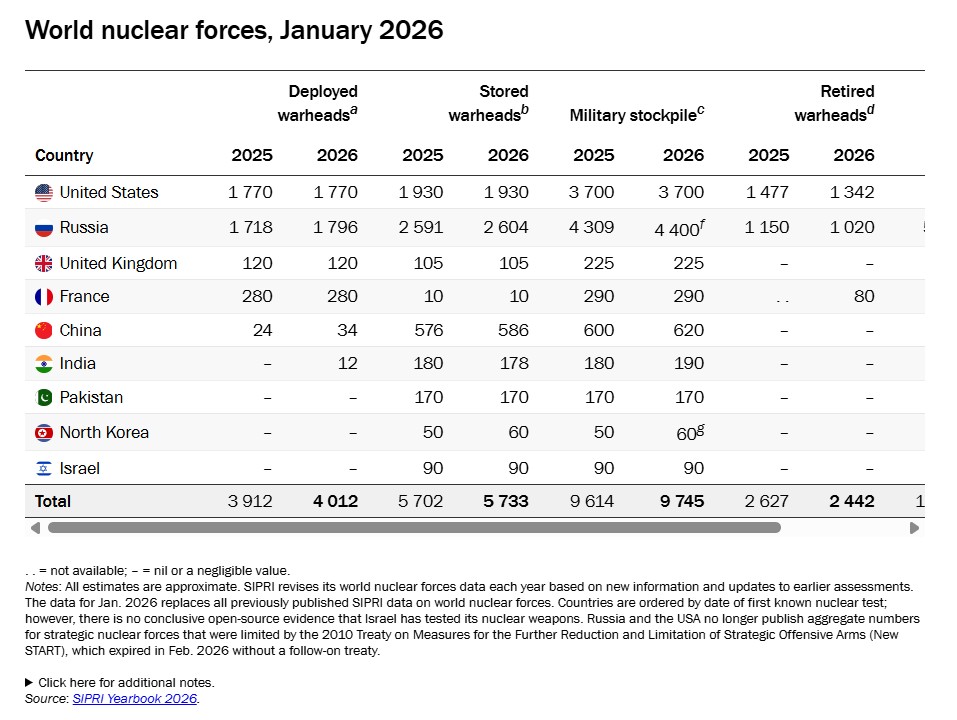
China is third with 620 nuclear warheads. Beijing added 20 nuclear weapons to its arsenal in 2025.
France is fourth with 290 nuclear warheads, and the UK is fifth with 225 nuclear weapons.
India is sixth with 190 nuclear warheads, and it added 20 weapons to its stockpile in 2025.
Pakistan is seventh with 170 nuclear warheads.
Israel is eighth with 90 nuclear warheads, and North Korea is ninth with 60 nuclear warheads. North Korea also added 10 new nuclear weapons to its arsenal in 2025.
Overall, 141 new nuclear warheads were added to the global stockpile in 2025, which now stands at 9,745 nuclear weapons.
Ironically, the world’s largest nuclear power, Russia, also added more than half of these 141 new nuclear weapons in 2025.
Though Pakistan did not add any new nuclear warheads to its stockpile in 2025, Islamabad is still making consistent efforts to develop new delivery systems and has accumulated more fissile material in 2025.
Pakistan maintains an estimated nuclear arsenal of approximately 170 warheads. This number has remained stable since around 2023–2024, according to the Bulletin of the Atomic Scientists (2025) and SIPRI estimates.
However, its arsenal could grow to around 200 warheads by the late 2020s if current trends in fissile material production continue.
“Pakistan continues to slowly modernize its nuclear arsenal with improved and new delivery systems, and a growing fissile material production industry. Analysis of commercial satellite images of construction at Pakistani army garrisons and air force bases shows what appear to be newer launchers and facilities that might be related to Pakistan’s nuclear forces,” the Bulletin of the Atomic Scientists said in its report in 2025.
Pakistan’s program is focused on “full-spectrum deterrence,” a posture that includes both strategic and tactical (low-yield) nuclear options.
Notably, Pakistan is also working on a credible nuclear triad.
India completed its nuclear triad in November 2018, and since Pakistan’s nuclear program is mostly “India-centric,” Islamabad believes that its nuclear deterrence vis-à-vis New Delhi will not be fully credible unless it also achieves a nuclear triad.
A nuclear triad consists of three legs: land-based, air-delivered, and sea-based systems for survivable second-strike capability.
Pakistan currently has an active and operational land and air-based nuclear delivery system.
The F-16 combat aircraft, along with some Mirage III and V aircraft, are believed to be dual-capable (capable of both conventional and nuclear strikes) and constitute the air component of Pakistan’s nuclear force.
Pakistan has approximately 36 warheads for the nuclear air branch. The F-16 A/B has about 24 launchers and a range of 1,600 kilometers (km), while the Mirage III/V has approximately 12 launchers and a range of 2,100 km.
A new, highly accurate air-launched cruise missile, the Ra’ad, has a range of 350+km.
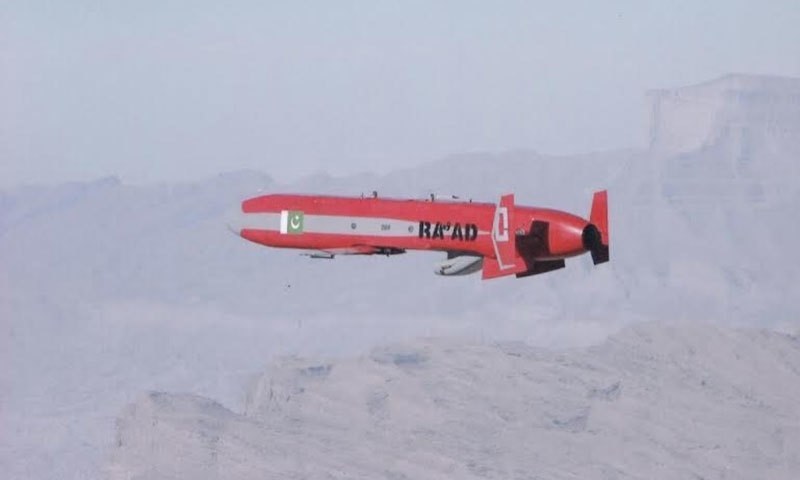
The Ra’ad (military designation Hatf-VIII) is a subsonic, standoff air-launched cruise missile. It is designed to deliver both conventional and nuclear warheads to an operational range of up to 350 km.
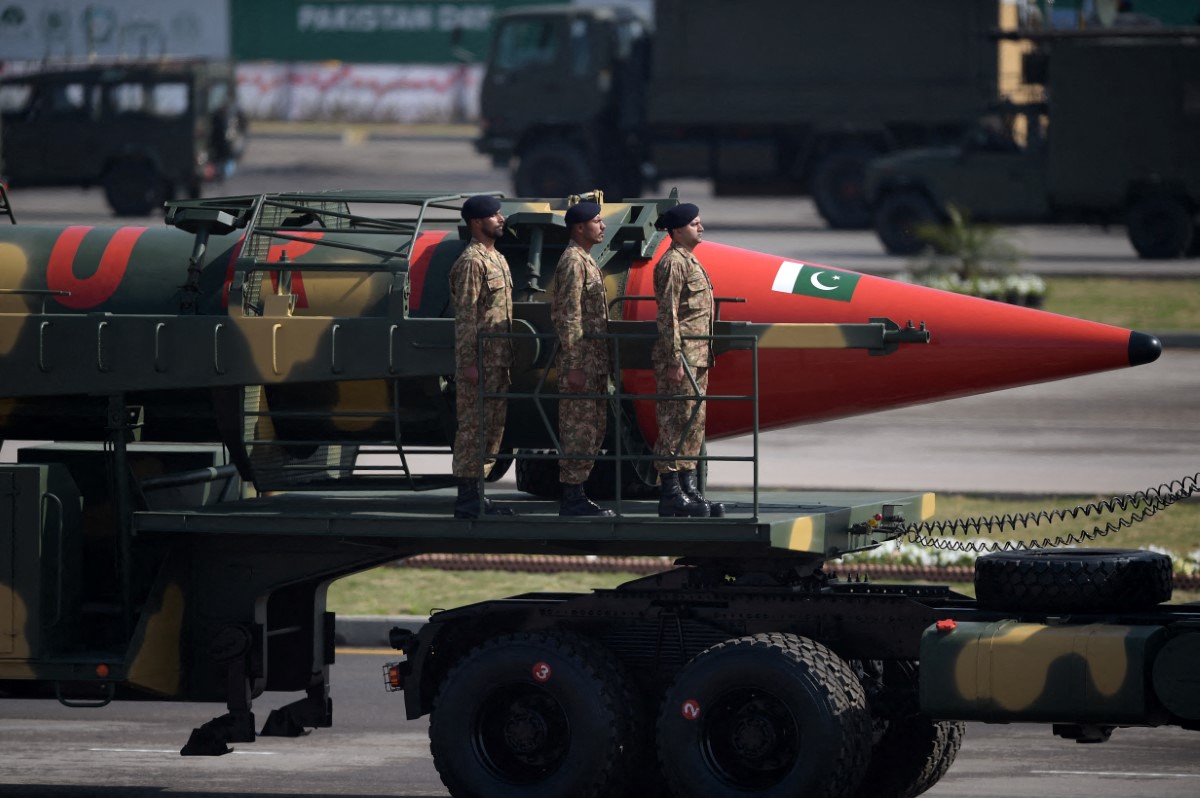
The ground arsenal consists of approximately 102 land-based missiles with yields ranging from 5 to 40 kt. Pakistan is in possession of several nuclear-capable, road-mobile ballistic missiles, including the short-range Abdali, Ghaznavi, Shaheen-1, NASR, and medium-range Shaheen-2 and Ghauri. Pakistan has 6 operational nuclear-capable ballistic missiles.
Pakistan’s longest-range operational nuclear-capable ballistic missile, Shaheen III, has a range of 2,750 km.
Pakistan is also developing the Ababeel medium-range ballistic missile (MRBM), believed to have multiple independently targetable reentry vehicle (MIRV) capabilities.
Notably, Pakistan’s long-range ballistic missile program has also caused concern in the US.
In December 2024, the U.S. Department of State announced the imposition of sanctions on Pakistan’s National Development Complex (NDC), which “has worked to acquire items in furtherance of Pakistan’s long-range ballistic missile program.” The State Department also imposed sanctions on three other Pakistani entities that supply the NDC with items and equipment for the program.
According to the US State Department, Pakistan continues to develop increasingly sophisticated missile technology that provides its military the means to develop missile systems with the capability to strike targets beyond South Asia and, if these trends continue, Intercontinental Ballistic Missiles (ICBMs) that would threaten the United States.
Pakistan is also working toward a sea-based deterrent and has successfully tested a nuclear-capable submarine-launched cruise missile from a submerged platform twice, once in January 2017 and again in March 2018. Once this missile is fully developed and tested on board a submarine, Pakistan will have a nuclear triad, with air, sea, and land capabilities.
However, even more worrying is Pakistan’s pursuit of tactical nuclear weapons.
Pakistan’s development of these non-strategic nuclear weapons has been criticized as destabilizing for severely lowering the nuclear-use threshold.
Pakistan has developed the NASR (Hatf-9) ballistic missile, which, with a range of just 60-70 km, cannot hit strategic targets in India. The new weapon has been tested using a road-mobile launcher and is thought to have been created for combating conventional Indian forces.
According to this doctrine, if India invades Pakistan, and Islamabad is unable to resist through conventional force, it could use low-yield nuclear weapons through the use of short-range missiles such as NASR.
By deploying battlefield-ready options, Pakistan has effectively brought the nuclear threshold down to the tactical level.
Meanwhile, India’s official nuclear doctrine dictates that any nuclear strike, including the use of tactical nuclear weapons, will trigger massive retaliation designed to inflict unacceptable damage to the attacking nation.
New Delhi’s stance is that any use of a nuclear weapon is a strategic strike, irrespective of yield or the territory on which it is detonated. Pakistan’s flirtation with tactical nuclear weapons, therefore, could trigger a full-blown nuclear response from India.
- Sumit Ahlawat has over a decade of experience in news media. He has worked with Press Trust of India, Times Now, Zee News, Economic Times, and Microsoft News. He holds a Master’s Degree in International Media and Modern History from the University of Sheffield, UK.
- This is an Opinion Article. Views Personal of the Author
- He can be reached at ahlawat.sumit85 (at) gmail.com