

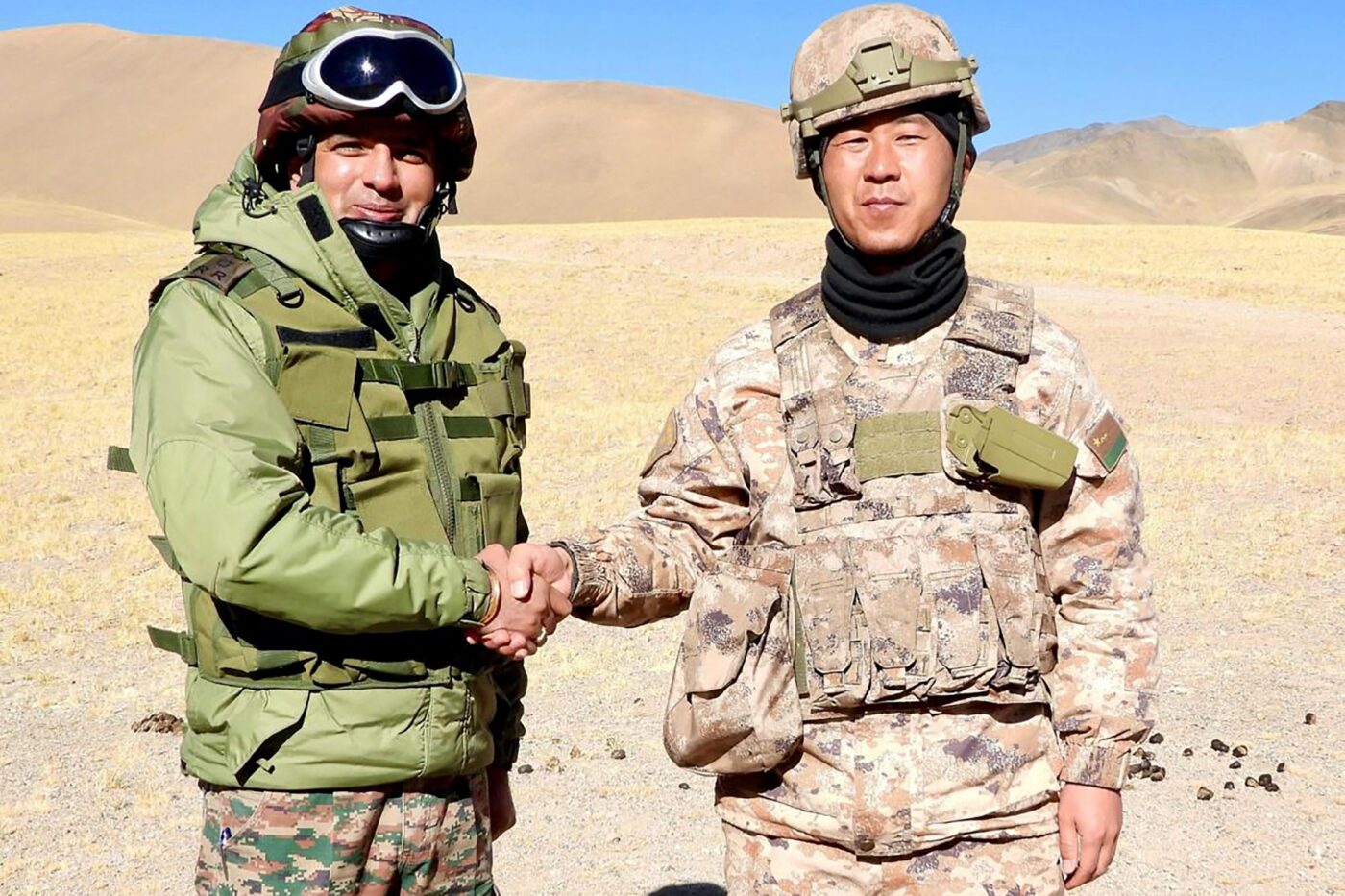
On October 22, India’s Indo-Tibetan Border Police (ITBP) chief, Shatrujeet Singh Kapoor, stated while addressing ITBP personnel in Alwar, Rajasthan, that the threat from China continues to persist. He said there had been face-offs between Indian and Chinese troops at several locations in Arunachal Pradesh in the preceding days, and that these were continuing.
Kapoor stressed that conventional military methods alone would not suffice against China, given the People’s Liberation Army’s extensive modernization. He called for stronger drone and anti-drone capabilities.
The ITBP chief’s call for stronger drone and anti-drone capabilities needs to be viewed in the correct perspective. Media coverage of military threats tends to focus on an adversary’s high-value weapon systems—ballistic and cruise missiles, fighter aircraft, bombers, warships and tanks. These systems are conspicuous, expensive and relatively easy to identify, quantify and assess in terms of their capabilities and the threats they pose.
The threat from drones, however, is fundamentally different and often underappreciated. Their low cost, small signatures, ease of deployment, and the difficulty of reliably detecting, identifying, and tracking them make the threat particularly hard to assess.
Drone Evolution
Drone warfare has evolved rapidly since the start of the war in Ukraine in February 2022.
Initially, small drones were widely deployed for short-range reconnaissance and attack, including as loitering munitions. Their range was often limited by their dependence on line-of-sight communications and control.
Ukraine and Russia also fielded medium-altitude, long-endurance (MALE) drones, which provided reconnaissance and strike capabilities broadly analogous to those of close air support aircraft.
However, their effectiveness depends inversely on the strength of the adversary’s air defenses. As a result, both sides have increasingly relied on these drones for reconnaissance and target acquisition, rather than operating them freely in heavily defended airspace.
Drone warfare capabilities have improved significantly since the start of the war through advances in propulsion, navigation, communications and machine vision. The evolution from short-range reconnaissance and attack drones to low-cost, long-range precision-strike systems has created a capability that, in some missions, can compete with that of cruise missiles.
Propulsion
Initially, many drones relied on internal combustion engines, which could be noisy, while smaller electric drones offered quieter operation but generally had more limited range and endurance.
Advances in battery technology have improved electric propulsion, although energy storage remains a constraint.
The development and wider availability of relatively low-cost jet engines have enabled some drones to fly at high speeds and altitudes over long distances, potentially complicating ground-based detection and interception.
Communication
Line-of-sight communications remain important, particularly for smaller drones. Their limitations can be mitigated through relay systems and mesh networking, while satellite links can extend communications beyond the radio horizon.
Geostationary satellite links generally have higher latency than low-Earth-orbit (LEO) satellite links, which can provide lower-latency communications. Together with improved networking, these technologies have expanded the scope for remote piloting and long-range operations. However, communications remain vulnerable to jamming and disruption.
Navigation and Precision Attack
Drones have traditionally relied on satellite navigation (SatNav) and other navigation methods to reach their targets. SatNav is vulnerable to jamming and can become unreliable in contested environments. A significant advance has been the development of AI-enabled terrain matching and machine vision, which allow drones to navigate using terrain features and visual cues rather than relying solely on satellite signals.
Machine vision has also improved precision-strike capabilities through target identification. Meanwhile, advances in counter-drone technologies have helped shape the evolution of strike drones, driving the development of systems designed to overcome increasingly sophisticated defenses.
Drone Development Cycle
Drone development and operational fielding cycles are considerably shorter than those of manned aircraft and helicopters.
Lower development costs and shorter timelines allow drone warfare to evolve rapidly in response to battlefield conditions. Drone designs and capabilities can be tailored to the specific challenges of a battlefield and the objectives of a particular campaign.
The design and capabilities of attack drones depend on the targets they are intended to engage. Attacking bridges, troop concentrations, moving road vehicles, or logistical storage facilities presents different operational requirements and calls for different drone capabilities. These requirements must also account for the counter-UAS systems deployed by the adversary.
The same principle applies to drone interceptors: their capabilities must match the threats they are designed to counter. For instance, countering high-speed, jet-powered attack drones may require equally fast, jet-powered interceptors, although other interception methods may also be effective.
Both the targets to be attacked and the capabilities of the adversary vary from one conflict to another. Consequently, drone development is driven by the specific operational requirements of each battlefield and the continuing interaction between attack drones and the defenses designed to defeat them.
Drone Warfare Enabling Technologies
A formidable drone warfare capability cannot be built merely by developing drones with impressive specifications. It requires drones whose capabilities are tailored to specific targets and tactical scenarios. For example, interdicting road supply lines requires drones that can identify and engage moving supply trucks while distinguishing them from other vehicles. Such drones may be unsuitable for attacking bridges.
The key is to master the enabling technologies that allow drones to perform specific tasks.
These broadly encompass five areas:
Propulsion: Low-cost, efficient engines for the required combination of speed, range, and endurance.
Communication: Resilient, low-latency communications, including LEO satellite links, for responsive remote piloting and target engagement.
Navigation: AI-enabled machine vision and terrain matching for navigation that does not depend solely on satellite navigation (SatNav).
Precision attack: Machine vision and target recognition for accurate engagement of intended targets.
Warheads: Payloads tailored to the intended targets and desired effects.
A nation cannot become a leader in drone warfare simply by developing drones. It must master these enabling technologies and continuously improve them to meet evolving battlefield requirements.
India’s mastery of drone-warfare enabling technologies remains limited in several critical areas, particularly when compared with China’s industrial scale and technological capabilities.
The Chinese Threat
China has substantial capabilities in many of the enabling technologies discussed above. More importantly, it has a formidable drone-component manufacturing ecosystem spanning electric motors, flight controllers, sensors, machine vision, navigation and communications modules, as well as drone propulsion.
Its experience with mesh networking can support low-latency drone control and coordination. China is also developing large-scale LEO satellite constellations, although their specific contribution to military drone operations should not be assumed without further evidence.
China could potentially develop and field drones tailored to exploit specific vulnerabilities in Indian Army capabilities or tactics within relatively short periods. It could also adapt its systems to counter tactical innovations introduced by Indian forces.
Along the border, China’s industrial capacity could enable it to manufacture and field drones in large numbers, threatening Indian troop movements by day and night. Supply lines, radars, tanks and artillery could all face persistent drone attacks.
Without comparable capabilities, the Indian Army would risk losing operational ground.
Long-range precision strikes by Chinese drones could also threaten IAF airbases, radars, air-defense units and logistics bases, potentially degrading India’s ability and willingness to sustain a prolonged conflict.
If this scenario seems overstated, consider how Russia, despite possessing a formidable layered air-defense network, has struggled to prevent Ukraine’s sustained drone attacks.
Ukrainian long-range strikes have benefited from intelligence, surveillance and reconnaissance (ISR) support, including Western assistance. Satellite communications, including Starlink, have also played a role in some Ukrainian drone operations.
China possesses substantial ISR and communications capabilities of its own, although their effectiveness in a conflict along the Indian border would depend on operational conditions and the resilience of the systems involved.
Given India’s resource constraints and technological gaps, it could struggle to withstand a sustained, large-scale Chinese drone campaign unless it develops comparable capabilities in drone production, deployment, and counter-drone warfare.
- Vijainder K Thakur is a retired IAF Jaguar pilot, author, software architect, entrepreneur, and military analyst.
- Views Personal of the Author
- Follow the author @vkthakur