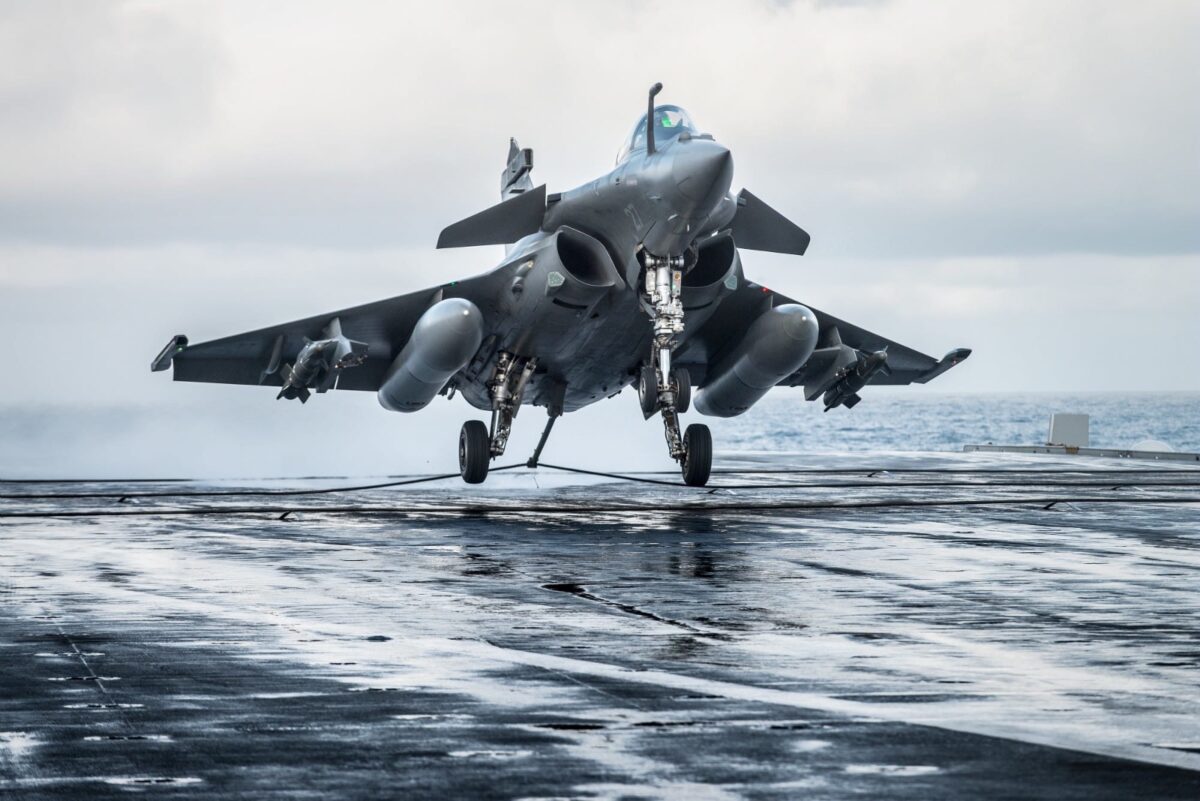
The Indian Navy is conducting trials of the French Dassault Rafale-M, the naval aircraft that edged out the American F/A-18E/F Super Hornet in a tight contest.
Interestingly, the Indian Navy already operates a substantial number of American platforms. Against that backdrop, Boeing had expected to secure yet another major Indian contract.
Why did the French Rafale-M ultimately edge out the Super Hornets?
In April 2025, India ordered 26 Rafale Marines to replace the Russian-origin MiG-29K, which currently operates from Indian aircraft carriers– INS Vikramaditya and INS Vikrant.
More than a year after signing the contract, the Indian Navy is running Rafale-M trials at the Shore-Based Test Facility (SBTF) at INS Hansa in Goa and is reportedly considering some minor modifications to its aircraft carriers to accommodate the French aircraft.
According to the reports, the service is considering these small modifications because the Rafale-M fighters were originally designed to operate from CATOBAR (Catapult Assisted Take-Off But Arrested Recovery) carriers—such as the French carrier Charles de Gaulle—whereas Indian carriers use a Short Take-Off But Arrested Recovery (STOBAR) system.
Additionally, the Rafale-M has a wingspan of almost 10.9 meters, and unlike the MiG-29K, it is not designed to fold its wings to take up less space on the deck. This creates a larger deck or hangar footprint. So, the Navy is purportedly examining minor procedural workarounds, such as temporarily detaching the wingtip missile launch rails to reduce the effective span to roughly 9.6 meters, along with handling and stowage adjustments.
Rafale-M deliveries are expected to begin in 2028 and likely conclude by 2030, marking the first time in a decade that the Indian Navy will operate a non-Russian or Western fighter. Its last Western carrier fighter was the British Sea Harrier aircraft, which it retired in 2016 after more than three decades of service.
Notably, the Indian Navy has operated French equipment before, though never on this scale.
Earlier, it acquired 12 Breguet Alizé carrier-based anti-submarine warfare (ASW) aircraft that participated in the 1961 Goa operations and the 1971 Indo-Pakistani War and served the Navy until 1991. The service has also operated the HAL Chetak, a French-designed light utility helicopter produced in India for decades, though it is now being phased out in favor of more advanced indigenous aircraft.
By contrast, the Indian Navy operates a range of US-origin equipment, from helicopters to spy aircraft, making the choice of a French carrier-based jet particularly interesting.
Indian Navy: Full of US-Origin Weapon Systems
Despite the push for indigenization, the Indian Navy has steadily acquired American platforms and weapons over the past few decades.
One of the most important items on this list is the P-8I Poseidon maritime surveillance aircraft. India first ordered eight P-8I aircraft in January 2009, becoming the type’s first international customer.
It signed a follow-on order for four additional aircraft in 2016, significantly enhancing its maritime surveillance, anti-submarine warfare, and ISR capabilities and positioning it as a critical asset in the Indian Ocean Region. In February 2026, the Defense Acquisition Council (DAC) officially cleared an additional P-8I purchase.
In addition to the Poseidon, the Indian Navy ordered 24 MH-60R Seahawk Multi-mission naval helicopters in February 2020. It has since received 21, and the rest are expected to arrive in 2027. These helicopters can conduct anti-submarine warfare, anti-surface warfare, shipborne multi-role operations, and networked operations, arming the Navy with the capability to detect and neutralize underwater and surface threats in the Indian Ocean.
The Navy has also leased two MQ-9B Sea Guardian drones from US-based General Atomics since 2020. It is supplementing these by leasing two more as per a contract signed in August 2026. These drones have supported maritime surveillance and intelligence, surveillance, and reconnaissance (ISR) missions in the Indian Ocean Region, complementing the Navy’s P-8I and helping maintain vigilance.
India also signed a $3.3 billion deal with the US in October 2024 to acquire 31 MQ-9B High-Altitude Long-Endurance UAVs. Of the 31 Sea Guardians the MoD purchased, the Indian Navy will receive 15 drones, while the Indian Army and the Indian Air Force will each receive 8 to strengthen surveillance along the northern and western borders.
The Indian Navy operates one US-acquired INS Jalashwa (the former USS Trenton), an Austin-class amphibious transport dock with a sealift capability for over 3,500 troops and a squadron of armored vehicles.
Furthermore, the service has also acquired several lethal US munitions over the years, including the AGM-84 Harpoon Block II anti-ship missile, Mk 54 lightweight torpedoes, and the AGM-114 Hellfire, to name just a few.
Despite these rather high-value acquisitions, the Indian Navy has never purchased or operated an American fighter jet. When it finally got the chance to buy a US aircraft, i.e., the F/A-18E/F Super Hornet, the service chose the Rafale-M instead.
Why did India Opt For Rafales over Super Hornets?
When India opened the contest for a carrier-based fighter to replace the MiG-29K jets, Boeing offered its F/A-18E/F Super Hornet Block III.
In 2022, Boeing India marketed the F/A-18 Super Hornet Block III as a carrier-based fighter designed for high-load, high-stress operations, and stressed that the multi-role naval fighter would be fully compatible with Indian Navy carriers.
Boeing pitched the Super Hornet as a jet that required minimal support equipment and had a remarkably low cost per flight hour while maintaining high mission readiness. It tried to woo the Indian Navy by emphasizing that the aircraft would become a force multiplier because it could interface with the P-8I and other US-origin systems the service operates.
To sweeten the deal, Boeing also announced a roadmap to significantly increase its investments in line with the “Make in India” initiative and pledged to transfer cutting-edge technologies to Indian industry if the Super Hornet was selected.
However, the Super Hornet had to dogfight with the French Rafale, a cutting-edge fighter for India’s carrier-borne aircraft tender.
In a tightly fought contest, both jets underwent extensive testing at a shore-based facility, including take-off trials from both ski-jump and catapult launchers. Both aircraft reportedly met the Indian Navy’s requirements, but the Rafale-M ultimately won.
Speaking to the EurAsian Times earlier, an ex-Indian Navy pilot who had flown both the Super Hornet and Rafale said both aircraft were extremely capable and on a level playing field. “The only issue I can think of is that the F-18 is a heavier aircraft, and the Rafale M is lighter. So, when it comes to arrested landing on the aircraft carrier, Rafale has more flexibility,” the naval aviator said at the time, requesting anonymity.

The Rafale-M shared a very high degree of commonality with the 36 Rafale jets operated by the Indian Air Force (IAF). This meant several parts, tools, and test equipment could be interchanged, and India could share ground-support systems, simulators, and diagnostic software.
Additionally, India had already established maintenance infrastructure, trained technicians, and supply chains for the IAF Rafales, which could support the Rafale-Ms.
The Navy would have assessed that Rafale-Ms would reduce costs by creating an inventory of maintenance facilities, spare parts, logistics, and potential future overhauls. Meanwhile, introducing the Super Hornet would require building an entirely separate support ecosystem.
In this scenario, the air force can familiarize itself with the Marine aircraft, while naval pilots can transition to the IAF’s twin-seat Rafales.
The IAF is now poised to acquire 114 Rafale multi-role fighters, most of which will be manufactured locally. Therefore, one could argue that the decision to choose French jets for the Indian Navy may have been driven by the need for uniformity and interoperability, which are crucial in fast-paced conflict zones.
A secondary factor could have been the Infrared Search and Track (IRST) system, which provides a stealthy advantage in detecting and engaging threats, including potential low-observable aircraft. The Rafale-M came with an integrated IRST, whereas the Super Hornet Block III lacked one, although Boeing offered a podded solution.
Moreover, the Meteor beyond-visual-range air-to-air missile on the Rafale also offered superior standoff capability compared to the Super Hornet’s AIM-120 AMRAAM.
More importantly, however, strong defense ties between India and France, smoother government-to-government negotiations even in past deals, the potential for indigenous weapons integration, and the presence of French fighter jets in the IAF played a crucial role in the decision.
India has never acquired US fighter jets for several reasons, including export controls and restrictions on their use.
Despite its best efforts to market the Block III jet to potential customers such as Canada, Finland, Germany, Poland, and Switzerland, Boeing failed to secure any new contracts and kept losing out to rivals such as Saab Gripen, Dassault Rafale, and the Lockheed Martin F-35.
- Contact the author at sakshi.tiwari13 (at) outlook.com
- Follow EurAsian Times on Google News