What’s in a landing at the roof of the world? Everything – when it’s the first of its kind at 16,614 feet.
In one unforgettable moment, the Lockheed Martin C-130J Super Hercules didn’t just touch down on the world’s highest airstrip. It proved its unmatched capabilities in the harshest conditions imaginable – and turned that feat into one of the most powerful marketing stories in modern military aviation.
The C-130J Super Hercules is already one of the most successful military transport aircraft ever built. Lockheed Martin has delivered more than 560 aircraft to 27 countries, with the global fleet logging over three million flight hours across every imaginable mission.
However, one particular C-130J landing in India more than a decade ago has become iconic and now serves as Lockheed Martin’s best marketing tool.
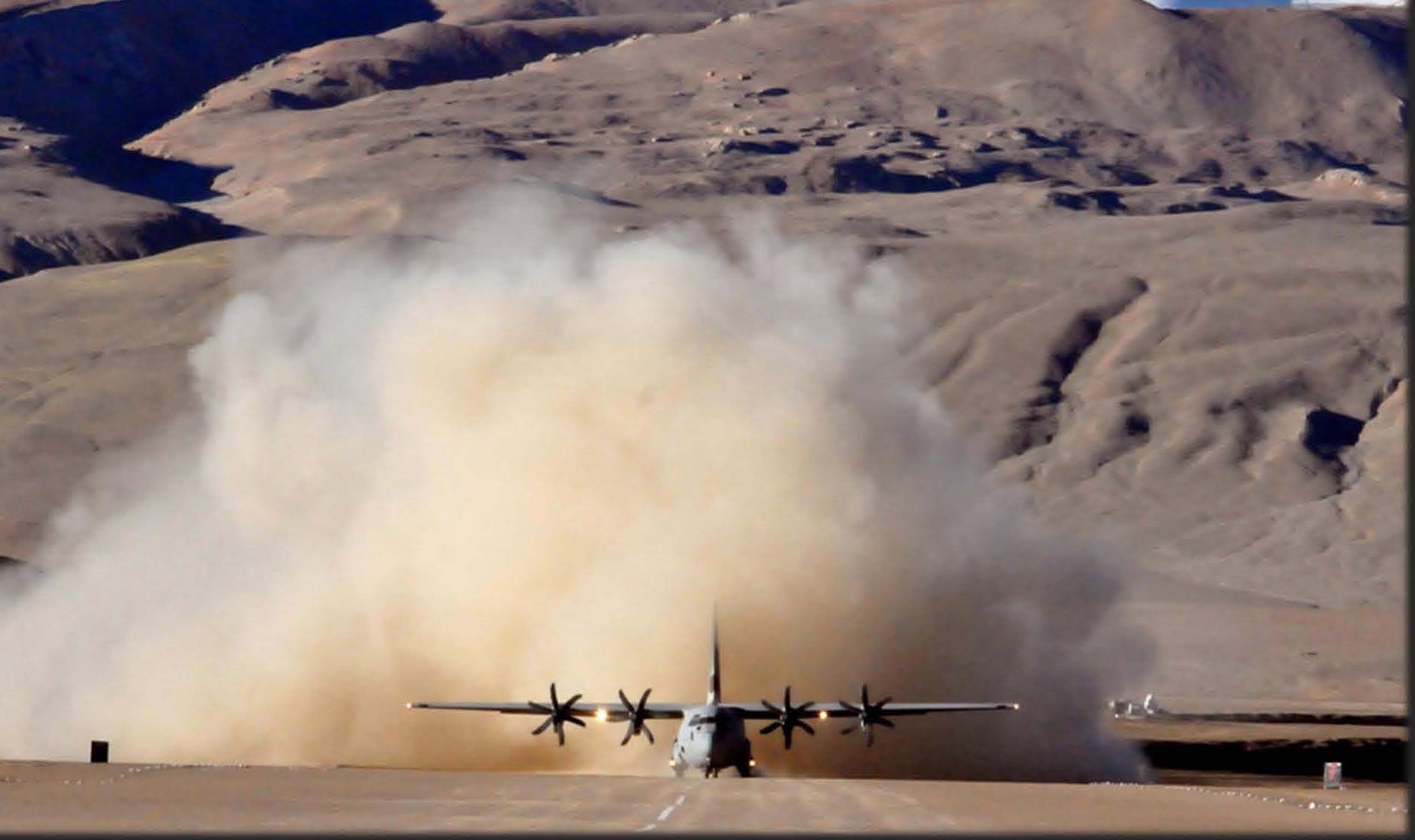
On August 20, 2013, an Indian Air Force (IAF) C-130J achieved something extraordinary: the first landing of a modern medium-lift transport at Daulat Beg Oldi (DBO) airstrip in Ladakh – a remote, unpaved strip perched at 16,614 feet (5,065 meters) in the Karakoram mountains, near the Line of Actual Control with China.
This is the world’s highest air strip, and to land a medium-transport aircraft, weighing more than 45 tonnes, loaded with over 20 tonnes of supplies, on a short, unpaved runway was no mean feat.
No other aircraft in its class had ever done it.
Operating at such extreme altitude, with razor-thin air, unpredictable strong winds, and a short, high-elevation runway, the C-130J demonstrated exceptional short-field performance, power, and reliability.
The mission instantly became iconic, a dramatic showcase of the aircraft’s real-world prowess in adverse conditions that no brochure or sales pitch could ever match.
More than a decade later, that single landing still resonates and still demonstrates to the world what Lockheed Martin’s C-130J war machine could achieve.
That is the power of a single landing at the roof of the world.
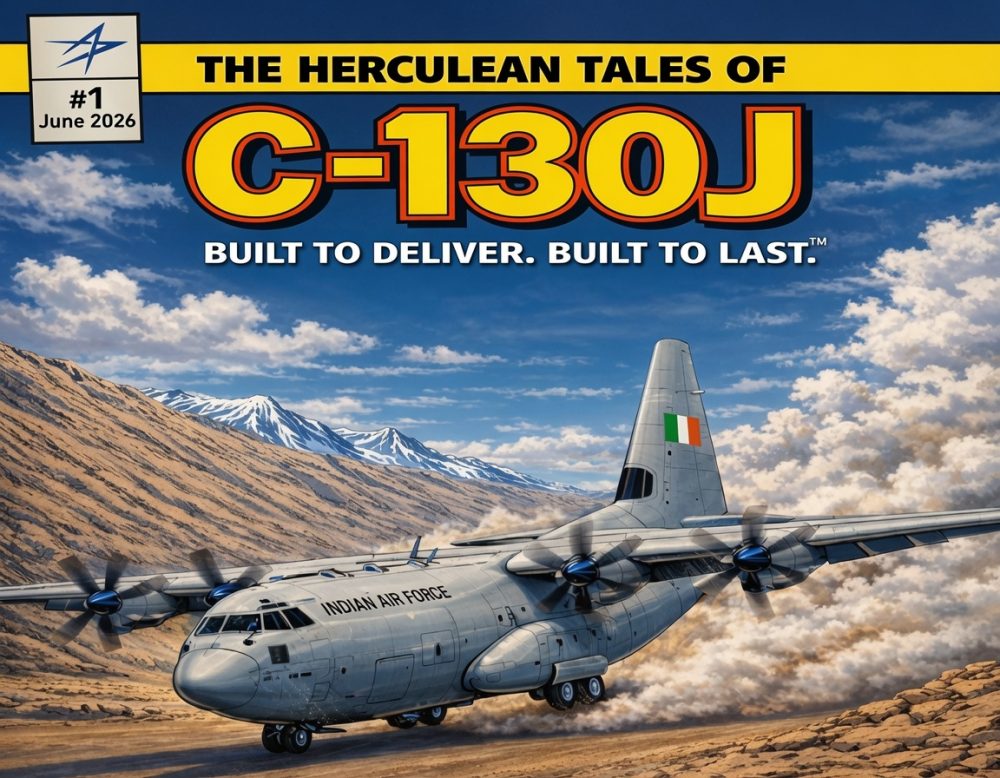
On June 9, Lockheed Martin launched a marketing campaign for the C-130J Super Hercules, and yet again, it turned to the C-130J’s historic landing at DBO airstrip to kick it off.
“We are bringing you tales of the mighty C130J, flying where others don’t, won’t & can’t. Presenting the first edition, where IAF & C-130J set a world record by landing at the highest runway in the world at Daulat Beg Oldie, the company posted on the social media platform X.
However, even 13 years after that historic landing that redefined military aviation, people still do not fully grasp the significance of that landing, the dramatic story that made it happen, and how that landing changed and is still changing the geopolitics of this region.
Daulat Beg Oldie – World’s Highest Air Strip
Daulat Beg Oldie (DBO) is a place in Ladakh named after a 16th-century Yarkandi nobleman who journeyed through the Karakoram Pass, just 17 km away, and perished there. In fact, the name literally means “Daulat Beg Died”.
The DBO is not only the world’s highest airstrip but also holds great military and strategic significance.
It lies next to the Depsang Plains, a place where India and China fought pitched battles in the 1962 war, and where New Delhi and Beijing still have a border dispute.
The area is also in close proximity to the disputed Line of Actual Control (LAC).
The airfield at DBO was commissioned in July 1962, a few months before the Sino-Indian conflict.
The first IAF pilot to land a C-119G Fairchild Packet aircraft at DBO was Squadron Leader C.K.S. Raje, who set a record of sorts. However, an earthquake in 1966 caused instability in the runway surface, leading to the discontinuation of fixed-wing aircraft operations. Helicopters, however, continued to operate to support troops deployed in the forward areas.
The airstrip was reactivated in 2008 after more than four decades, when an Antonov An-32 landed there. However, logistic support by transport aircraft was not sustained thereafter.
Therefore, prior to 2013, aircraft such as the C-119G Packet, the C-47 Dakota, and the An-32 had already landed there. However, none were as big, heavy, or powerful as the C-130J Super Hercules.
The Historic Super Hercules Landing at DBO
In 2008, India signed a Foreign Military Sales (FMS) deal with the US for 6 C-130J aircraft worth US$1.2 billion.
The first aircraft was inducted into the IAF in 2011.
Just two years later, in April 2013, a major 3-week military standoff occurred between Indian and Chinese troops in the Depsang Plains, just 30 km from DBO.
A platoon-sized contingent of the Chinese PLA made an incursion and raised an encampment in the dry river bed of Raki Nala, in the Depsang Bulge area, 30 km south of Daulat Beg Oldi near the LAC.
India not only wanted to resupply its troops stationed there but also to reestablish its deterrence by reactivating the strategic DBO airstrip and sending a clear message of resolve to China.
The airstrip had seen only a limited number of landings by fixed-wing aircraft; however, all of those were light-weight aircraft.
The newly acquired C-130J was a good option, as it could deliver over 20 tonnes of supplies in a single sortie. The C-130J gives the IAF a sixfold increase in deployment capabilities over the An-32 and Mi-17s already deployed to DBO. However, the plane weighed over 45 tonnes when empty.
There were serious security concerns about whether such a heavy aircraft could land on such a short, unpaved, high-altitude airstrip.
The Lockheed Martin campaign highlights these doubts.
Impossible is where the C-130J story begins.💪
We are bringing you tales of the mighty #C130J, flying where others don’t, won’t & can’t.
Presenting the first edition, where @IAF_MCC & C-130J set a world record by landing at the highest runway in the world at #DaulatBegOldie. pic.twitter.com/HkWy4P0pZ8
— Lockheed Martin India (@LMIndiaNews) June 9, 2026
The picture slides show IAF officers in uniform standing in an operations room, looking at a large map of Jammu and Kashmir & Ladakh, highlighting Daulat Beg Oldie.
As an aside, the map shown is significant because it depicts the whole of Aksai Chin (occupied by China) and Pakistan-occupied Kashmir (PoK) as part of Indian territory.
True, the picture depicts an Indian operations room, and therefore, the map used in that room would have shown these parts as Indian territories only. Still, Lockheed Martin could have shown a dotted line to show the parts under Chinese and Pakistani control.
That a US company, which has significant business interests in Pakistan as well, decided against pleasing Islamabad and Beijing.
In the next slide, one IAF officer remarks, “The altitude is brutal. The runway is short. The margin for error is almost zero.”
The next slide shows an IAF C-130J landing on the dusty, unpaved runway at DBO and delivering supplies to troops.
#DYK that the @IAF_MCC performed the highest ever landing of a C-130J at an altitude of 16,614 ft (5000+ meters)?
Anytime and anywhere, the #SuperHerc delivers. 💪 #DefExpo2020 #DefExpoLucknow @DefExpoIndia pic.twitter.com/u9f6T8n2fF
— Lockheed Martin India (@LMIndiaNews) February 6, 2020
The overall message is that the C-130J delivers real capability, not just supplies, at the roof of the world and rewrites possibilities.
On that day, not only was history made, but it also delivered a strong message to China that India will not hold back from committing its frontline aircraft when it comes to protecting its territory in the Depsang plains.
However, even 13 years after that historic landing, many people still do not know the real story behind it, including the fact that, in 2008, the IAF ignored the Indian government’s reluctance to reopen the world’s highest airstrip.
DBO Landing – A Military Decision
The IAF’s requests to the government to reactivate DBO were denied for fear of rubbing China the wrong way. Then Vice Chief of Air Staff, Air Marshal (retd) Pranab Kumar Barbora, studied the IAF’s requests to the Ministry of Defense and decided to land a twin-engine turboprop Antonov An-32 at DBO.
Before arriving at the decision, he consulted the then Chief of Air Staff, Air Chief Marshal Fali Homi Major, and the Army Chief, General Deepak Kapoor.
In an interview with an Indian News Agency, Air Marshal Barbora said: “….now since nothing was done in writing, the government was informed only after I had landed and come back from there and through proper channels. So, the government asked, “Why did you do it?” We said it is my responsibility, the air force’s responsibility, to maintain troops, logistics support, and any kind of emergency troop deployment or weapons deployment…
“…whatever it might be – we can do it now, not using helicopters anymore, it’s by a transport aircraft which can carry much more load and bring backload – so we said it is our…. responsibility as Indian Air Force and it falls within our jurisdiction and Indian territory, so we did it…” The Air Marshal (Retd) further stated, “….we broke the ice and proved a point that we were capable. We surprised the Chinese. Later, in 2013, a four-engine aircraft C-130 Hercules landed there…”
Apart from the muddy strip acting as a landing ground, the biggest issue in landing the aircraft at that height is the elevation. A rarefied atmosphere (thin atmosphere means less oxygen- about 40-45 percent less than that at sea level) means no aircraft has these conditions in its engine and aircraft performance parameters.
Aircraft engines require an ideal combination of oxygen and fuel to perform to the best of their potential. The aircrew cannot switch off the engine with less oxygen, as it won’t restart. After landing, the engine needs to be kept running. DBO airstrip is surrounded by high mountains with an average height of 20-22,000 ft, making it difficult to maneuver an aircraft in this space.
It was the reopening of the DBO airstrip in 2008, after a 43-year gap, that paved the way for the C-130J’s 2013 landing.
It can transport more than 20 tonnes of supplies and more than 100 armed troops to the Depsang plains within hours. India now operates 12 C-130J, operated by two squadrons – the 77 ‘Veiled Vipers’ Squadron at Hindon and the 87′ Wings of Valor’ Squadron at Panagarh in the east.
India, therefore, could transfer over 1,200 troops and nearly 250 tonnes of supplies to its remote Depsang plains in one day if it pressed all its Super Hercules into service.
- Sumit Ahlawat has over a decade of experience in news media. He has worked with Press Trust of India, Times Now, Zee News, Economic Times, and Microsoft News. He holds a Master’s Degree in International Media and Modern History from the University of Sheffield, UK.
- This is an Opinion Article. Views Personal of the Author
- He can be reached at ahlawat.sumit85 (at) gmail.com