A US drone boat rescued two crew members after an AH-64E Apache helicopter went down near the Strait of Hormuz, the US military said on Tuesday.
US Central Command spokesperson Capt. Timothy Hawkins said, “A U.S. Navy surface drone found and rescued the crew from the water. U.S. 5th Fleet’s Task Force 59 is the Navy’s first operational AI and drone task force.”
“The Soldiers were safely rescued within approximately two hours and are in stable condition. The cause of the incident is under investigation,” US Central Command, the military branch responsible for operations in the Middle East, said in a post on X.
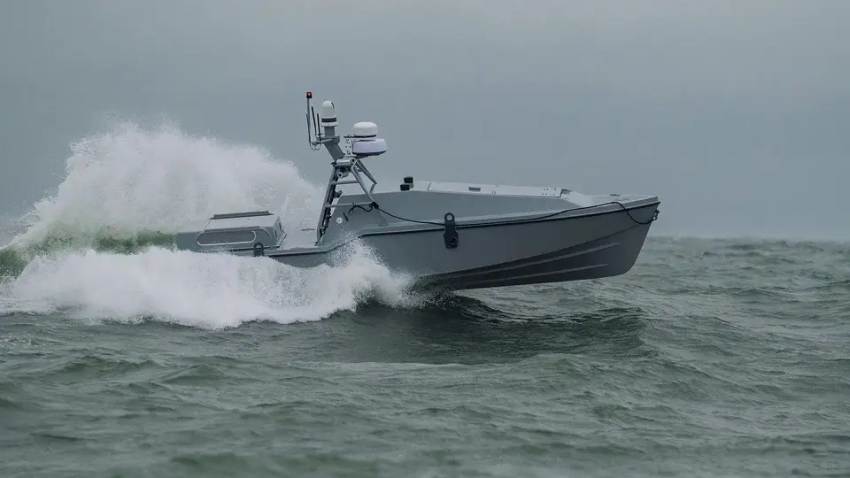
According to WSJ, the unmanned surface vessel — a Saronic Corsair drone boat operated by the U.S. Navy’s Task Force 59 — located the two AH-64E crew members floating in the waters off the coast of Oman.
The entire rescue mission was completed in approximately two hours. This marked the first known instance of an unmanned surface vessel (USV) being used for a rescue mission at sea, showcasing the growing utility of drones.
The Saronic Corsair is a high-speed USV developed by Saronic. Designed for multi-mission operations, the Corsair features a wave-piercing hull, advanced AI-driven autonomy, and a top speed exceeding 35 knots. Equipped with modular payload bays, sophisticated sensors, radar, and communication systems, it can operate independently for extended periods. It reportedly has a range of over 1,000 nautical miles.
Earlier, a United States AH-64 Apache helicopter crashed near the Strait of Hormuz, adding to a string of aircraft losses suffered by the American military in the volatile West Asian region since the start of the Iran War.
While the exact cause of the crash is currently unknown, one of the two sources cited by the NYT said the US military is currently investigating whether the aircraft crashed due to a technical malfunction, was hit by enemy fire, or encountered some other unknown operational trouble.
Meanwhile, speaking to reporters on the runway at John F. Kennedy International Airport, US President Donald Trump said, “The pilots are fine. Nobody injured. We are going to issue a report tomorrow.”
#WATCH | On the US Army's attack helicopter crashing near the Strait of Hormuz, US President Donald J Trump says, "The pilots are fine. Nobody injured. We are going to issue a report tomorrow."
(Source: US Network Pool via Reuters) https://t.co/utTgjXfitT pic.twitter.com/1wob2vHFWj
— ANI (@ANI) June 9, 2026
The latest crash marks the first loss of an Apache since the conflict with Iran began with the US military’s “Operation Epic Fury” in late February. The US Army has extensively used AH-64 Apache attack helicopters to escort commercial shipping and enforce the naval blockade on Iranian ports.
The choppers have conducted patrols, provided visible deterrence, and engaged threats in the volatile region. In May 2026, the AH-64 Apache and the MH-60 Seahawk struck six small Iranian fastboats in the Strait of Hormuz that were allegedly threatening commercial shipping, as the EurAsian Times reported.
One possible cause of the crash could be mechanical failure. An Army investigation earlier revealed that “some AH-64E [improved drive system] main transmissions can experience an internal failure resulting in loss of accessory gearbox drive, which can result in loss of tail rotor thrust, electrical power, and hydraulics,” according to an April internal safety document.
Despite the AH-64 Apache’s strong track record in maritime security and counter-fast boat operations in the region, the loss marks the first AH-64E downed since the start of U.S. Operation Epic Fury in late February 2026.
A US Congress report published last month revealed that about 42 aircraft belonging to the USAF were either destroyed or significantly damaged in the six-week war with Iran. These include assets shot mid-air by Iranian missiles, assets destroyed by drones while still on the tarmac of air bases in the Gulf, and assets lost in friendly fire incidents. The US has lost another Reaper after the war ended, compounding existing losses.
The US lost/damaged about two dozen Reapers, multiple F-15E Strike Eagles, one F-35A, and one A-10 Thunderbolt II, in addition to several KC-135 Stratotankers, one E-3 Sentry (AWACS), MC-130Js, among other aircraft, as earlier reported by the EurAsian Times.
AH-64E Apache Helos Are Formidable War Machines
The Apache is a land-based attack helicopter that has been deployed on missions in CENTCOM over the past few months.
The AH-64E Apache helicopter is described by its manufacturer, Boeing, as “an advanced multi-mission helicopter with the latest technology insertions, maintaining its standing as the world’s best attack helicopter. It is the only available combat helicopter with a spectrum of capabilities for virtually any mission requirement, including greater thrust and lift, joint digital operability, improved survivability, and cognitive decision aiding.”
It is a four-blade, twin-turboshaft helicopter with a nose-mounted sensor suite that simplifies target acquisition. The laser, infrared, and other systems enable the helicopter to locate, track, and attack targets.
The Apache has a 30mm automatic cannon with up to 1,200 high-explosive, dual-purpose rounds, 70mm rockets, and laser-guided precision Hellfire missiles, which could be useful for strafing small boats. It can operate in hostile airspace, confront ground threats, and carry out precise assaults at standoff ranges. The AH-64’s advanced targeting systems and sensors enable day, night, and all-weather missions.
Notably, the Apaches are designed to be “tank killers,” and their Hellfire missiles may precisely hit armored formations in a conflict. However, they are also used for patrol purposes in combat zones, as recently seen in the Middle East.
The NYT report stated that the choppers have been pushing deeper into Iran in an effort to project a more aggressive posture by CENTCOM. They are used for patrolling to detect and shoot down Iranian or proxy drones threatening shipping or US and allied assets. Their sensors, 30mm chain gun, and rockets make them effective in this role.

Notably, the Apaches are capable of performing extended maritime operations, including patrols, deck landings on military vessels, and long-range overwater flights. The US Army has practiced “maritime deep attack” scenarios in the Pacific, particularly in the South China Sea, with an emphasis on anti-surface strikes, island-chain support, and long-range maritime air assault.
With its advanced avionics, including helmet-mounted displays, FLIR/EO targeting, and the Longbow millimeter-wave radar, the AH-64 can detect and engage small, fast-moving surface targets, such as boats, while flying low.
Before the latest incident, two Apaches crashed in March 2026: one during routine training at Fort Rucker (Fort Novosel), Alabama, and another during a training flight at Fort Campbell, Kentucky.
The latest crash may be a setback for the US Army and could have been potentially fatal for its crew, but it does not impact the Apache’s strength or the overall combat potential of this battle-hardened aircraft.
- Contact the author at sakshi.tiwari13 (at) outlook.com
- Follow EurAsian Times on Google News