Japan’s F-2 fighter jets first took to the skies nearly 31 years ago. As EurAsian Times reported, they are heading to India for the first time to participate in the “Veer Guardian 2026” exercise.
Japan Air Self-Defence Force (JASDF) will deploy three F-2 fighter jets along with 110 troops from the Eighth Air Wing based at Tsuiki Airbase in southwestern Japan’s Fukuoka Prefecture to India.
So, what is this F-2 fighter jet and what is its operational history?
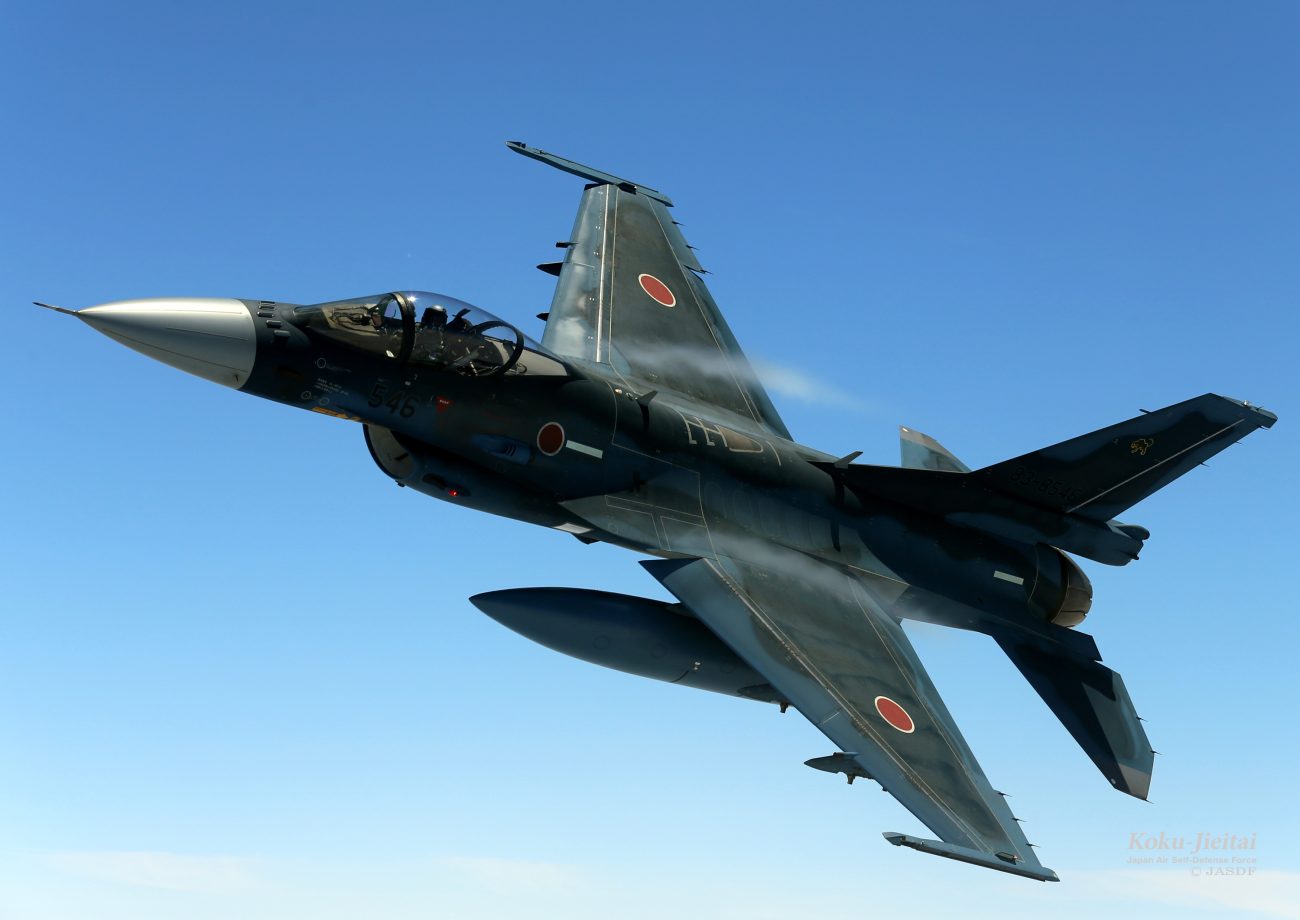
The Mitsubishi F-2, also popularly known as “Viper Zero”, is a multirole fighter aircraft that was developed primarily for the Japanese Air Force.
It began as a joint US-Japan program to develop a cutting-edge replacement for Tokyo’s obsolete Mitsubishi F-1 support fighter, leveraging the country’s domestic manufacturing expertise and US aviation technology.
Mitsubishi Heavy Industries (MHI) was the prime contractor, and Lockheed Martin Aeronautics Company served as the principal US subcontractor.
The first F-2 prototype, a single-seat variant called XF-2A, took its first flight on October 7, 1995, at the Komaki Air Base, Japan. Mitsubishi test pilot Yoshiyuki Watanabe piloted it, drawing on extensive experience.
The F-2’s maiden flight was a major milestone, validating the US-Japanese aircraft design. By March 1996, it had reached 14 sorties. The second XF-2A (63-0002) flew on December 13, 1995, focusing on loads and Electronic Warfare (EW) systems.
The flights demonstrated several shortcomings, especially in the newly built fiber composite wings. These findings were quickly incorporated into the modified aircraft before it entered serial production.
Delivery of the first F-2 production models began in 2000. The first of these aircraft entered service with the 3rd Fighter Squadron at Misawa Air Base, replacing F-1s and complementing F-15Js.
How Was The F-2 Conceived?
In the early 1980s, Japan sought to modernize its air force with a domestically designed multirole fighter.
Drawing from experience in licensed production of the F-15J Eagle, Japanese contractors like Mitsubishi Heavy Industries (MHI) pushed for an indigenous design to build domestic aerospace expertise.
However, the US reportedly advocated co-developing an existing design to ensure interoperability and cost efficiency, proposing variants of the F-16 Fighting Falcon or F/A-18 Hornet.
In 1987, the JASDF selected a variant of the F-16C as the Japanese FS-X aircraft to replace the Mitsubishi F-1 aircraft.
General Dynamics, which is now part of Lockheed Martin, and MHI signed a co-development agreement in 1988. This is how the F-2 was conceptualized. The program aimed for a fighter optimized for air-to-air combat, close air support, and anti-ship missions, tailored to Japan’s island geography and regional threats.
As part of the program, the United States transferred technology to Japan, with the US sharing 40% of the cost and Japan footing 60%.
Several analysts have noted that Japan decided to develop the F-2 due to pressure from the United States. Originally intended to be a “pure” Japanese fighter, the F-2 was meant to integrate the latest technological advancements. However, it became a copy of the F-16 as Japan could not produce a fighter jet domestically.
However, it featured a host of structural, avionics, and capability enhancements over the baseline F-16. For example, it had a larger wing area, a longer fuselage, and used co-cured composite materials in its wings and tail, a first for operational fighters at the time.
Additionally, the F-2 features a stronger, one-piece canopy with improved bird-strike resistance, unlike the F-16’s standard canopy.
Most notably, the F-2 was equipped with the Mitsubishi Electric J/APG-1 Active Electronically Scanned Array (AESA) radar, the first of its kind in a production fighter.
This radar offered better detection, tracking, and jamming resistance compared to the F-16C’s mechanically scanned AN/APG-68 radar. Furthermore, the F-2 featured an integrated, Japanese-developed electronic countermeasures (ECM) system that was far more advanced than the F-16’s and tailored for maritime environments.
While both aircraft used the General Electric F110-GE-129 engine, the F-2’s engine was optimized for Japan’s maritime missions, with slight tuning differences for low-altitude performance. Moreover, the F-2’s hardpoints were optimized for heavier anti-ship loads as compared to the F-16.
According to a US-based think tank, CSIS, the US was concerned that Japan’s push for a domestically made aircraft might fail. Japan, in turn, was dissatisfied with what it regarded as a US power maneuver to deny Japanese access to vital defense technologies. The compromise that resulted was the F-2, an arrangement that worked for both parties in the 1990 international security context.
Some reports suggest the country struggled to upgrade the aircraft because Lockheed Martin was reluctant to transfer the technology needed for the required upgrades.
The first FS-X prototype made its maiden flight on October 7, 1995, followed by four more prototypes that were built and tested extensively for flight performance, weapons integration, and avionics.
Full production was achieved in 1996, and the aircraft was redesignated the F-2. It was manufactured in two variants: the F-2A, a single-seat fighter version, and the F-2B, a twin-seat trainer version.
Japan wanted to develop a third, upgraded aircraft variant—the F-2A Super Kai—featuring conformal fuel tanks and sniper targeting pods. However, Tokyo dropped the plan when it decided to purchase the fifth-generation F-35 from the USA.
Although categorized as a support aircraft, the F-2 was designed to counter threats from regional adversaries such as North Korea and China. However, unlike the American F-16s, which have flown multiple combat missions worldwide, the aircraft saw no combat in its nearly 31-year service.
The official website of Lockheed Martin states: “In 2015, the F-2 became the eighth aircraft platform to be equipped with Lockheed Martin’s Sniper Advanced Targeting Pod…The F-2 has a wing area enlarged approximately 25 percent over the F-16 wing area. The larger wing allows more internal fuel storage and two more weapon store stations than the F-16…In addition to the larger wing area, the F-2 fuselage is approximately 17 inches longer than that of the F-16. The horizontal tails are also larger.”
Meanwhile, the MHI states, “F2 achieves a better maneuvering capability, with the introduction of an integral structure using a composite material and maximizing the wingspan. Also, by using various high-tech materials and structural technology, we have succeeded in making the wings lighter. In avionics, the newest technological domestically oriented equipment has been installed, such as an integrated electronic warfare system and an onboard computer.”
According to Mitsubishi, radio wave absorption materials were used to enhance the aircraft’s stealth and Control Configured Vehicle (CCV) capabilities, while the engine was given extra thrust to boost takeoff and landing capabilities. The aircraft has been a force to reckon with, despite having barely had the opportunity to prove its might in combat.
The F-2 has been frequently criticized, even though it is a stalwart of the JASDF. Critics have pointed out that the plane has been too expensive for Japan and that it hasn’t improved much over the standard F-16.
Others say the F-2, characterized by its compact radar and single-engine configuration, has been less effective than the older F-15 Eagles.
Nonetheless, the upcoming India-Japan drills mark another exercise between the two air forces and the first time Japanese fighters will operate from Indian soil. In January 2023, the Indian Air Force (IAF) deployed four Su-30MKIs against four JASDF F-2s and four F-15s.
- Contact the author at sakshi.tiwari13 (at) outlook.com
- Follow EurAsian Times on Google News