Egyptian President Abdel Fattah El-Sisi met with Chinese President Xi Jinping and once again stressed Egypt’s full support for the One-China Principle.
“The Egyptian side emphasized its rejection of interference in China’s internal affairs and its steadfast commitment to the One-China principle, recognizing Taiwan as an inalienable part of the territory of the People’s Republic of China, supporting the Chinese position on issues pertinent to China’s sovereignty and territorial integrity, and supporting the achievement of China’s national reunification,” states a joint statement published by the Egyptian government after a meeting between the two leaders.
China considers Taiwan a renegade Chinese province and has vowed to unite it with the Chinese mainland, with force if necessary. In fact, it has been preparing for a full-scale invasion and regularly engages in gray-zone warfare tactics against the self-ruled state.
Egypt was the first Arab and African country to recognize China and establish diplomatic relations with the communist country in 1956.
However, the latest statement uses relatively strong language, aligning with Beijing’s preferred “One China principle” rather than the more qualified “One China policies” of countries like the United States, which “acknowledge” but do not fully endorse China’s sovereignty claim over Taiwan.
Xi’s visit to Egypt coincides with the 70th anniversary of diplomatic relations and marks his first trip to Egypt in a decade.
Beyond the One-China reaffirmation, both sides pledged mutual support for each other’s core interests — for example, China recognized the Nile River’s vital importance to Egypt and Egypt’s right to protect its water and food security.
The visit comes shortly after the People’s Liberation Army Air Force (PLAAF) and Egyptian Air Force launched the Eagles of Civilization 2026 joint aerial drills on 22 August.
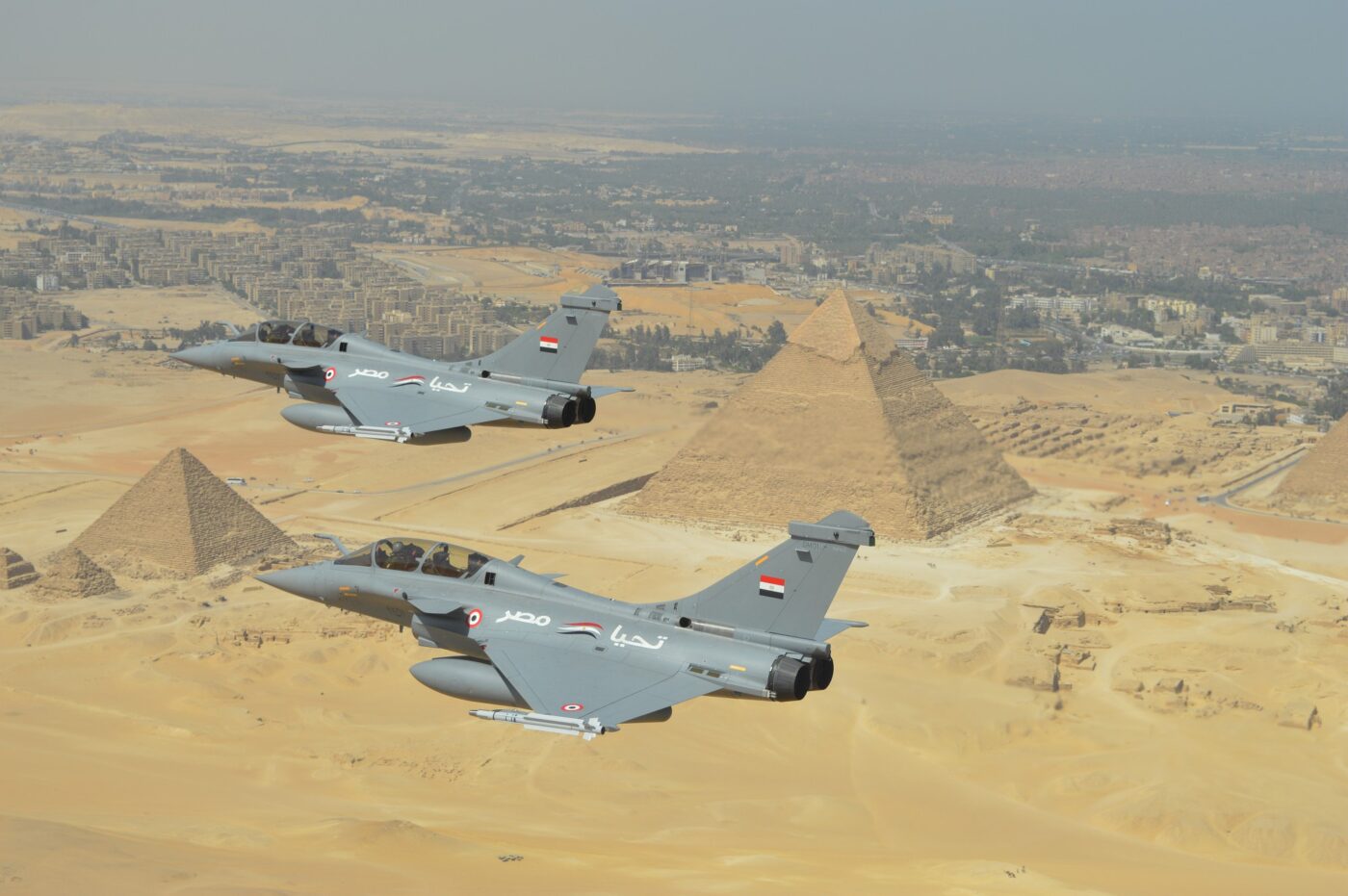
The exercise featured mock engagements between Chinese J-16 fighters and Egyptian Rafales, covering both beyond-visual-range (BVR) and within-visual-range combat, marking the first time Chinese combat aircraft trained against a Western-origin platform.
Separately, a Chinese YY-20 aerial tanker also conducted mid-air refueling of Egyptian Rafales—an event widely described as historic, according to the EurAsian Times.
However, within days of these historic drills and the supposed high degree of cooperation between the two sides, Egypt has reportedly submitted a formal Request for Proposal (RFP) to Dassault Aviation for 24 additional Rafale fighters. This will be Egypt’s third Rafale purchase, bringing its total Rafale fleet to 78.
Rafale Over J-10C For Egypt
The Egyptian Air Force currently operates a mixed fleet of American F-16s, Russian MiG-29M/M2s, and French Rafales.
Egypt purchased 24 Rafales from France and 46 MiG-29M/M2 fighters from Russia in 2015.
This was followed by an order for 24 Su-35 fighters from Russia in 2018, although Cairo eventually abandoned the purchase due to the threat of US sanctions, prompting it to place another order for 30 Rafale fighters from France.
Despite these purchases, Egypt has been seeking another advanced aircraft, mainly because of difficulties maintaining the existing Russian and American fighters in its inventory.
For example, the maintenance of the Russian MiG-29 fleet has been complicated by supply disruptions caused by the war in Ukraine, while upgrades and spare parts for the large, aging F-16 fleet face US restrictions and operational limitations.
These experiences prompted Cairo to diversify its arms suppliers.
Seizing the opportunity, China debuted its J-10C multi-role combat aircraft at the Egypt International Air Show in September 2024, sparking speculation that Egypt was considering a purchase.
Later, in February 2025, local Egyptian publications reported that the country had secured the delivery of the aircraft from China. The Chinese Defense Ministry later dismissed the claims as “fake news.”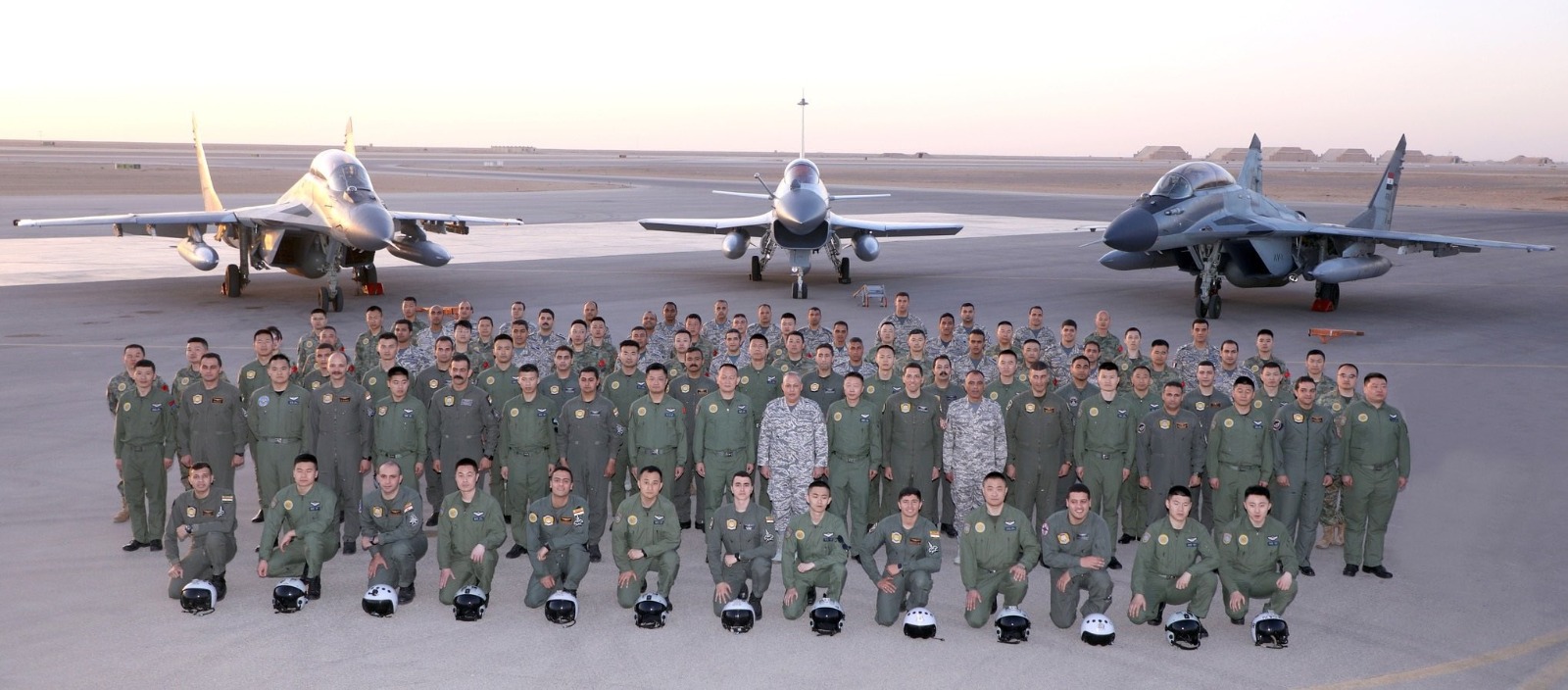
The Egyptian military announced the opening of the joint Chinese-Egyptian exercise “Eagles of Civilization 2025.” For the drill, China brought the J-10C fighter jet to Egypt. Via: X
Later in the year, the J-10C made its combat debut in the Pakistani Air Force (PAF) during the four-day conflict with India in May 2025. The PAF claimed that the J-10C shot down Indian Rafales during an intense aerial duel—a claim that has been extensively amplified by China to promote the aircraft in the export market.
In fact, France accused China of running an anti-Rafale campaign to promote its warplanes like the J-10C.
The PLAAF even brought its J-10Cs to Egypt for the “Eagles of Civilization 2025” military drills. This was seen as the most direct promotion of the jet to the Egyptian Air Force, especially since footage from the exercise showed an Egyptian pilot sitting in the J-10C’s cockpit, potentially to familiarize himself with the aircraft.
Against this backdrop, Egypt’s decision to pursue more Rafales has drawn criticism from some Chinese observers and bloggers.
Why is Egypt Choosing More Rafales?
China is making a concerted effort to position itself as Egypt’s preferred non-Western airpower supplier, capitalizing on Russian industry constraints stemming from the war in Ukraine.
The J-10C offers clear advantages on paper: it supports Egypt’s diversification goals, falls below the most sensitive sanctions thresholds, and would deepen the military partnership with China. However, Egyptian weapons procurement is not purely technical; it also serves political objectives.
For one, Egypt is a close partner of the United States and one of the largest beneficiaries of American military aid, second only to Israel. Washington has provided Cairo with tens of billions of dollars in military and economic support over the last four decades, which could be used to discourage major Chinese purchases of combat aircraft.
Moreover, Egypt’s purchase and integration of the J-10C into its air force could ruffle some feathers in both the United States and France, as it would heighten the risk of an adversary state gaining access to F-16s and Rafales.
Earlier, for instance, Egypt had to give up its Su-35 purchase to avoid sanctions under CAATSA (Countering America’s Adversaries Through Sanctions Act) amid similar risks assessed by Washington.
Analysts note that a J-10C acquisition could risk aid suspension, restrictions on F-16 spare parts, or broader cuts in cooperation. This may be too high a cost for Cairo, which was finally cleared to buy AIM-120 air-to-air missiles in July 2025 along with a major air defense package consisting of NASAMS.
While Egypt has already acquired Chinese drones, trainers, and some air-defense systems, major combat aircraft could still face significant political constraints. Moreover, US anxieties about a Chinese aircraft in the Middle East may have seen a further uptick, as Beijing is seeking closer partnerships with US allies in the region amid a rapidly changing geopolitical landscape and US losses in the war with Iran
- Contact the author at sakshi.tiwari13 (at) outlook.com
- Follow EurAsian Times on Google News