After India and Indonesia, another Asian country with an adversarial relationship with China is planning to acquire French Rafale fighter jets.
Vietnam, which fought a bloody war with China in 1979 and has a complex maritime boundary dispute with Beijing in the South China Sea, is reportedly considering the Rafale jet as it seeks to modernize its aging Air Force, which is largely composed of legacy Soviet and Russian fighter jets.
Notably, while India has historically operated a mix of French, British, and Russian fighter jets, and Indonesia also operates a diverse fleet of American F-16s, French Rafale, South Korean T-50, and Russian Su-27 and Su-30, the Vietnamese Air Force hitherto has been an all-Russian force, composed of Su-22, Su-27, Su-30, and Yak-130 trainers.
Therefore, if Vietnam finally picks the French Rafale, it will be a major shift in its force structure.
Fighter jet deals are rarely decisions purely about air combat power, and they often signal changing geopolitical realities.
Vietnam’s decision to pick the Rafale would underscore Hanoi’s efforts to diversify its fighter fleet away from a single, heavily sanctioned power, as well as its efforts to hedge and win the support of another Western power that also holds a veto in the UN Security Council.
Russia, however, is still in the running.
Russia’s fifth-generation stealth fighter jet, Su-57, is also in the reckoning.
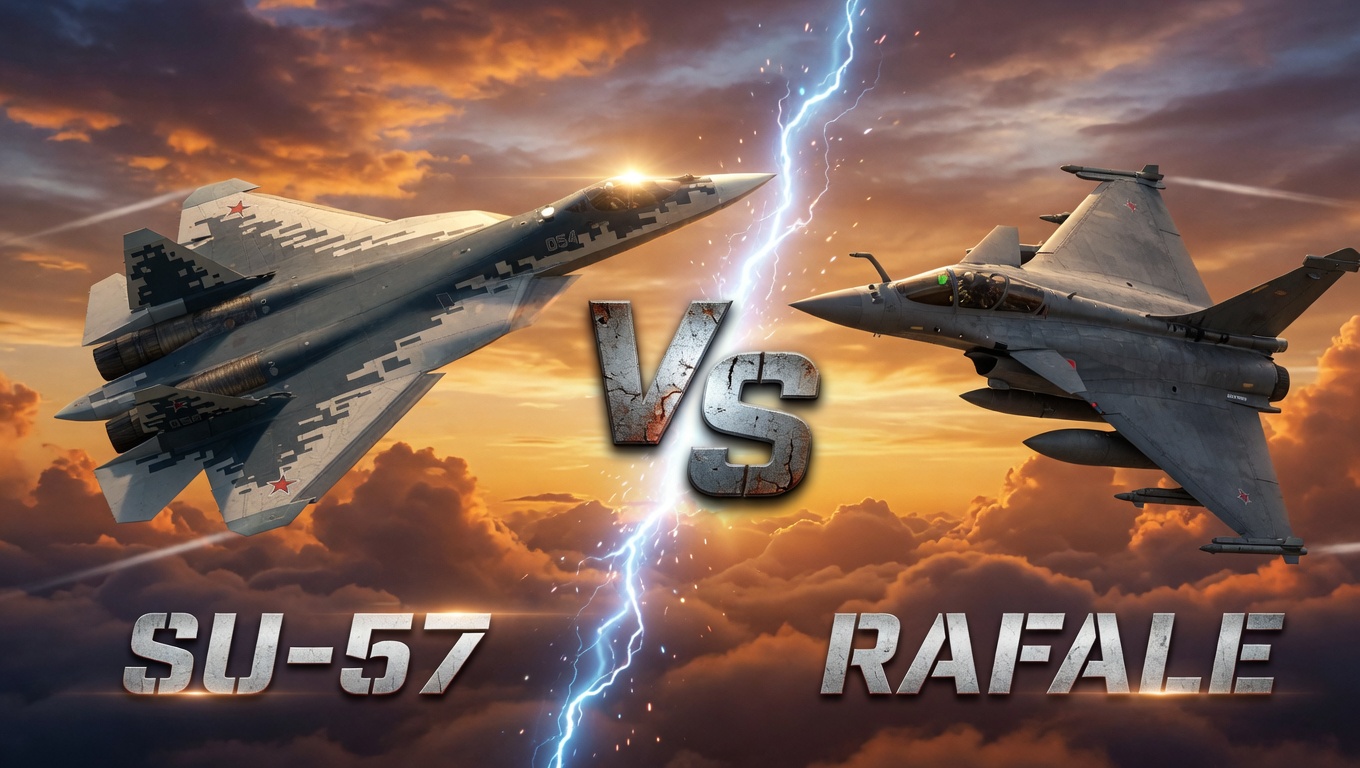
According to defense analysts, Hanoi could pick one of the two or buy a limited number of both fighter jets.
Rafale Vs Su-57: Once Again
Earlier this year, the French magazine L’Express reported that exchanges between Vietnam and France have progressed quite far, with a notable sign being that a Vietnamese pilot was even allowed to test-fly the Rafale in France.
Such test-fly access is often reserved for customers with whom discussions have progressed to a very advanced stage.
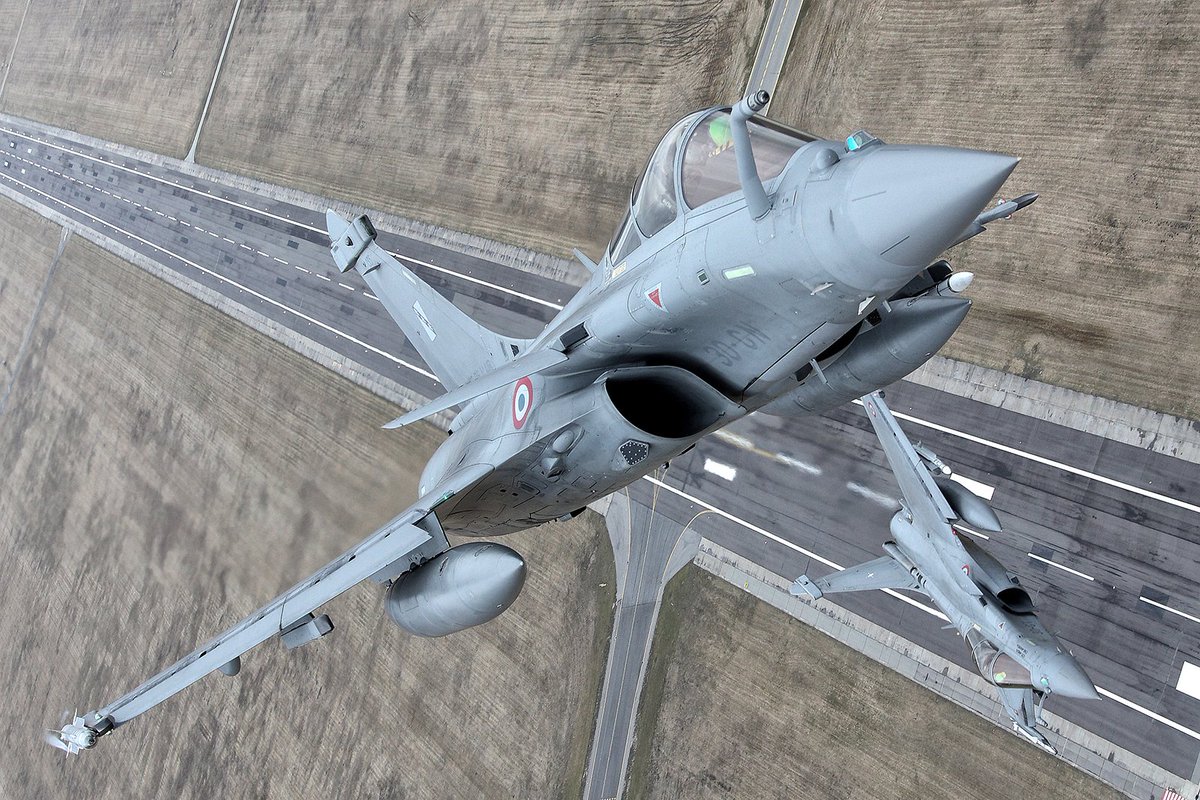
Rafale is a genuine omni-role fighter, offering an AESA radar, the formidable SPECTRA self-defense suite, ground-attack capability, reconnaissance capability, a 9-tonne weapons load, and long-range air-to-air and air-to-ground precision strike capability.
Open-source estimates suggest Hanoi could sign a deal for 24 to 40 jets to raise two to three squadrons, and the deal could cost between US$4 and US$6 billion.
France previously deployed the Rafale to Vietnam as part of the French Air Force’s deployment flights.
In 2018, three French Air Force Rafale aircraft landed at Noi Bai Airport in Hanoi as part of France’s PEGASE operation in the Asia-Pacific region, according to the French Ministry of Defense.
French President Emmanuel Macron also made a high-profile three-day state visit to Vietnam in May last year. The visit was significant as it marked the first visit by a French head of state to Vietnam in nearly a decade.
Reportedly, Macron discussed the Rafale deal with Hanoi during his trip.
Indonesia’s order for 42 Rafales could also be a strong factor working in Dassault’s favor.
Vietnam’s overreliance on Russian weapons, the heavily sanctioned Russian economy, and repeated production delays driven by Moscow’s wartime needs are other factors that could push Hanoi to finally choose a French aircraft.
According to reports, the first Rafales could arrive in Vietnam between 2028 and 2030.
However, given the heavy backlog of Rafale deliveries, this timeline seems unrealistically ambitious.
In June 2026, Dassault had a Rafale backlog of 208 fighter jets. Dassault currently has a capacity to deliver 28 Rafale jets annually.
Separately, India is negotiating a deal for 114 Rafales, and in July, Ukraine signed an agreement to buy 16 initial Rafales, part of a planned fleet of 100 announced in November last year.
These orders will add to Dassault’s heavy backlog and could push the timelines even further.
Hanoi, however, is also considering the Russian Su-57.
Hanoi has been interested in the Su-57 since at least 2017. Reportedly, Hanoi is aiming for the upgraded Su-57M1 expected to mature early in the next decade.
The Su-57’s advantages are clear. Russia has been Vietnam’s trusted security partner for decades.
Vietnam operates an all-Russian fighter jet fleet composed of Su-22, Su-27, and Su-30 Aircraft. It also operates the Yak-130 trainer and the S-300 air defense system.
The Su-57 will therefore integrate easily with Vietnam’s existing fighter fleet.
The Su-57 will also give Vietnam limited stealth capability. This is especially relevant in the South China Sea, where Beijing operates not only fourth-generation heavy fighter jets, such as the J-16, but also fifth-generation stealth fighters like the J-20.
The Su-57’s stealth is limited; however, its frontal stealth profile is comparable to other advanced fighter jets.
Production delays, sanctions on the Russian aerospace industry, and Moscow’s wartime needs mean Vietnam cannot trust Su-57 delivery timelines.
Another option could be to buy a limited number of both fighter jets: the Rafale as a medium-weight multirole fighter and the Su-57, which offers a better stealth profile.
The Rafale vs Su-57 contest, however, isn’t new.
Earlier, India faced the same question. However, after multiple tests, endless negotiations, and hard bargaining, India has picked the Rafale.
New Delhi is negotiating with France for a deal to buy 114 more Rafale jets. However, even in New Delhi, a raging debate rages over whether India should buy 2-3 squadrons of the Su-57 as well.
According to reports, Putin is offering India domestic production and almost full technology transfer for the Su-57 fighter jet.
It will be interesting to see if India, along with 114 Rafales, also decides to buy around 40 Su-57 fighter jets.
Rafale vs China
Last month, Chinese fighter jets, the J-16s, participated in the ‘Eagles of Civilization 2026’ air combat drills against Egyptian Rafales.
Earlier, as EurAsian Times reported, a mock exercise between the J-16 and the Rafale was held in Xuchang, Henan province, China, in December 2025.
This raises the question: why is China’s PLA Air Force (PLAAF) repeatedly testing against the French Rafale?
The answer to this vexing question may be that India and Indonesia have already bought the French Rafale. Both these countries have long-standing boundary disputes with China. India has a border disagreement with China in the high Himalayas, and Indonesia has a maritime boundary dispute with Beijing in the South China Sea.
Last year, EurAsian Times reported that Taiwan is also exploring the purchase of Rafale jets to replace its aging Mirage-2000 fleet.
Eric Trappier, Chairman and CEO of Dassault Aviation, has confirmed that Taiwan is showing clear interest in acquiring the Rafale fighter jet as its fleet of Mirage 2000s nears the end of its operational life.
“Everybody has said that the future would be the Rafale. That is true for all our export clients who are moving from the Mirage 2000 to the Rafale. And you know very well what the Taiwanese want. What they want is Rafale,” Trappier said.
Notably, since the May 2025 India-Pakistan clash, the Indian Air Force (IAF) has successfully updated the electronic warfare (EW) threat library of its Dassault Rafale fighter jets to include the seeker signatures of China’s PL-15 missile.
This upgrade was achieved through electronic intelligence (ELINT) and analysis of recovered PL-15 missile components. By incorporating the PL-15’s characteristics into the Rafale’s Spectra EW suite, the IAF aims to improve its aircraft’s ability to detect, track, jam, and evade these advanced Chinese missiles.
If Vietnam and Taiwan select the Rafale jets, four of China’s neighbors with boundary disputes could be armed with Dassault jets.
- Sumit Ahlawat has over a decade of experience in news media. He has worked with Press Trust of India, Times Now, Zee News, Economic Times, and Microsoft News. He holds a Master’s Degree in International Media and Modern History from the University of Sheffield, UK.
- He can be reached at ahlawat.sumit85 (at) gmail.com