Europe is rapidly running out of missile-defense interceptors, even as Ukraine’s Patriot SAM launchers stand virtually empty, while Russia launches an almost daily barrage of ballistic missiles to make the most of this critical vulnerability.
Kyiv desperately wants a license to manufacture Patriot interceptors domestically, but the missile’s manufacturers, Lockheed Martin and Raytheon, are reportedly reluctant to share the technology with Ukraine.
Meanwhile, the US military has burned through nearly four-fifths of its THAAD missile inventory compared to pre-war numbers and roughly half of its Patriot interceptors since the start of the Iran war.
The US quickly identified the vulnerability. In April, the Pentagon’s Munitions Acceleration Council (MAC) identified 12 legacy and two “emerging” munitions as part of its ambitious plan to ramp up production and ink a series of agreements with key vendors to ensure cost efficiency while maintaining production stability, according to fiscal 2027 budget documents.
The 12 legacy munitions include Patriot Advanced Capability-3 (PAC-3) Missile Segment Enhancement interceptors, Terminal High Altitude Air Defense (THAAD) interceptors, Standard Missile-3 IIA, SM-6, and SM-3 Block IB interceptors.
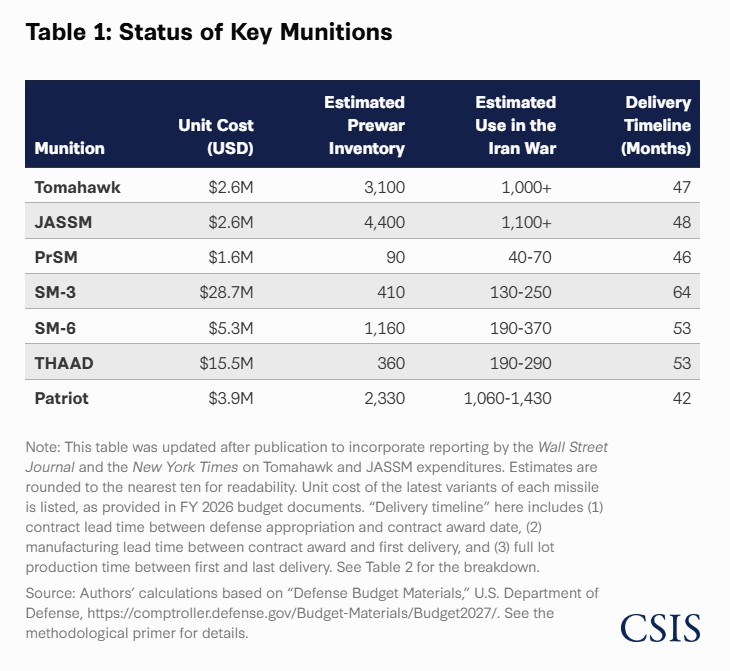
Earlier this month, to boost production of these critical missile interceptors, the US signed a more than US$3 billion deal with Lockheed Martin and Northrop Grumman to ramp up production of Patriot and THAAD interceptor parts; however, analysts warn that it will be years before Washington reaches its pre-War inventory levels.
For perspective, Lockheed Martin produced only 620 Patriot missile interceptors in 2025.
Similarly, last year, a White Paper for ‘European Defense and the Rearm Europe Plan – Readiness 2030‘ identified air and missile defense as one of the seven critical capability areas requiring urgent action to close existing gaps.
To meet urgent needs, European governments have spent heavily, reportedly around US$50 billion since 2022, primarily on US systems.
However, the expectation that the US will continue to meet all of Europe’s missile defense needs may prove increasingly unrealistic, especially in light of the Iran War, when the US is itself struggling with historically low inventories.
With Washington’s long-term strategic focus fixed on the Indo-Pacific and its attention currently absorbed by the Middle East, Europe has become, at best, a tertiary security interest.
With Washington’s long-term strategic focus fixed on the Indo-Pacific and its attention currently absorbed by the Middle East, Europe has become, at best, a tertiary security interest.
Even when production finally picks up, the US is likely to prioritize first its own needs and then the Gulf countries. Europe could be near the end of the queue.
Meanwhile, if China opens a new front with Taiwan in the near future, the pressure on US supply chains will increase manifold.
At a time when some critics fear that Russia could invade another Eastern European country by 2028, Europe faces a critical question: Does it have the necessary missile-defense inventory to neutralize Russian drones and missiles—and if the US cannot meet Europe’s needs, where else can it turn?
According to a recent research paper by the International Institute for Strategic Studies (IISS), South Korea is well positioned to meet some European missile-defense needs.
European Missile Defense Architecture
Europe has relied mainly on the US-made Patriot system for its air defense.
Germany has purchased the Arrow 3 long-range air-defense system, developed by Israel Aerospace Industries, with Boeing as a co-developer and co-producer, but this represents only a small fraction of the air- and missile-defense capacity Europe needs.
The National Advanced Surface-to-Air Missile System (NASAMS), jointly developed by Norway and the US, is effective against cruise missiles, aircraft, and many unmanned aerial systems, but not ballistic missiles.
Likewise, Germany’s IRIS-T SLM system is optimized for air defense against cruise missiles and unmanned systems rather than high-end ballistic threats.
Europe has an alternative to Patriot – the SAMP/T surface-to-air missile system, developed by the Franco-Italian Eurosam consortium (MBDA and Thales). The system, however, has secured far fewer sales than its US competitor, and its production capacity remains constrained.
Can South Korea Help?
According to the paper, Europe’s pressing need for air defense could present South Korea with further opportunities to secure sales on the continent.
Although South Korea has not yet fully entered Europe’s missile-defense market, it has already demonstrated its ability to deliver major conventional systems quickly, supplying tanks, howitzers, and aircraft to Poland while also securing contracts with Romania and Norway for K9 howitzers and K10 ammunition resupply vehicles, and with Norway and Estonia for Chunmoo multiple-launch rocket systems.
According to a 2026 SIPRI report, South Korea was the second-largest supplier of major arms to NATO countries in Europe during 2021–25, behind only the US.
Last month, the Eurasian Times reported that South Korea and NATO have agreed to open negotiations on a basic procurement agreement that would allow Korean defense companies to participate in NATO’s joint procurement market, estimated at 15 trillion won (US$9.9 billion) annually.
The Jets That Sank British Ships Grounded Forever: Argentina Finally Retires Its Super Étendards
South Korea’s Cheongung-II medium-range surface-to-air missile system, jointly produced by LIG Nex1, Hanwha Systems and Hanwha Aerospace, has had a positive debut in the Middle East.
South Korea built the Cheongung-II to stop North Korean missiles. However, the system is now stopping Iranian missiles and, in doing so, has turned Seoul into one of the most sought-after defense suppliers on the planet.
The UAE ordered the Cheongung-II in 2022. Two systems were deployed in early 2026, shortly before the outbreak of the Iran conflict, and reportedly achieved an interception success rate exceeding 96%, as EurAsian Times reported at that time.
It was a combat debut that rivaled, and in some cases exceeded, the performance of the US Patriot anti-missile system, analysts said.
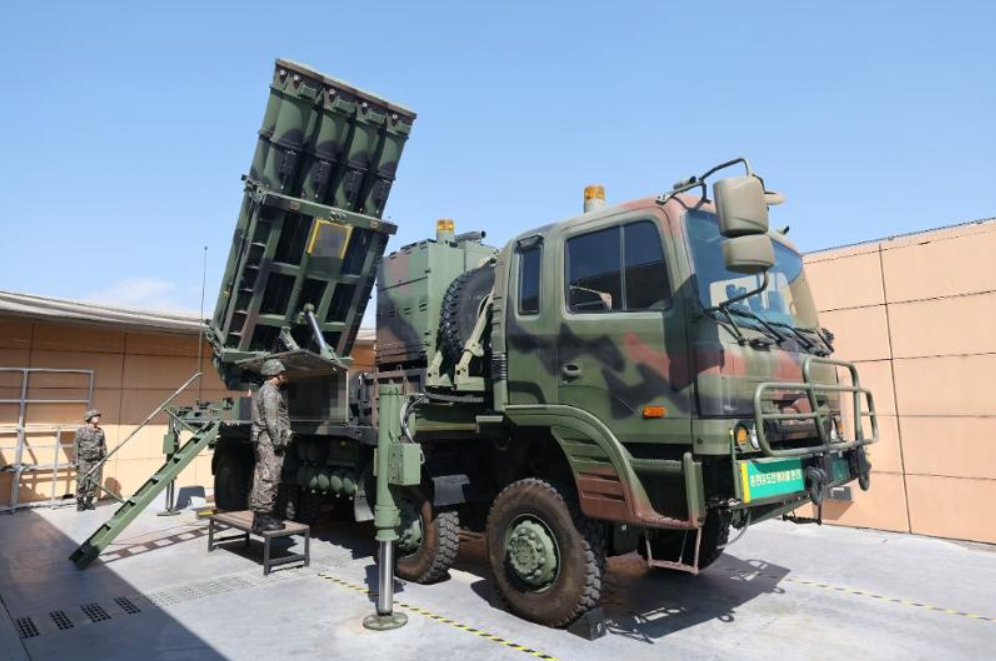
The third one was delivered to the UAE on an expedited, emergency basis. Meanwhile, additional orders from Saudi Arabia and Iraq, placed in 2024, remain pending.
One advantage of South Korea’s systems arguably lies in their high degree of domestic production, estimated at around 95%, which reduces vulnerability to supply-chain disruptions and export restrictions while helping to keep production costs low.
Another advantage is price – the South Korean Cheongung-II costs nearly one-third of the Patriot system. Therefore, in the cost of one Patriot battery, a country can field three Cheongung-II batteries.
Furthermore, South Korea’s L-SAM system, sometimes described as a Korean equivalent to THAAD, could further enhance its appeal as a supplier of higher-tier missile-defense capabilities once the system is fully ready for deployment, expected by 2028.
However, concerns remain about whether Seoul can boost production to meet additional demand from European countries.
Notably, Hanwha is expanding production in Europe, including building new facilities in Poland and Romania. Although these plants are not intended for missile-interceptor production, they could be adapted for that purpose, thereby significantly increasing output and shortening delivery timelines for European customers.
However, the European Union’s Security Action for Europe (SAFE) initiative, adopted in May 2025, could limit South Korea’s role in meeting European air defense needs.
The program allocates €150 billion (US$175 billion) to strengthen the continent’s defense-industrial base. To qualify for a loan under this initiative, projects must meet a requirement that at least 65% of the product is produced within the EU, effectively prioritizing domestic production.
South Korea’s exclusion from SAFE limits the attractiveness of its systems for EU-funded procurement.
At a time when Europe desperately needs to augment its air defense architecture, South Korean systems could fill in the gap.
- Sumit Ahlawat has over a decade of experience in news media. He has worked with Press Trust of India, Times Now, Zee News, Economic Times, and Microsoft News. He holds a Master’s Degree in International Media and Modern History from the University of Sheffield, UK.
- He can be reached at ahlawat.sumit85 (at) gmail.com