A small Asian country that depends on the US for its own security and had no defense industry worth its name until two decades ago is on the verge of signing a historic defense procurement agreement with NATO, the world’s largest security and military alliance.
If the talks succeed, indeed, it will become the first country ever to have signed such an agreement with NATO.
South Korea and NATO have agreed to open negotiations on a basic procurement agreement that would allow Korean defense companies to participate in NATO’s joint procurement market, estimated to be worth 15 trillion won (US$9.9 billion) annually, National Security Adviser Wi Sung-lac said on the sidelines of the recent NATO summit in Turkey.
“The agreement, once concluded, will provide an institutional framework for Korean companies to participate in NATO’s joint procurement market,” Wi said during a press briefing.
“The agreement would give Korea a foothold to enter NATO’s defense market, the world’s largest,” Wi added, referring to NATO’s 32 member states, which make up the world’s largest defense procurement market with a roughly 55 percent share of global defense spending.
Wi said Korea and NATO also discussed harmonizing defense standards as part of their expanding defense cooperation.
“We expect the discussions to improve Korean companies’ access to NATO’s defense market by aligning with NATO’s ongoing standardization efforts,” he said.
According to Korea Joongang Daily, NATO member states reportedly expressed interest in the technological capabilities and price competitiveness of Korea’s defense industry during the summit.
Separately, Korea will also join as an “observer” in NATO’s defense industry and raw materials programs, part of the alliance’s multinational cooperation projects in which member states jointly develop equipment, supplies and capabilities. Korea had previously participated as an observer only in the munitions and space programs.
This is the first time in NATO’s 77-year history that it is negotiating such a defense procurement agreement with any country. It stands as a clear testament to the remarkable transformation of South Korea’s defense industry over the past two decades.
What makes the achievement especially notable is that South Korea recently entered the field. A tiny country of 50 million people, it entered defense production only in the 1980s, starting with small firearms and reverse-engineered US weapons, and entered the international defense export market only two decades ago.
South Korea’s Rising Defense Exports
In fact, South Korea has shown one of the fastest rises among arms exporters in recent years.
According to SIPRI, South Korea entered the world’s top 10 defense exporters list for the first time between 2016 and 2020, ranking 10th.
According to SIPRI’s latest data, between 2021 and 2025, South Korea was the world’s 9th largest defense exporter.
Over the past 15 years, South Korean defense exports have more than tripled.
Between 2010 and 2014, South Korea had a 0.9% share in global arms exports. By the 2021- 2025 period, its share has already jumped to 3% of global arms exports, underscoring the growing popularity of South Korean weapons systems.
In fact, several NATO countries are already procuring South Korean weapons systems, as many of its arms and ammunition have already received various NATO standardization and interoperability certifications.
South Korean Weapons Export to NATO Countries
NATO countries place a lot of emphasis on equipment standardization and interoperability, especially when importing foreign weapons systems.
It does not mean that the weapons systems have to be identical; rather, the systems should be able to communicate, share data, use common facilities, and work together logistically.
The United States has its own domestic law requiring that equipment for U.S. forces in Europe be standardized or interoperable with NATO allies “to the maximum feasible extent.”
There are various mechanisms in place to ensure standardization and interoperability among NATO countries, such as STANAGs (Standardization Agreements) and the NATO Standardization Office (NSO).
The doctrine stresses that in a war situation, the allied forces should be able to operate together coherently, effectively, and efficiently.
In July 2024, a mutual recognition agreement on military airworthiness certification between NATO and South Korea was signed.
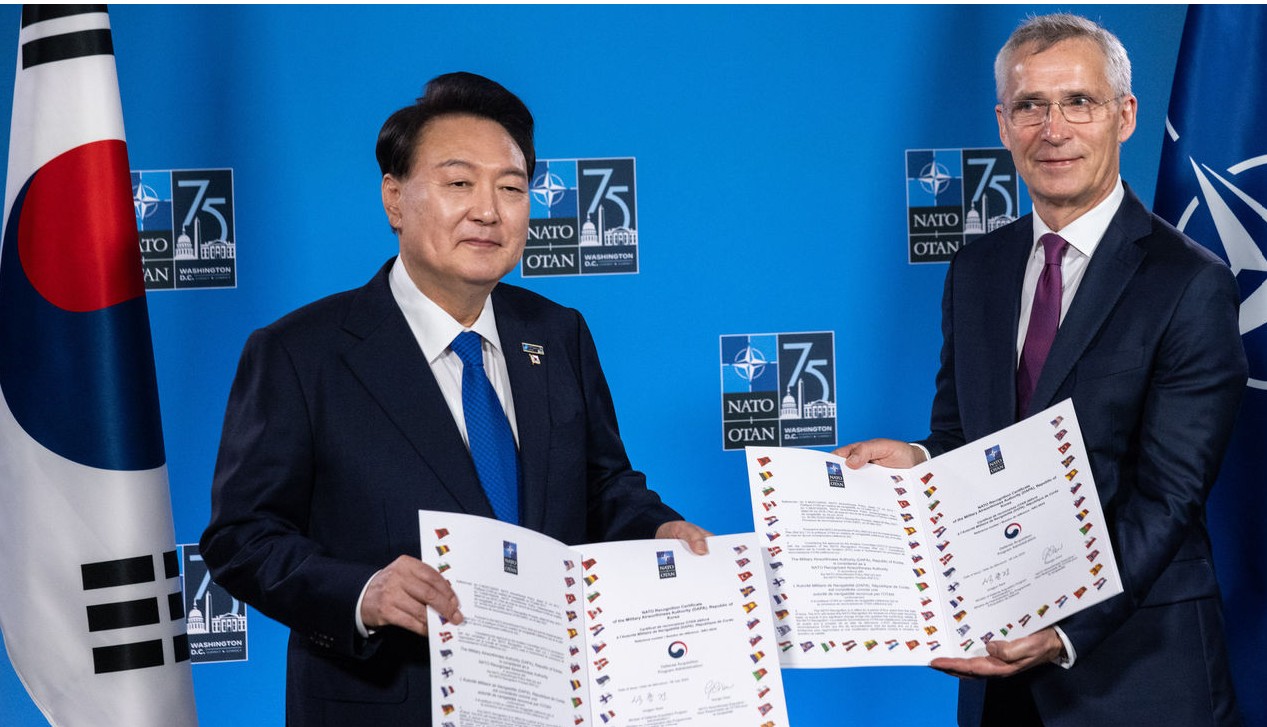
Notably, this was NATO’s first such agreement with an Asian country. It allowed NATO to recognize South Korea’s domestic airworthiness certification process for its manufactured aircraft, streamlining safety standards, interoperability, and potential exports or use with NATO allies.
“Under the agreement, NATO will recognize the Republic of Korea’s airworthiness certification process for domestically manufactured aircraft. While the Republic of Korea has previously signed similar agreements with the United States, Spain, France, and Poland, this new deal with NATO is expected to streamline mutual recognition procedures between the Republic of Korea and NATO Allies,” NATO said in a statement at that time.
The agreement applies to domestically produced Korean aircraft certified by the country’s Defense Acquisition Program Administration (DAPA).
Under the agreement, domestically produced Korean aircraft, such as the KF-21 Boramae, the FA-50/T-50 Golden Eagle light combat/trainer aircraft, and the KUH-1 Surion utility helicopter, are set to benefit.
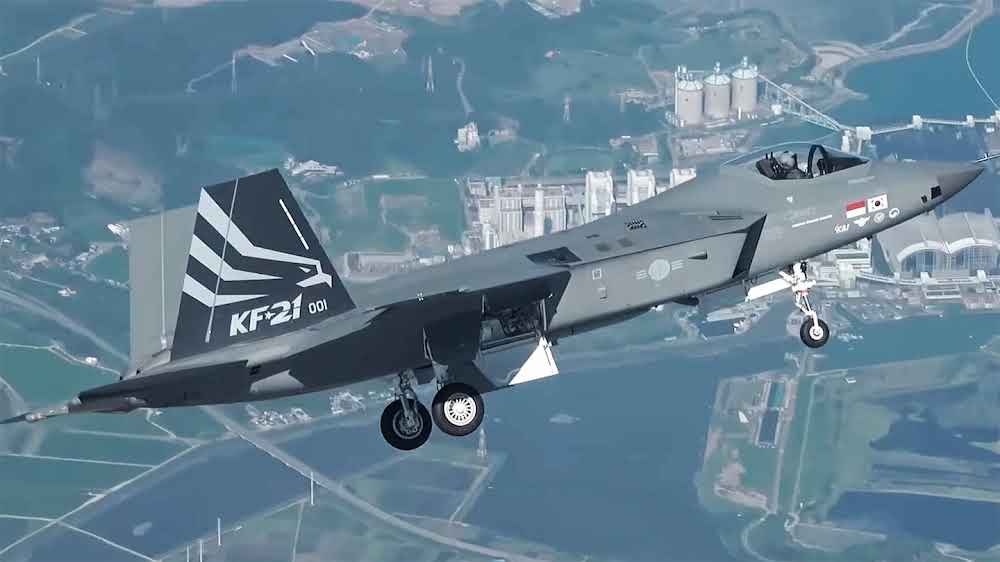
Notably, Poland has already ordered 48 FA-50 (Light Combat Aircraft), becoming the first NATO and European country to order South Korean combat aircraft.
The jets are being supplied in NATO-compatible configuration, including integration of AIM-120 AMRAAM and AIM-9X Sidewinder missiles.
Poland has also expressed interest in Korea’s latest combat aircraft, KF-21 Boramae, though no deal has been signed yet.
The Korean artillery systems are particularly popular with many NATO countries.
The K2 Black Panther main battle tank, manufactured by Hyundai Rotem, features a 120mm smoothbore gun compatible with NATO-standard 120×570mm ammunition.
The K9 Thunder self-propelled howitzer, manufactured by Hanwha, uses NATO-standard 155mm ammunition.
Poland has ordered 360 K2 Black Panther MBTs. It ordered 180 units in 2022 and followed up with another 180 units last year.
Besides, many NATO countries, such as Romania, Turkey, and Norway, are evaluating the K2 Panthers.
The biggest success of South Korean weapons systems with NATO countries has been the K9 Thunder self-propelled howitzer.
Poland has ordered 212 units. However, Poland plans to induct up to 672 K9 Thunder units.

Finland already operates 96 units and has ordered 112 more units this year.
Norway has a fleet of 36 K9 Thunder.
Besides Estonia, Romania and Turkey also operate a significant number of K9 Thunder.
As many as six NATO countries already operate the K9 Thunder, and many others have shown interest.
Poland has also ordered 290 K239 Chunmoo multiple launch rocket systems (MLRS), manufactured by Hanwha.
Norway and Estonia have also ordered a few units.
Notably, Norway selected K239 Chunmoo MLRS over HIMARS and European options.
South Korean artillery systems are gaining traction, especially on NATO’s eastern flank.
As these countries modernize their armed forces, the reliability, ease of operation, cost competitiveness, and faster delivery timelines of South Korean artillery systems, compared to Western systems, are among the factors behind their popularity on NATO’s Eastern flank.
This potential agreement represents far more than just another export opportunity for South Korea.
NATO is the world’s largest defense bloc, representing 55% of global defense spending. NATO’s interest in signing such an agreement with South Korea underscores the extraordinary speed with which South Korea has transformed its defense industry from near non-existence into a globally competitive player.
South Korea is already the world’s ninth-largest defense exporter; if the deal is finalized, it will give a further significant boost to its defense exports.
- Sumit Ahlawat has over a decade of experience in news media. He has worked with Press Trust of India, Times Now, Zee News, Economic Times, and Microsoft News. He holds a Master’s Degree in International Media and Modern History from the University of Sheffield, UK.
- He can be reached at ahlawat.sumit85 (at) gmail.com