Nearly a year after pitting its J-16 vs Rafale jets, Chinese J-16 fighters drilled with the Egyptian Rafales during the “Eagles of Civilization 2026” exercise.
Earlier, as EurAsian Times reported, the mock exercise between J16 and Rafale was held in Xuchang, Henan province, and was part of a broader Chinese effort to promote large-scale war-gaming—the first of its kind at this scale this year.
Beijing simulated a high-stakes air battle, pitting eight J-16 fighters against six French-built Rafale jets, and surprisingly aired footage of the encounter.
Now, during the “Eagles of Civilization 2026” exercise, Chinese state media released footage from the first day of the joint training exercise, which commenced over the weekend. The video showed PLAAF J-16s practicing air warfare against Egyptian MiG-29 and Rafale fighters in real-world scenarios.
Interestingly, India operated both the Rafales and MiG-29s and used them in combat during Operation Sindoor against Pakistan.
The two sides engaged in both beyond-visual-range (BVR) combat and dogfighting, according to the reports.
It was a rare opportunity for China to familiarize itself with the Rafale fighter jets that its neighbor and “nemesis,” India, operates. Indonesia has also acquired the French jets in the Indo-Pacific region—it shares friendly relations with Beijing and was even considering acquiring J-10C aircraft.
India has already acquired “heavily customized” 36 Rafale jets; it plans to acquire 114 F4/F5 variants of the French aircraft to boost its dwindling jet fleet. The Indian Navy has also ordered 26 Rafale-M jets.
Notably, this comes over a year after Pakistan, a close ally of China, claimed to have downed several IAF Rafales during the Indo-Pakistan confrontation in May 2025, a claim that India has flatly rejected. IAF, on the other hand, claimed destroying around 12-14 PAF warplanes during the brief but intense clash.
The Chinese and Egyptian air forces started their first flight training day of the joint exercises "Eagles of Civilization-2026" on August 23 in Egypt. https://t.co/80RsrCP8D2 pic.twitter.com/88TXsiVicK
— CCTV+ (@CCTV_Plus) August 24, 2026
Observers have hailed the J-16 & Rafale drills as historic because Chinese pilots rarely get live dissimilar training against modern Western fighters.
No official kill ratios, scores, or “win or loss” tallies were released by the Chinese PLA Air Force, the Chinese Ministry of National Defense, the Egyptian Ministry of Defense, or independent observers. However, popular PLA watcher Rick Joe cautioned on X: “Healthy reminder for everyone to take any eventual leaks/rumours of ‘results’ of DACT well salted, as the parameters and restrictions of such exercises are never known.”
Notably, the exercise outcomes in dissimilar air combat training are heavily shaped by rules of engagement, simulated weapons or sensors, mission objectives, pilot proficiency, and supporting assets. These results are not direct measures of which aircraft would win in real combat.
Since these are not Indian Rafales, there may be some differences in weapons configuration, electronic warfare suites, pilot training, and support systems. Nonetheless, any real-world data on performance and tactics is useful even if incomplete, which may benefit the country in combat against operators of the jet—such as India.
It appears China isn’t just building capability; it is actively testing it against some of the best aircraft in the world.
“The Chinese would probe the Egyptian Rafales. It will depend on how much the Egyptians will give away. They can develop tactics against the Rafale. Finally, it is the man behind the machine that matters. We beat the US F15s in air combat in the first-ever exercise between IAF & USAF. They decided to accelerate the F-22 to beat us. It was all over the US press,” IAF veteran and military commentator, Group Captain Johnson Chacko (retd), told the EurAsian Times.
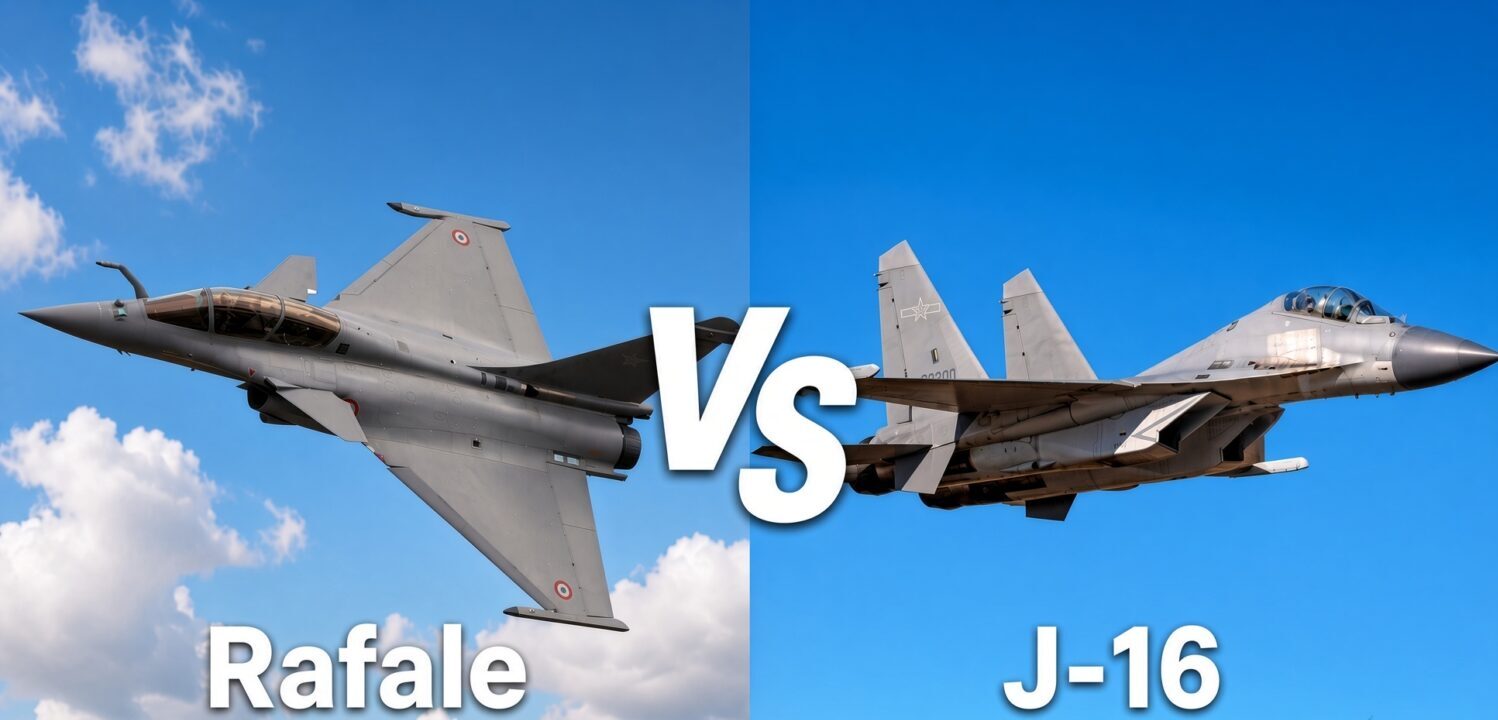
J-16 vs Rafale
The J-16 is a heavy twin-engine fighter designed for long-range operations.
It can deploy long-range air-to-air and strike weapons, has a powerful radar, and is ideal for missions prioritizing firepower and range.
The J-16 is envisioned as part of a larger network that also includes ground sensors, electronic warfare capabilities, and early-warning aircraft. This enables the aircraft to fight as part of a large, coordinated system. The J-16 also has a specific electronic warfare variant, the J-16D, and excels in payload and range.
The J-16 boasts sophisticated fire control and radar systems. It has a local Active Electronically Scanned Array (AESA) radar installed. The aircraft can track 15–20 air targets simultaneously, with a stated range of 150–200 kilometers for fighter-sized targets. The aircraft also boasts an advanced Infrared Search and Track (IRST) system for passive detection with a range of 50–80 kilometers.

The fighter has a glass cockpit design influenced by the J-20 stealth fighter, with a modernized cockpit featuring a helmet-mounted display (HMD) for enhanced pilot situational awareness. It can conduct electronic warfare (EW), suppress enemy air defenses (SEAD), carry out precision strikes, and engage in air-to-air combat.
The aircraft also uses radar-absorbent materials (RAM) and a dark grey stealth coating to reduce its radar cross-section and enhance survivability.
To improve defensive capabilities, the J-16 also has chaff/flare dispensers, electronic countermeasures (ECM), and missile approach warning systems (MAWS). The aircraft has occasionally been used to intercept Western surveillance planes over the South China Sea, leading to several risky confrontations. Furthermore, the introduction of new datalinks, improved EW systems, and the increased use of carbon composites by the Chinese on this aircraft give it a superior combat capability.
According to previous reports/claims, the J-16 simultaneously forced two foreign stealth fighter jets to retreat by locking them. While the report did not disclose which foreign stealth aircraft it was referring to, the only two aircraft that fit the description were the F-22 and the F-35.
The Dassault Rafale, on the other hand, is a twin-engine fighter designed for versatility and independence on a range of missions. It is well known for its exceptional agility, superb sensor fusion, and potent electronic warfare system that increases survivability in contested locations.
Rafale can quickly switch between air-to-air combat, ground attack, reconnaissance, and marine strike, and it often operates well with minimal external support.
This French fighter jet’s design meets the requirements of quick deployment, carrier operations in the naval variant, and expeditionary operations.
It is considered attractive to air forces that need a single aircraft to perform many roles efficiently.
The close-coupled canard-delta arrangement of the Rafale’s aerodynamic design offers superior low-speed handling, high-angle-of-attack performance, and maneuverability, as the Eurasian Times explained earlier.
Its entire airframe was designed for energy maneuverability, allowing a pilot to transition quickly between attack and defensive positions. The Rafale’s precise fly-by-wire controls and high-angle-of-attack stability make it responsive and forgiving, encouraging aggressive handling while allowing for mistakes.
Although it is not as stealthy as the F-35 or J-20, the airframe’s substantial use of composite materials and radar-absorbent materials (RAM) gives it a lower radar cross-section (RCS) than earlier-generation fighters.
The Rafale is also equipped with the RBE2-AA active electronically scanned array (AESA) radar, developed by Thales. This radar can track up to 40 targets simultaneously, engage up to 8 targets at once, and perform ground mapping and terrain avoidance.
Additionally, the aircraft has the OSF (Optronique Secteur Frontal) infrared search and track system with a passive long-range target detection capability and the SPECTRA electronic warfare suite, which reduces the aircraft’s detectability and increases its survivability by combining radar warning receivers, laser warning receivers, missile approach warning, jamming, decoy dispensing, and active cancellation techniques.
The J-16 has greater range, can carry a larger payload, and may be better suited to saturation strikes or long-endurance patrols. The Rafale, in contrast, offers stronger situational awareness, improved avionics integration, and dogfighting agility.
- Contact the author at sakshi.tiwari13 (at) outlook.com
- Follow EurAsian Times on Google News