

Although it entered Russia’s full-scale invasion in February 2022 with an aging fleet of Soviet-era jets, Ukraine is now rapidly building a Western fighter fleet to challenge Moscow.
Ukraine has approached Italy to acquire early-production Tranche 1 Eurofighter Typhoons that the Italian Air Force intends to phase out, Italian publication La Repubblica reported earlier this month.
More recently, reports have indicated that discussions were continuing despite diplomatic friction between the two countries following a Ukrainian strike on Russian naval assets in Libyan waters. Italian Prime Minister Giorgia Meloni has expressed concern about the incident and the potential for the conflict to spread into the Mediterranean.
The Eurofighter Typhoon could give Ukraine another Western fighter capability, although the transfer would require approval from other members of the Eurofighter consortium, which includes Germany, Spain and the UK.
Designed primarily for air superiority, the Eurofighter Typhoon was later adapted for several roles, including air-to-air combat and interception, airspace policing, air defense, and limited air-to-ground strike operations.
Its high maneuverability, powerful twin Eurojet EJ200 engines, and sophisticated flight-control systems make it a formidable air-combat platform.
However, Kyiv is seeking the Tranche 1 Typhoons, which the Italian Air Force is poised to retire.
Eurofighter Tranche 1 has older avionics, an earlier radar configuration, and limited weapons integration. This means the fighter jet could boost Ukraine’s interception capabilities, but it would be nowhere near the latest variant in sensors, avionics, and attack capabilities.

Early variants reportedly include the PIRATE infrared search-and-track system, the mechanically scanned CAPTOR multifunction radar, and the DASS defensive aids suite—which provides radar threat detection, missile-attack alerts, and electronic countermeasures to help protect the aircraft in combat. Furthermore, they are configured primarily for air-to-air missions, carrying medium-range AIM-120 AMRAAM and short-range AIM-9 Sidewinder missiles, but not the long-range Meteor.
Notably, Italy ordered 28 Eurofighter Typhoon fighters in the Tranche 1 configuration, with about 26 currently in service.
The Italian Air Force intends to progressively withdraw these beginning in 2028/2029 as newer aircraft enter service. However, their planned retirement does not automatically make them available for transfer, as any agreement would essentially depend on aircraft condition, remaining airframe life, maintenance requirements, weapons compatibility, and political approvals from partners.
Nevertheless, if Giorgia Meloni’s administration signs off on the transfer, Ukraine would add another Western-origin fighter to its arsenal—bringing the country another step closer to boasting the world’s most diverse fighter fleet.
Ukraine: Most Diverse Air Force In The World
After Russia’s invasion / military operations in February 2022, Ukraine’s Air Force relied almost entirely on Soviet-era MiG-29 and Su-27 fighters, alongside Su-25 and Su-24 combat aircraft.
As the conflict progressed, the country received several batches of Soviet jets from NATO countries that still operated them–both Poland and Slovakia donated their MiG-29s to Kyiv.
Although Ukrainian engineers maintained and upgraded these aircraft, the country faced increasing difficulties obtaining replacement components, modernizing avionics, and sustaining an aging fleet during a high-intensity conflict. As a result, Ukraine began pressing its Western partners for modern fighter aircraft.
The first major breakthrough in its quest to obtain a modern Western fighter jet came with the F-16 Fighting Falcon.
Several European countries, including Denmark, the Netherlands, Belgium, and Norway, committed to supplying aircraft from their existing inventories. Deliveries began in 2024, providing Ukraine with access to a Western fighter ecosystem, including modern air-to-air missiles, precision-guided weapons, and NATO-compatible communications systems.
Subsequently, Ukraine secured the Dassault Mirage 2000-5 from France.
The first aircraft arrived in Ukraine in February 2025, bringing additional capabilities to the Ukrainian Air Force, including modernized avionics and MICA air-to-air missiles.
While both aircraft were initially deployed for combat patrols and air defense missions to combat Russian aerial strikes against Ukrainian cities, their role has evolved over time to include offensive missions. In fact, a Ukrainian F-16 made history this year when it reportedly downed a Russian Su-35 multirole fighter jet on the eastern front in July 2026, as the EurAsian Times previously reported.
While Ukraine does not officially publish its active aircraft inventory, it is believed to possess about 39 F-16s and six Mirage fighters after accounting for losses.
Earlier this month, Ukrainian President Volodymyr Zelenskyy said the Ukrainian air force needs more F-16s and Mirage 2000s, urging NATO allies to draw from their stockpiles. “Ukraine needs a strong air force. And we need enough ammunition for the aircraft we are flying right now. Let’s make this a priority,” Zelenskyy said at the Ukraine Defense Contact Group meeting in the Ramstein format.
Following his appeal, Belgium committed to providing 10 F-16s with associated weapons, and additional jets from Denmark and Norway are in the pipeline after overhaul. Meanwhile, France has promised two additional Mirage jets, along with AASM Hammer 250 aerial bombs and ammunition.
Beyond these two fighters, Ukraine has already laid the groundwork to acquire more European fighters, with Sweden providing the next major infusion. Earlier this year, Stockholm signed a contract with Ukraine to deliver 16 Gripen-E fighter aircraft, valued at about$2.54 billion.
Saab said it will deliver the aircraft, along with spare parts and associated equipment, between 2029 and 2039.
In addition, it will provide the embattled air force with about 16 older Gripen C/D aircraft, which Zelenskyy’s administration has campaigned for since at least 2023.
The Ukrainian President Zelenskyy recently noted that the first of these jets may arrive by January 2027.
The Saab Gripen prioritizes dispersed basing and high-tempo operations, offering short-field operations, rapid turnaround, and relatively modest logistical demands.
Making the acquisition deal even sweeter, Ukraine, Sweden, and the UK signed a Letter of Intent (LoI) this month covering weapons, ammunition, spares, and sustainment for both donated and purchased Gripens, with a special focus on the Meteor beyond-visual-range air-to-air missile, which is being positioned as ideal for engaging Russian glide-bomb carriers at standoff ranges.
You can read a detailed EurAsian Times analysis on how the Gripens will bolster Ukraine’s aerial combat against Russia.
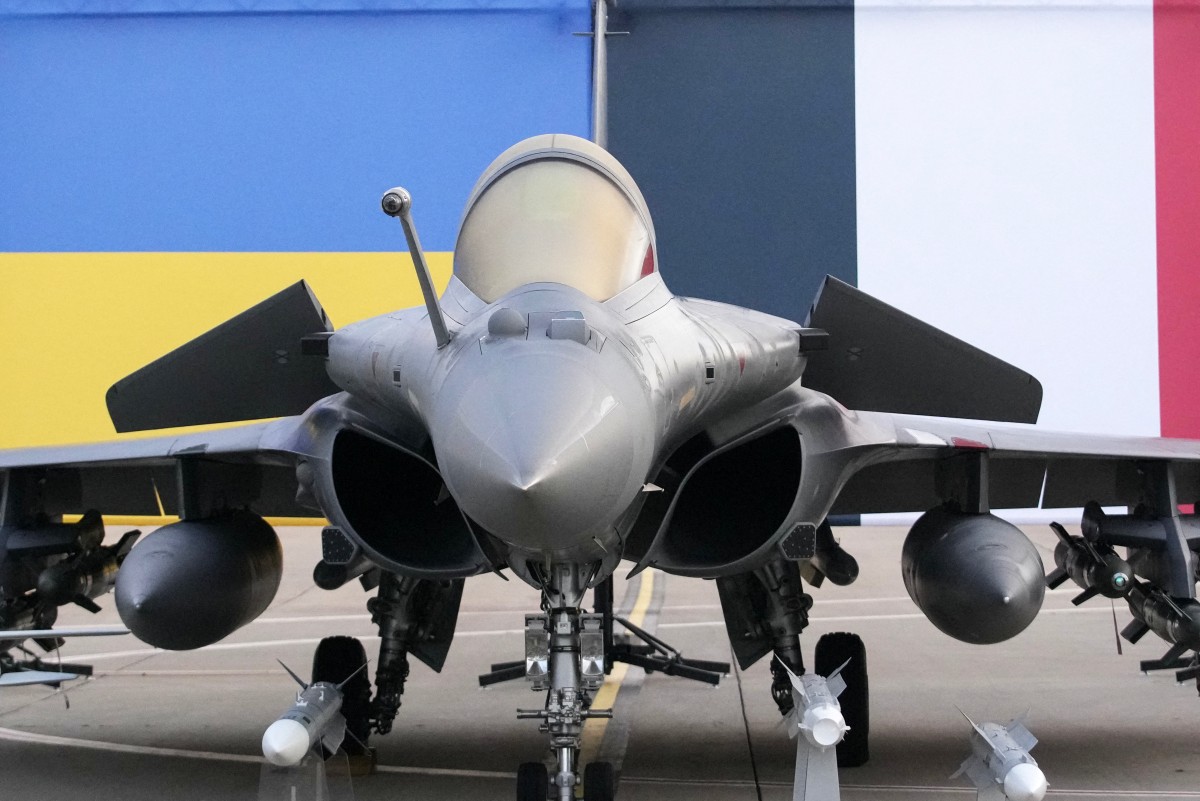
In addition to obtaining F-16s and Mirage 2000s for urgent use and earmarking the Gripens for the medium term, Ukraine has also made arrangements to protect the skies in the long term by advancing plans to buy the French Rafales.
French President Emmanuel Macron told reporters on July 13 that France and Ukraine agreed on a roadmap to help Ukraine acquire 16 Rafale aircraft, along with other weapons.
France has begun preparing to train Ukrainian pilots to fly Rafale fighter jets ahead of delivery, as Benjamin Haddad, France’s Minister Delegate for European Affairs, said last month. An initial batch is targeted to enter service before the end of this decade.
Unlike single-role planes, the omnirole Rafale can perform air superiority, ground attack, reconnaissance, and even nuclear deterrence missions. It can switch between missions with ease, making it versatile across evolving battlefields. Rafale also provides sensor fusion, a digital architecture, Link 16 data links, and networked operations, as the EurAsian Times explained.
Since the Ukrainian crew is already familiar with the French/Dassault ecosystem, integrating the Rafale is likely to be relatively smooth.
Against that backdrop, the Eurofighter Typhoon—despite the Trance 1’s basic configuration—would be the fifth Western aircraft Kyiv could operate. However, acquiring so many different types of jets brings challenges like pilot training, maintenance ecosystems, weapons systems, integration, and a highly diverse supply chain etc.
- Contact the author at sakshi.tiwari13 (at) outlook.com
- Follow EurAsian Times on Google News