

Ukraine is expecting to receive its first Swedish-made Saab Gripen fighter jets in January or February 2027, President Volodymyr Zelensky said after talks with Nordic and Baltic leaders.
Speaking to journalists in Copenhagen, Zelensky said Kyiv had raised the need to accelerate the transfer of Gripen fighter jets.
“They should arrive in January-February, possibly in February. We have raised the issue that we need them as quickly as possible. But, so to speak, the process is already underway,” he said.
He added that Ukraine was “very grateful to Sweden” and that “they have to arrive in January-February, maybe February… but it’s on the way.” On the jets’ role against Russian threats, Zelensky said: “We will see how the Gripens perform against these. We are counting on them for this as well. This is about air defense,” referring in particular to jet-powered variants of Russian Shahed attack drones.
Zelensky also called for more F-16 Fighting Falcons and ammunition, noting that many of Ukraine’s aging existing fleet require frequent repairs. “But they are good, fast, they are capable of destroying jet-powered Shaheds. We use them, and we are grateful to the countries that provided them to us: Denmark and Norway,” he said.
Sweden is donating up to 16 used Gripen C/D fighter jets to Ukraine, which are expected to arrive in early 2027. In a separate deal signed on June 30, 2026, Ukraine is also buying 16 newer Gripen E jets, with deliveries starting in 2029.
Ukraine has expressed interest in acquiring 100–150 Gripen E/F aircraft, potentially including industrial cooperation and local maintenance. In addition to the Gripens, Ukraine is also keen to acquire up to 100 twin-engine Rafale fighter jets from France.
Ukrainian pilots and technicians have already begun training on Gripens in Sweden. The Gripen C/Ds could carry IRIS-T, AIM-120 AMRAAM, and METEOR missiles.
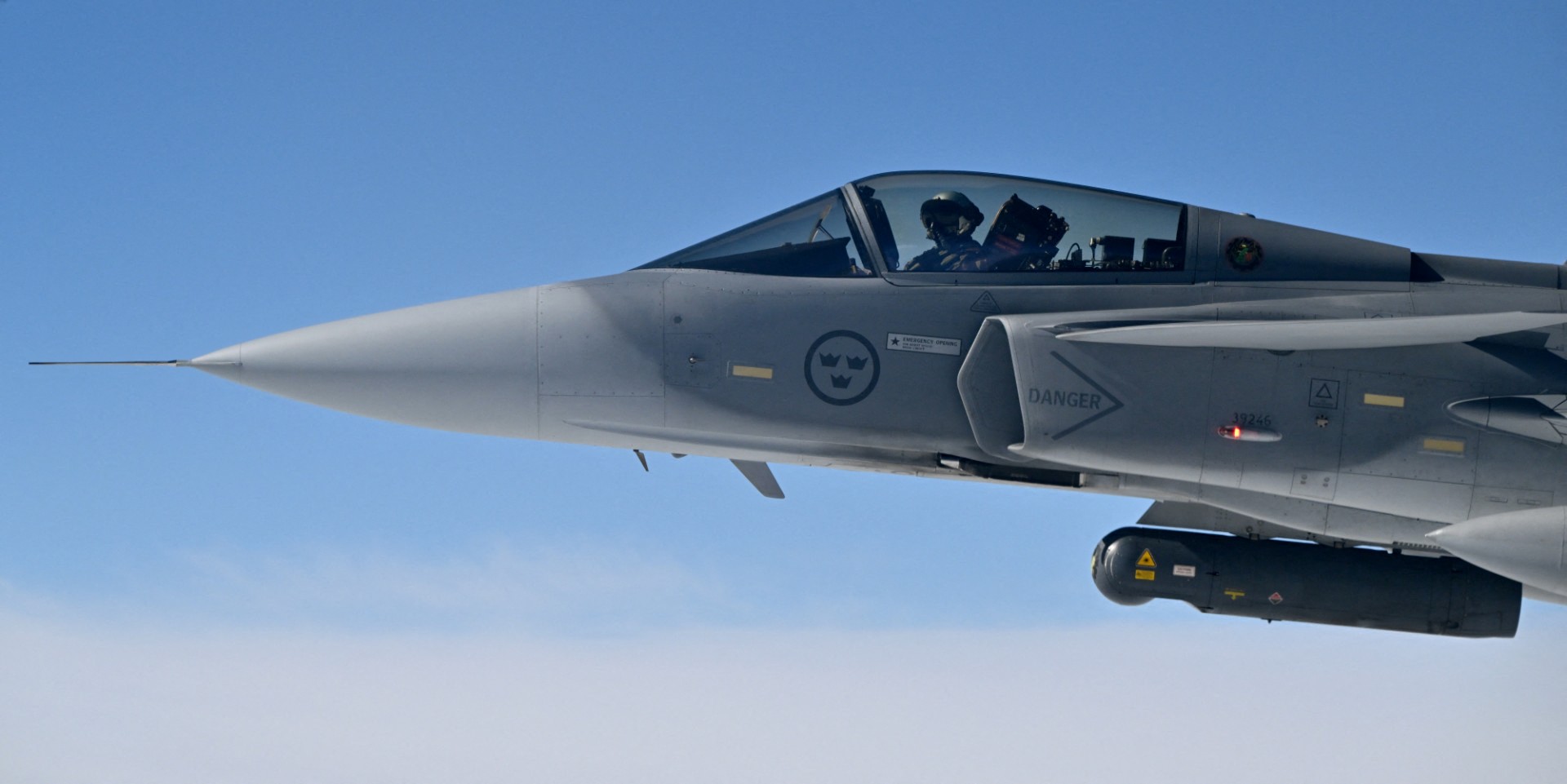
Ukraine has long wanted the Gripen because the aircraft was designed specifically to counter Russia.
It can operate from taxiways, small public airports, and motorways, and conduct dispersed operations, which would help Ukraine not only protect its jets from Russian attacks but also launch surprise attacks from unexpected routes.
With excellent sensor fusion, a capable radar, low operating costs, and the ability to operate effectively from dispersed, austere airfields, the Gripens could greatly boost Ukraine’s ability to counter Russian glide bombs. The initial C/D aircraft use the upgraded PS-05/A radar, while the later Gripen E models will be equipped with the more advanced AESA radar.
Ukrainian officials, including Deputy Head of the President’s Office Pavlo Palisa, have described the Gripen-Meteor combination as the “long arm” of Ukrainian aviation.
“Gripen C with Meteor offers a significantly better chance to successfully engage Su-34s dropping glide bombs 60- 70 km behind Russian front lines than F-16 with AIM-120 or Mirage 2000 with MICA,” Justin Bronk, senior research fellow for air power at the Royal United Services Institute, has said.
Fabian Hoffmann of the Norwegian Institute for Defense Studies has described the pairing as “in principle, the best capability to counter Russian glide bombs before they are launched that Ukraine realistically has access to.”
Gripens are armed with the Meteor missile, widely regarded as one of the world’s best air-to-air missiles that even the US is integrating on F-35s. Equipped with a ramjet propulsion system, Meteor maintains high speed and maneuverability throughout its flight, giving fighter pilots a decisive “no-escape zone” advantage over adversaries.
The Gripen-Meteor combo could be invaluable for neutralizing Russian tactical aircraft—especially Su-34s and escort Su-35s—that launch these glide bombs from standoff distances that Kyiv has not been able to intercept.
Most of the glide bombs Russia uses are unguided Soviet-era gravity bombs fitted with glide kits to generate aerodynamic lift and simple satellite navigation modules for accurate guidance. Initially, Russia developed glide kits for 500-kg gravity bombs. Over time, they developed kits for 250-kg, 1,500-kg, and 3,000-kg bombs.
Ukraine has yet to find an effective counter to UMPK bombs because of their low radar and thermal signatures. In contrast, cruise missiles fly for longer durations and have easily detectable thermal and radio-frequency signatures. So far, Ukraine’s most effective defense against these bombs has been electronic warfare.
The Meteor missiles could try to neutralize Russian glide bombs not by intercepting them, but by destroying the launch platform, mainly the Su-34, before or during bomb release.
The Su-34s typically climb high and fast, release UMPK-equipped bombs from roughly 60–70 km behind the front line and turn away quickly. The Gripen’s radar and sensor fusion, combined with Meteor, improve the odds of getting a viable shot at the Su-34 during that brief period.
However, the Su-34s do not fly alone
They are mostly accompanied by Su-35s and sometimes by MiG-31s.
These escort jets are armed with the R-37M, a very long-range missile that can reportedly strike as far as 300-400 kms, if reports are to be believed. That actually outranges the Meteor missile, which can strike up to 200 km but has a superior no-escape zone. That only happens when the target is locked.
The R-37M was designed for long-range intercepts of less-maneuverable targets like AWACS aircraft or aerial tankers. Against a highly maneuverable combat jet like the Gripen, its effectiveness drops. The point is, whoever sees first will shoot first, despite the missiles’ range. The AEW&C aircraft will play a critical role.
The real air-to-air contest could be between the Gripen and the Su-35. Success will depend on who detects the other first and who has a better risk appetite. Ukraine would have limited Gripen availability to begin with, and they could understandably be more cautious.
The Gripen-Meteor combo may not fully neutralize the Russian glide-bomb threat; however, it improves Ukraine’s ability to inflict heavy penalties on Su-34s and can push release points farther back.
Mail us at: editor (at) eurasiantimes.com