The US has used one-way attack sea drones in combat for the first time, striking Iranian military targets on July 12 as part of ongoing operations against Iran.
Notably, this is the third major weapon system to make its combat debut in the Iran War, following the earlier use of the LUCAS (Low-cost Uncrewed Combat Attack System) and Precision Strike Missiles (PrSM).
The kamikaze naval drones were used by the US on July 12 to strike Iranian military targets in its coastal areas.
An official statement regarding this operation was released by the CENTCOM press office.
“CENTCOM forces struck Iranian military air-defense systems, coastal radar sites, missile and drone capabilities, and small boats using U.S. fighter aircraft, naval vessels, one-way attack aerial drones, and one-way attack sea drones for the first time,” it said in a statement.
While the US has earlier used sea drones, also called unmanned surface vessels (USVs), for surveillance and ISR purposes, this is the first combat use of one-way attack sea drones by the US, underscoring how the US is integrating uncrewed platforms (both aerial and naval drones) in its force structure.
Notably, the US has also used these naval drones for high-risk rescue missions in the Iran war.
Last month, a Corsair USV manufactured by Saronic was instrumental in the rescue of two US Army helicopter crew members after their Apache helicopter was shot down in the Strait of Hormuz off the coast of Oman.
The CENTCOM later confirmed this was the first publicly known instance of an unmanned surface vessel being used to conduct a rescue mission in real-world combat.
The operation was carried out by U.S. 5th Fleet’s Task Force 59, which had begun fielding these sea drones not only for strike and surveillance but also for high-risk support missions, including approaching dangerous zones where sending manned vessels was considered too risky.
For instance, Task Force 59 has publicly stated that it deployed multiple types of sea drones, including Corsair-class USVs, for mine detection and clearance operations in areas considered too dangerous for manned vessels.
Task Force 59 is the US Naval Forces Central Command (NAVCENT) Unmanned Systems Unit and the Navy’s primary hub for integrating drones and AI‑enabled maritime platforms.
In April, CENTCOM announced it would send underwater drones to help clear the Strait of Hormuz.
“Today, we began the process of establishing a new passage, and we will share this safe pathway with the maritime industry soon to encourage the free flow of commerce,” Adm. Brad Cooper, commander of CENTCOM, was quoted as saying at the time.
“Additional US forces, including underwater drones, will join the clearance effort in the coming days,” he added.
All these efforts underscore the rising importance of sea drones in the US Navy’s operations.
In fact, in March, the US Navy canceled the Modular Attack Surface Craft program launched last year to create a new acquisition strategy for unmanned vessels, and launched the medium unmanned surface vessel (MUSV) marketplace.
The naval drones have already proven their worth in the Ukraine War, where Kyiv has achieved many historic firsts with its sea drones, including shooting down a Russian helicopter and even a combat jet and launching devastating attacks on Russian ships, ports and infrastructure.
The global rush for sea drones is thanks in large part to Ukraine’s success in humbling Russia’s mighty Black Sea fleet (BSF) with its sea drones.
It is worth noting that in June, the Ukrainian surface drone Magura sank a target ship during the U.S.-Philippine Balikatan 2026 exercises.
While CENTCOM has not disclosed the specific drone used, Ukrainian media reports suggest it may have been the Variant 7, a US-manufactured drone developed by Red Cat that closely resembles Ukraine’s Magura V7.
Red Cat first announced plans to manufacture these drones in partnership with an unnamed company in May 2025. Last month, the company announced that it had launched the full-scale serial production of the Variant 7.
While Red Cat stresses that the V7 drone was “designed, built, and assembled in the United States,” it has acknowledged that from the outset, the program has involved cooperation with a manufacturer whose maritime drones are being tested daily in real combat conditions, likely a reference to Magura V7.
The published specifications of the V7 closely matched the Magura V7 concept.
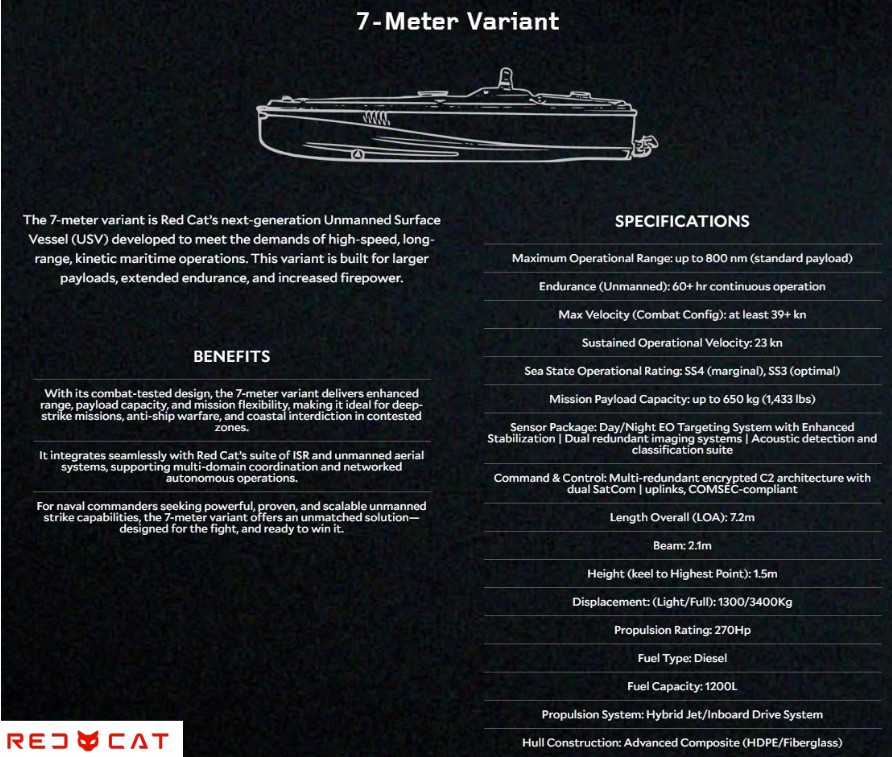
The drone has a maximum range of up to 800 nautical miles and an endurance of over 60 hours of continuous operation. The drone’s maximum speed reaches 39+ knots, and its payload capacity is up to 650 kg. The sensor suite includes a day/night optoelectronic targeting system with enhanced stabilization, dual redundant imaging systems, and an acoustic detection and classification system.
Red Cat states that the V7 integrates a US-developed suite of autonomous control, command, communications, and mission systems. The company also emphasizes that serial production prioritizes US-made components compliant with the National Defense Authorization Act (NDAA).
Nevertheless, Magura V7’s influence on Variant 7 in particular, and in the development of combat naval drones in general, is hard to ignore.
How the Ukrainian Magura Sea Drone Transformed Naval Warfare
In December 2024, Ukrainian military intelligence (HUR) announced that it employed the Magura V5 naval strike drone to hit a Russian Mi-8 helicopter.
The helicopter was hit by a missile launched from the naval drone.
💥 Історичний удар ― воїни ГУР вперше у світі знищили повітряну ціль за допомогою морського дрона Magura V5
🔗 https://t.co/Td2vPEy6St pic.twitter.com/UC3SNnp6ah
— Defence Intelligence of Ukraine (@DI_Ukraine) December 31, 2024
The HUR stated that during a battle in the Black Sea off the western coast of Crimea, the special unit Group 13 fired an R-73 “SeeDragon” missile from the Magura-V5 drone.
The MAGURA V5 achieves a quasi-stealth configuration and exceptional mobility because of its hydrodynamic structure and streamlined profile.
The V5’s automated control system reduces the need for human intervention during missions. This cutting-edge drone has many uses, including combat operations, mine countermeasures, patrols, search and rescue, surveillance, reconnaissance, and naval defense.
Magura-V5 drone boats have been instrumental in pushing back the Russian Black Sea fleet by attacking multiple vessels in the Black Sea. For instance, Ukraine successfully employed six MAGURA V5 multi-purpose unmanned surface vessels (USVs) to sink the Russian Tarantul-III-class missile corvette Ivanovets.
Earlier, in July 2023, the Security Service of Ukraine (SBU) deployed SeaBaby USVs packed with explosives to strike the Kerch Bridge. The attack damaged both the road and rail sections, temporarily halting traffic and disrupting a key Russian supply route to Crimea.
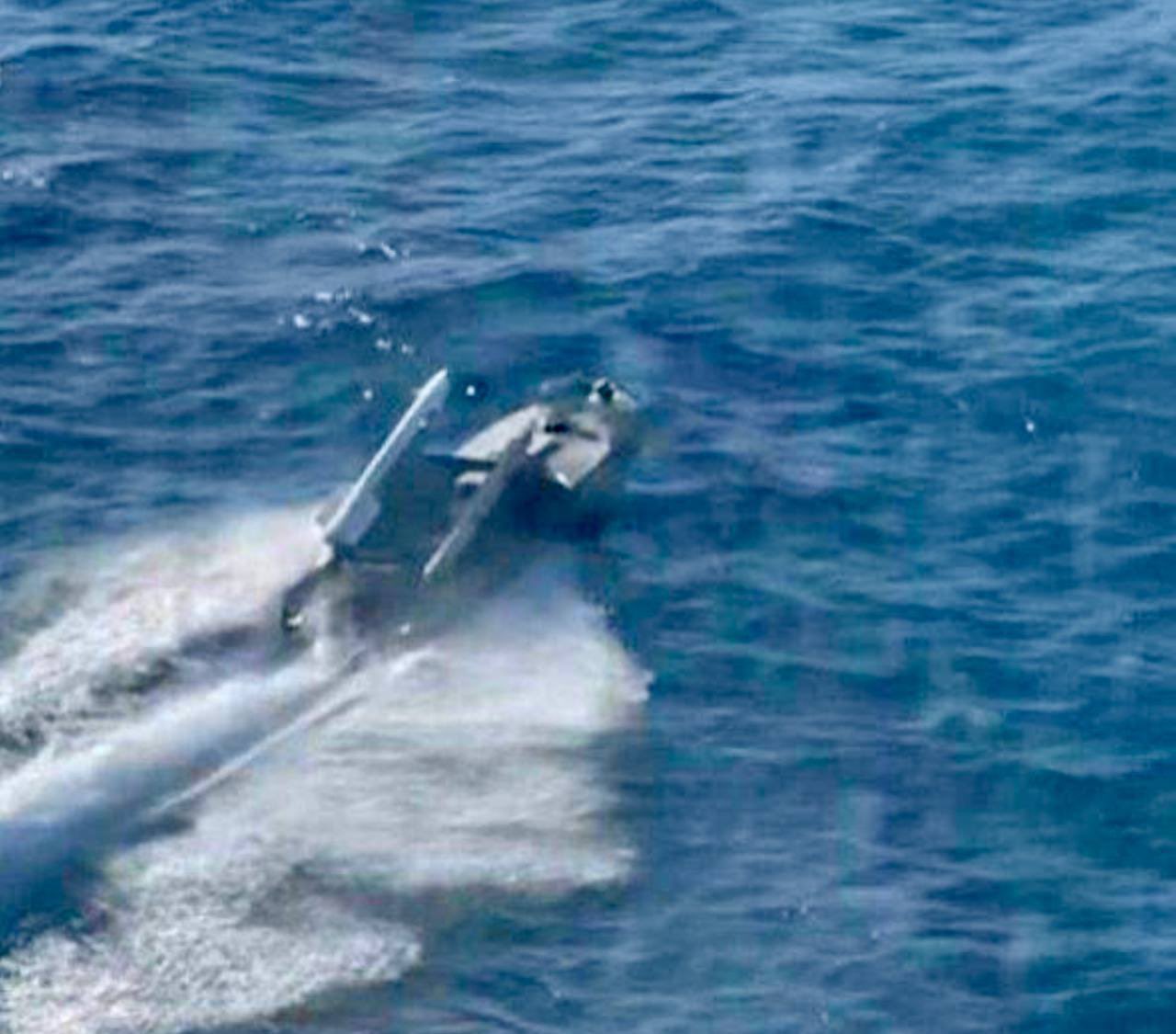
In August 2023, an SBU-operated USV struck the landing ship Olenegorskiy Gornyak in Novorossiysk Bay.
In February 2024, five Magura V5 USVs attacked the Russian amphibious assault ship Tsezar Kunikov.
However, Magura’s crown achievement came in May last year when it struck a Russian Su-30SM fighter jet with an R-73 air-to-air missile.
‼ For the first time in history, a warplane was destroyed by a sea drone.
On May 2, @DI_Ukraine together with @ServiceSsu destroyed a russian Su-30 fighter jet near Novorossiysk with a Magura V5 naval drone.
War at sea is entering a new era. pic.twitter.com/qFTxseh0co
— Defense of Ukraine (@DefenceU) May 3, 2025
In fact, such is the popularity of Ukrainian naval drones that several countries have signed cooperation and co-production agreements with Kyiv.
In December last year, Ukraine and Portugal signed a partnership to jointly produce Ukrainian sea drones.
Earlier this year, the UK signed an agreement to support Ukraine in developing and deploying long-range naval drones capable of open-sea operations, including joint production lines, R&D collaboration, AI integration, and broader maritime unmanned systems capabilities.
Earlier this year, Ukraine even offered its sea drones to Japan.
Similarly, in March 2026, during President Volodymyr Zelensky’s visit to Gulf countries, Ukraine signed 10-year defense partnership agreements with Saudi Arabia, Qatar, and the UAE.
These deals explicitly include the supply of Ukrainian naval drones.
The US military’s first combat use of one-way attack sea drones against Iran represents a major shift in naval warfare, directly inspired by Ukraine’s successful Magura drones.
As Task Force 59 integrates these low-cost, expendable unmanned systems for strikes, surveillance, and high-risk missions, it signals that sea drones have evolved from experimental tools into a core capability for modern navies.
Combat naval drones have now reached the Middle East theatre, and unmanned maritime warfare is becoming a global reality.
- Sumit Ahlawat has over a decade of experience in news media. He has worked with Press Trust of India, Times Now, Zee News, Economic Times, and Microsoft News. He holds a Master’s Degree in International Media and Modern History from the University of Sheffield, UK.
- He can be reached at ahlawat.sumit85 (at) gmail.com