The US Navy recently awarded Boeing a $16.7 million contract to support the shutdown of production lines for the F/A-18E/F Super Hornet and EA-18G Growler.
The Department of War said: “The Boeing Co., St. Louis, Missouri, is awarded a $16,667,607 firm-fixed-price order (N0001926F1139) against a previously awarded basic ordering agreement (N0001926G1002).
This order provides planning, analysis, engineering, and program management support for the shutdown of the F/A-18E/F Super Hornet and EA-18G Growler production lines.
This effort includes inventorying and assessing government-owned production equipment and tooling; developing retention, storage, and disposition recommendations; and delivering a master property inventory and disposition plan. Work will be performed in St. Louis, Missouri (60%); El Segundo, California (37%); and Bethpage, New York (3%), and is expected to be completed in November 2030.
Fiscal 2024 aircraft procurement (Navy) funds in the amount of $16,667,607 will be obligated at the time of award. This order was not competitively procured. Naval Air Systems Command, Patuxent River, Maryland, is the contracting activity.”
Super Hornets Fail to Attract Customers
Boeing announced in 2023 that it would halt Super Hornet production by late 2025. The deadline was pushed back when the US Navy awarded Boeing a $1.3 billion contract to acquire 17 Block III Super Hornets and deliver a technical data package essential to the aircraft’s maintenance.
Boeing later said that it will shutter its production lines once it completes delivery of its last order, projected for 2027.
Despite production coming to a full halt, Boeing will continue upgrading the aircraft. Earlier, it received a new $930.77 million contract from the US Navy to continue work on the Super Hornet Service Life Modification (SLM) program.
The program will increase the service life of up to 60 F/A-18E/F aircraft from 6,000 to 10,000 flying hours, keeping them operational well into the future. Additionally, the US Navy has contracted Boeing to upgrade all the older Super Hornets to the latest Block III standard.
Boeing’s official said on February 23, 2023: As we invest in and develop the next era of capability, we are applying the same innovation and expertise that made the F/A-18 a workhorse for the US Navy and air forces around the world for nearly 40 years.”
Boeing spokeswoman Deborah VanNierop confirmed then that the remaining congressionally added US jets would be “the last American Super Hornets ever built” (absent an Indian Navy win, which did not materialize).
Indian Snub
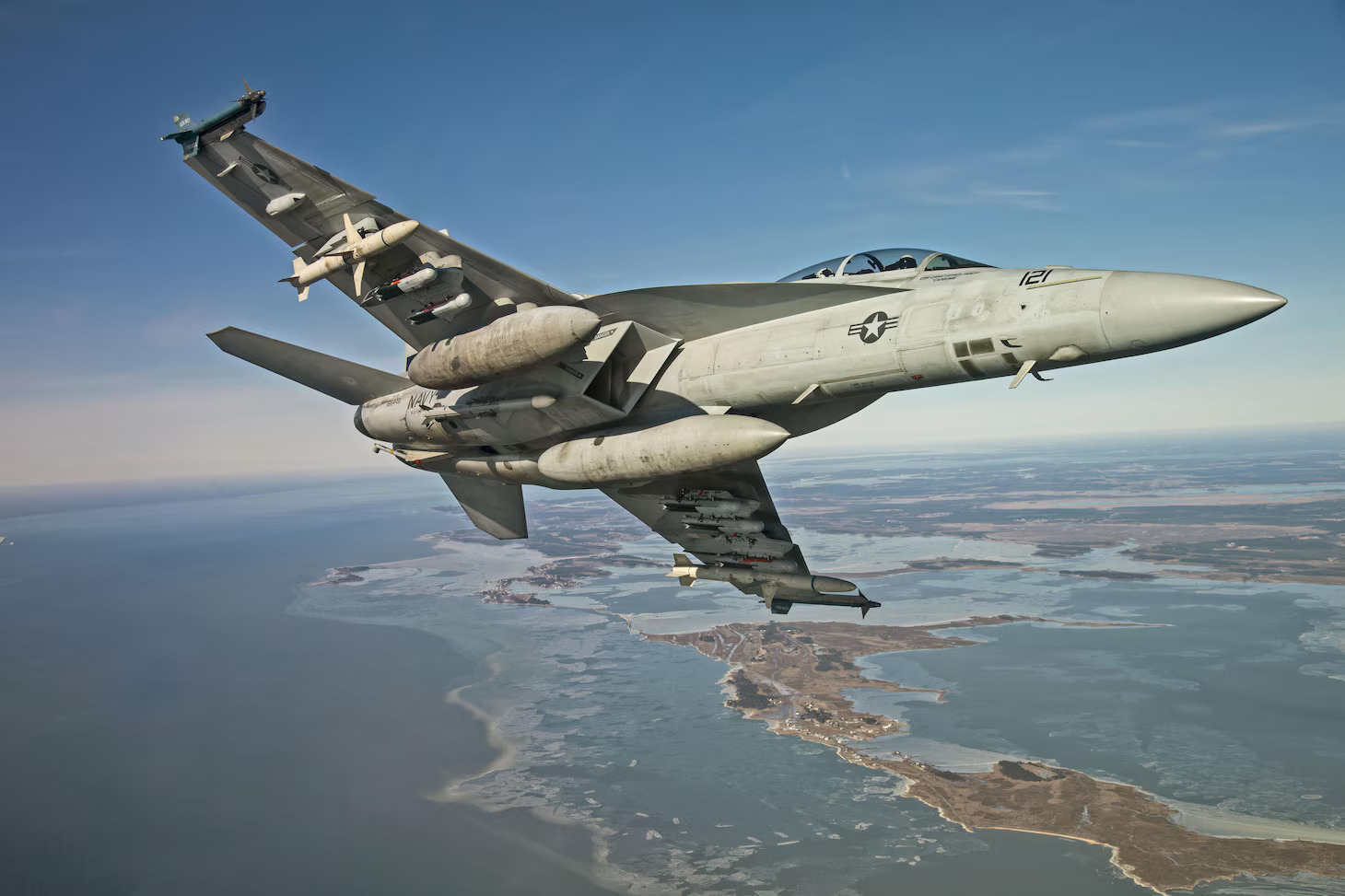
Despite its best efforts to promote the Super Hornets to customers such as Canada, Finland, Germany, Poland, and Switzerland, Boeing failed to secure any new contracts. The last snub came from India, which was looking to replace its Russian-supplied MiG-29 K jets.
Boeing said it would extend the deadline by 2 years to 2027 if the Indian Navy selected the F/A-18 Super Hornet Block III over the French Rafale-M.
Boeing pitched the Super Hornets to India in 2022 and announced a roadmap to greatly increase its investments, in line with the “Make in India” initiative.
It also promised technology transfer (ToT) to the Indian industry if Delhi selected the Super Hornets. However, after a series of trials, India selected Rafale-M jets over the Super Hornets. You can read a full analysis of why the Super Hornets lost to the Rafale-M jets here.
“We ran several international campaigns or competitions that we were unsuccessful in previous years,” Mark Sears, Boeing vice president for fighters, said in a 2024 interview. “That kind of played out, and there are no active discussions with the Navy about additional F-18s beyond these.”
He added that Boeing was focused on delivering the remaining jets on schedule “because we know how badly the Navy needs this capability,” while pivoting the St. Louis workforce to other programs (F-15EX, T-7A, MQ-25).
Super Hornet
The Super Hornet was developed to close a critical capability gap in US naval aviation during a period of major service restructuring.
The A-6 Intruder fleet was aging, the F-14 Tomcats were becoming difficult & expensive to maintain, and the baseline F/A-18 Hornets lacked the range and payload for deep-strike operations, creating a capability gap for the US Navy in the 1980s.
Because building a new jet from scratch would require a significant investment in an austerity-dominated era, McDonnell Douglas proposed developing a 70% larger, extensively redesigned F/A-18 Hornet.
McDonnell Douglas established the F/A-18E/F Super Hornet production line in the mid-1990s, and Boeing acquired the company in 1997. The aircraft made its maiden flight on November 29, 1995, and Boeing began full-rate production in September 1997.
The first production Super Hornet flew in November 1998, with deliveries to the US Navy beginning in January 1999.
It replaced the F-14 Tomcat in fleet defense, assumed the A-6 Intruder’s strike role, and eventually became the model for the EA-18G Growler. This dedicated Electronic Warfare combat aircraft entered service with the US Navy in 2009.
“The Super Hornet is the second major model upgrade since the inception of the F/A-18 aircraft program, highly capable across the full mission spectrum: air superiority, fighter escort, reconnaissance, aerial refueling, close air support, air defense suppression and day/night precision strike,” as per information on the official website of NAVAIR (Naval Air Systems Command).
The production line, primarily at Boeing’s St. Louis, Missouri, facilities, has continued to churn out these cutting-edge jets since then.
The aircraft was upgraded to Block II standard in 2002, adding Active Electronically Scanned Array (AESA) radar, improved sensors and avionics, increased range, and the ability to employ a precision-weapons arsenal.
This aircraft then became the workhorse of the US Navy’s carrier operations and recently received its most advanced Block III upgrade.
The US Navy is the largest operator of the Super Hornets.
The aircraft has seen extensive combat, including the current conflict in the Middle East, since it made its debut with a strike against hostile targets in Iraq’s no-fly zone in November 2002.
- Mail us at editor (at) eurasiantimes.com
- Follow EurAsian Times on Google News