An MQ-28 Ghost Bat flew in formation with a US Air Force F-15EX Eagle II during Exercise Valiant Shield 2026, marking a major milestone in manned-unmanned teaming (MUMT).
The Boeing Defence Australia-developed MQ-28 Ghost Bat, a production representative test aircraft, was reportedly integrated with US and allied forces during Exercise Valiant Shield 2026—the 10-day multinational drills that included anti-submarine warfare, maritime strike, and cutting-edge drone testing, among other activities.
The exercise tested human-machine teaming in realistic scenarios, including defensive and offensive counter-air missions. The main objective of deploying the MQ-28 to drill was to analyze the aircraft’s role as a force multiplier, increasing the reach, awareness, and survivability of crewed platforms in contested areas, as noted by Pacific Air Forces (PACAF) ahead of the drone’s deployment.
According to open-source reporting, the MQ-28 flew alongside the US Air Force F-15EX Eagle II assigned to the 85th Test and Evaluation Squadron over the Philippine Sea.
PACAF posted a photograph of the CCA and the American F-15EX Eagle II flying together. However, there is currently no information on whether the fighter jet pilot directly commanded the Collaborative Combat Aircraft (CCA).

CCAs, also known as loyal wingman drones, are capable of performing high-risk missions, extending sensor range, carrying additional payloads, providing electronic warfare or jamming support, or conducting ground strikes.
The integration of the MQ-28 Ghost Bat with manned fighters in the Indo-Pacific theatre is consequential, given that the US and its allies are consistently seeking to build capabilities to counter China and its aggressive military posturing, particularly in the South and East China Seas.
“The future of airpower is a partnership between our greatest assets: our skilled warfighters and the technology that empowers them,” US Air Force Maj. Daniel Pesich, Experimental Operations Unit collaborative combat aircraft detachment officer in charge, said. “By advancing human-machine teaming, we are increasing our power projection while building a more resilient, capable, and lethal joint force.”
The MQ-28 & F-15EX Combination
The MQ-28 is a stealthy, Artificial Intelligence (AI)-driven drone designed for intelligence, surveillance, reconnaissance (ISR), electronic warfare (EW), and strike roles. Meanwhile, the F-15EX is a modernized, twin-seat, high-payload, non-stealthy 4.5-gen fighter with powerful radars, long range, and a large weapons loadout.
It is believed to be an excellent “quarterback” for loyal wingman drones such as the MQ-28.
“Batman and Robin? Well, actually, it’s the F-15EX Eagle II and the MQ-28 Ghost Bat loyal wingman, photographed during Exercise Valiant Shield ’26. This Pacific debut is a big milestone for manned-unmanned teaming (MUM-T). Boasting a 3,700 km range, the AI-driven Ghost Bat acts as an off-board, low-observable sensor and weapons platform for the F-15EX,” wrote AirPower, a dedicated aviation-tracking page on X.
This may be the first time the Boeing Australia MQ-28 has been seen flying alongside the F-15EX, even though it has previously integrated with the Royal Australian Air Force (RAAF) E-7A Wedgetail and an F/A-18F Super Hornet.
Initiated under Australia’s Loyal Wingman Advanced Development Program, the MQ-28 has a range of about 3,700 kilometers and an endurance of over 10 hours and is harder to detect due to its low radar cross-section.
The MQ-28 can perform ISR (Intelligence, Surveillance, and Reconnaissance) missions, collecting real-time data and disrupting enemy communications, radar, and defense systems, just like a standard long-winged drone, as previously explained by the EurAsian Times. At the same time, it can conduct precision strikes against enemy targets or act as decoys to draw enemy fire and help protect manned aircraft.
Unlike typical drones, which require constant pilot “remote control,” the MQ-28 combines built-in artificial intelligence (AI) with autonomous capabilities, enabling it to fly independently and adapt to evolving combat conditions.
Meanwhile, the F-15EX is the most advanced variant of the iconic F-15 Eagle built to date and can engage multiple targets simultaneously and execute a range of missions per sortie, including close air support, interdiction, and air superiority, as noted in an earlier information sheet.
While it lacks the stealth of fifth-generation US fighters like the F-22 Raptor and F-35, the F-15EX possesses remarkable combat capabilities and unmatched payload capacity, earning it the moniker “Bomb Truck.”
The F-15EX can swiftly penetrate deep into contested airspace using external fuel tanks without compromising weaponry, thanks to its combat radius of over 1,000 kilometers and top speed of Mach 2.5. Additionally, the aircraft is equipped with fly-by-wire controls, the APG-82 AESA radar, and the EPAWSS electronic warfare suite, which provide better jamming resistance and sensor fusion.
Boeing had previously offered a package deal comprising the F-15EX and MQ-28 to Poland, as reported by EurAsian Times.
One twin-seater F-15EX with a pilot and a weapons systems officer (WSO) can control or direct multiple MQ-28s, dramatically increasing sortie generation, sensor coverage, and weapons-on-target without introducing more manned fighters.
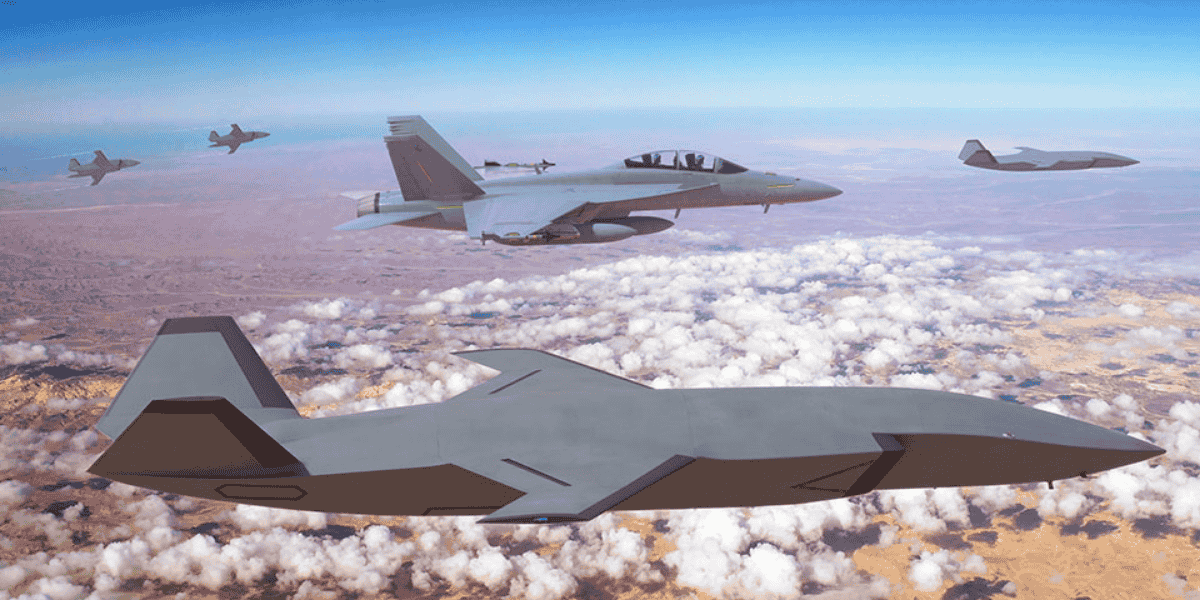
Teaming up with crewed fighters, including but not limited to the F-15EX, the MQ-28 could extend the sensor envelope for early threat detection and carry electronic warfare payloads in contested battlefields. In fact, Boeing and Rheinmetall are together offering the MQ-28 to Germany on this premise.
MQ-28-like CCA drones could absorb higher-risk roles, such as penetrating deeper into contested areas, drawing fire, or lingering in threat zones, allowing the crew of the F-15EX to remain safer. This is especially valuable in high-threat scenarios, such as those involving adversaries like the Chinese People’s Liberation Army (PLA).
The MQ-28 Ghost Bat test-fired an AIM-120 Advanced Medium-Range Air-to-Air Missile (AMRAAM) over the Woomera Range Complex (WRC) in southern Australia in December 2025. At the time, the CCA worked alongside a Royal Australian Air Force (RAAF) E-7A Wedgetail and an F/A-18F Super Hornet to effectively engage and destroy an Australian-made Phoenix jet-powered target drone.
Equipping the Ghost Bat with air-to-air missiles transforms it into a more deadly strike platform while maintaining low observability.
Moreover, integrating the Ghost Bat with the F-15EX, already known as a bomb truck, will introduce immense firepower to the battlefield.
Last month, the upgraded version of the MQ-28—the Block 3—was unveiled, as the EurAsian Times reported at the time. Boeing states that the wings of the Block 3 Ghost Bat will be about 25% larger than those of previous iterations, allowing the CCA to carry an additional 2,000 pounds of fuel, stores, and mission payloads.
More importantly, though, Block 3 adds internal armament bays that can hold four Small Diameter Bombs (SDBs) or two AIM-120 AMRAAM missiles, making the drone stealthier. The low-RCS MQ-28 could complement the more detectable F-15EX, providing forward presence for reconnaissance, jamming, or initial engagements in aerial combat.
The MQ-28 has an open, modular architecture that supports integration with the F-15EX’s advanced systems to share data and coordinate attacks. It can be acquired in larger numbers, creating “affordable mass” for high-threat scenarios, such as in the Indo-Pacific, where losses are more acceptable than those of expensive manned aircraft.
The Block 1 and Block 2 variants of the drone have completed more than 150 test flights in Australia and the US, making the Ghost Bat one of the most mature CCA technologies in the world. The integration with manned fighters in a multinational exercise adds to the many milestones the drone has achieved recently, including its first international flight on the Point Mugu Sea Range at the US Naval Base Ventura County in Point Mugu, California.
- Contact the author at sakshi.tiwari13 (at) outlook.com
- Follow EurAsian Times on Google News