The two most lethal attack helicopters of the United States military—the AH-64 Apache and the MH-60 Seahawk—conducted strikes on multiple Iranian boats as a fresh operation aimed at reopening the Strait of Hormuz.
The Strait of Hormuz, a vital shipping route through which one-fifth of the world’s crude oil normally flows, has been under a de facto closure enforced by Iran’s IRGC (Islamic Revolutionary Guards Forces) since the US-Israeli offensive began.
In a latest development, the US will pause escorting commercial ships through the Strait of Hormuz, US President Donald Trump said Tuesday, citing a desire to reach a peace deal with Iran. Despite an uptick in military activity in recent days, Trump said “great progress has been made” toward a deal with Tehran and that the ship-guiding operation “will be paused for a short period of time to see whether or not the Agreement can be finalized and signed.”
The announcement came hours after Secretary of State Marco Rubio said Washington had completed its offensive operations against Iran, while withholding the right to unleash a “devastating” response to any new attacks on shipping in the narrow shipping lanes.
Earlier, with the peace talks hitting a stalemate, Trump ordered a new military strike in the Strait of Hormuz on May 4, 2026, under “Project Freedom,” and announced that the US would help “guide” ships that had been stranded in the Persian Gulf by Iran’s closure of the strait.
“The Ship movement is merely meant to free up people, companies, and Countries that have done absolutely nothing wrong — They are victims of circumstance,” Trump stated. He termed the operation as “a Humanitarian gesture on behalf of the United States, Middle Eastern Countries, but, in particular, the Country of Iran” – as many of these vessels were “running low on food, and everything else necessary for large-scale crews to stay on board in a healthy and sanitary manner.”
Meanwhile, the commander of US CENTCOM, Adm. Brad Cooper, reported that US forces had successfully cleared an Iranian mine-free path, emphasizing that two US attack choppers, the AH-64 Apache and the MH-60 Seahawk, had struck six small Iranian fastboats in the Strait of Hormuz as part of the mission.
“We have an enormous amount of capability and firepower concentrated in and around the strait, including AH-64 Apache and MH-60 Seahawk helicopters used just this morning to eliminate six Iranian small boats threatening commercial shipping. So we’re backing up commitment with action,” Navy Adm. Brad Cooper said during a press conference.
Adm. Brad Cooper, CENTCOM commander, flew over regional waters in and near the Strait of Hormuz in an AH-64 Apache helicopter, May 3, on the eve of U.S. military support for Project Freedom. He interacted with U.S. Army Soldiers after visiting with Sailors and Marines on Saturday… pic.twitter.com/NEc9YCFBPB
— U.S. Central Command (@CENTCOM) May 4, 2026
“You typically see between 20 and 40 small boats in a pack coming out,” the admiral said. “Today, we saw six and eliminated them quickly. I think this is an example of the degradation of their capability. It doesn’t mean it’s all gone, but it’s highly degraded.”
This is not the first time these two cutting-edge helicopters have been deployed to chase and hit small boats. In December 2023, for instance, these choppers conducted a similar mission against three of four hostile small boats allegedly belonging to the Yemen-based Houthis, who were involved in conducting attacks on commercial shipping in the Red Sea.
Modern platforms, such as the Apache and the Seahawk, are equipped with sophisticated sensor suites that allow their crews to identify, track, and target small, fast-moving surface threats. They are also outfitted with high-caliber machine guns or autocannons, laser-guided rockets, and anti-tank missiles, forming a diverse loadout that allows commanders to adjust their response to the type and intensity of the threat.
Apache and Seahawk On Duty
According to open source reporting, the US Air Force A-10 Warthogs and Army AH-64s had begun carrying out sorties against Iranian naval assets in and around the Strait of Hormuz even before the US and Iran mutually agreed to the ceasefire that ended about five weeks of intense hostilities. Meanwhile, the MH-60 Seahawk was previously known to be flying armed force-protection missions as part of Operation Epic Fury against Iran.
The Apache, for one, is a land-based attack helicopter that has been deployed on missions in CENTCOM over the past few months.
The manufacturer, Boeing, describes the AH-64E Apache helicopter as “an advanced multi-mission helicopter with the latest technology insertions, maintaining its standing as the world’s best attack helicopter. It is the only available combat helicopter with a spectrum of capabilities for virtually any mission requirement, including greater thrust and lift, joint digital operability, improved survivability, and cognitive decision aiding.”
Apache 64-A is a four-blade, twin-turboshaft helicopter with a nose-mounted sensor suite that simplifies target acquisition. The laser, infrared, and other systems enable the helicopter to locate, track, and attack targets.
It also features a combination of laser-guided precision Hellfire missiles, 70mm rockets, and a 30mm automatic cannon, equipped with up to 1,200 high-explosive, dual-purpose ammunition rounds, which could be useful for strafing small boats. The helicopter can conduct precision attacks at standoff ranges and operate in hostile airspace while facing ground threats. The AH-64’s advanced targeting systems and sensors enable day, night, and all-weather missions.

Notably, the Apaches are built to be “tank killers,” and in the event of a confrontation, their Hellfire missiles could launch precise attacks against armored formations. However, in the present context, the Apaches seemed to have assumed the role of “small boat killer”.
Apaches are capable of performing extended maritime operations, including patrols, deck landings on military vessels, and long-range overwater flights. In fact, the US Army has practiced “maritime deep attack” scenarios in the Pacific, notably near the South China Sea, focusing on long-range maritime air assault, island-chain support, and anti-surface strikes. It has also performed deck-landing and live-fire drills from ships.
The AH-64 has sophisticated avionics, including helmet-mounted displays, FLIR/EO targeting, and the Longbow millimeter-wave radar, which enable it to identify and engage small, swiftly moving surface targets, such as boats, in a variety of scenarios, including low-level flying, for improved spotting. Moreover, fire-and-forget engagement is supported by radar-guided Hellfire missile variants that can be fired from the helicopter.
On the other hand, the MH-60 Seahawk is a highly versatile, twin-engine, medium-lift helicopter used extensively by the US Navy for a wide array of maritime missions. It is essentially a navalized version of the UH-60 Black Hawk, adapted for the challenging environment of shipboard operations.
The current fleet is standardized into two primary variants: the MH-60R “Romeo” and the MH-60S “Sierra.”
Often called a “hunter-killer” helicopter, the MH-60R is the Navy’s top anti-surface and anti-submarine combat platform. It can identify, track, and combat both undersea and surface threats thanks to its comprehensive sensor package, which includes sophisticated radar and dipping sonar. It is crucial for safeguarding carrier strike groups and surface combatants because it has primary responsibilities in electronic warfare, anti-surface warfare, and anti-submarine warfare.
The MH-60S, on the other hand, is a multipurpose utility helicopter intended for both humanitarian and combat support operations. It is considered an ideal platform for mine countermeasures, vertical replenishment (supplying ships), search-and-rescue, and special operations support, thanks to its large cargo doors and high degree of configurability.
While it has the same airframe architecture as the MH-60R, its adaptability and transport capabilities are prioritized over the specialized sub-hunting sensor package.
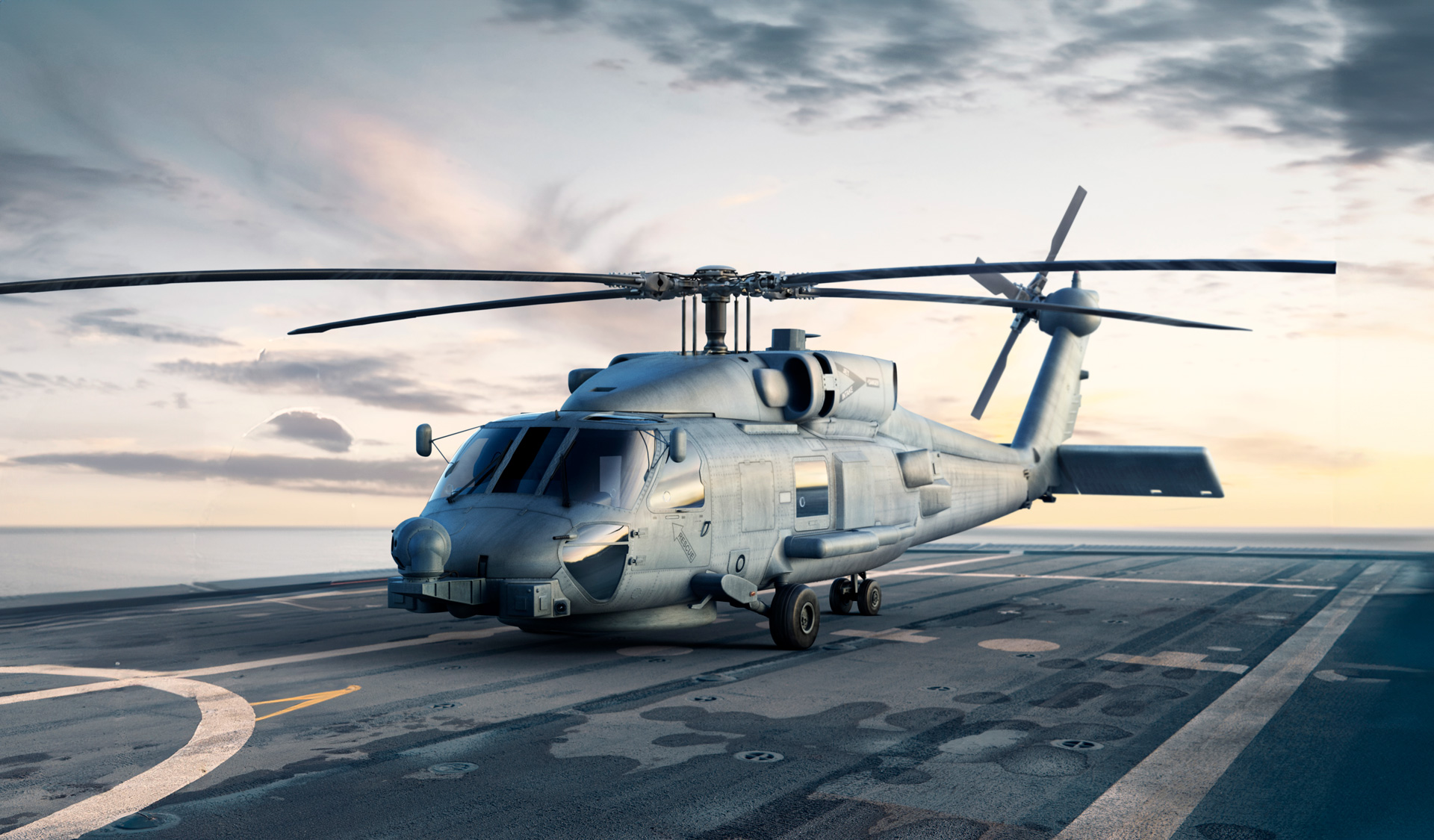
Both the above-mentioned helicopters can operate across a range of platforms in littoral warfare, including surface ships, destroyers, and aircraft carriers. They can deliver vital supplies at sea or carry out life-saving rescues, thanks to their cargo hooks and rescue hoists. And, they can effectively hunt down enemy small boats.
These helicopters can detect and track hostile small ships from considerable distances using a combination of high-resolution radar and electro-optical/infrared sensors, enabling operators to maintain situational awareness even in crowded waterways. This means that commanders can detect threats early and develop a precise, proportionate reaction thanks to this sensor integration.
When engaging targets, the MH-60 platform offers a diverse and lethal array of weaponry tailored for maritime environments.
The MH-60R variant is frequently armed with AGM-114 Hellfire missiles, which are highly effective against patrol boats and fast attack craft due to their precision-guidance capabilities. In addition to precision missiles, these helicopters can deploy door-mounted crew-served weapons, such as .50-caliber machine guns, to neutralize threats at shorter ranges or provide suppression fire during interdiction operations.
Beyond direct kinetic attacks, the MH-60 can serve as a mobile “hunter-killer” platform, operating alone or in tandem with surface ships. The helicopter can be used as a rapid-response unit, providing a high-value targeting platform, or as an over-the-horizon sensor node that directs strikes launched from ships.
- Contact the author at sakshi.tiwari13 (at) outlook.com
- Follow EurAsian Times on Google News