As the Philippines advances its search for a new multi-role aircraft, aerospace and defense manufacturer Leonardo has stepped up its pitch to sell the Eurofighter Typhoon, offering a new customization option to meet Manila’s requirements.
“The Eurofighter program has consistently configured the aircraft to meet each operator’s specific environmental and operational conditions, a reflection of the platform’s design flexibility and the depth of engineering experience behind it,” Enrico Fossatti, head of Leonardo’s Eurofighter Export Campaigns for marketing and sales, told the Philippine News Agency (PNA) on August 11, 2026.
Eurofighter Typhoon was developed by a consortium consisting of Airbus and BAE Systems. In an interview last year, Leonardo’s Vice President for Eurofighter Typhoon Exports, Constantino Pravini Rosati, said the company was designated by the consortium in 2023 to lead the Philippine campaign following the PAF’s Request for Information (RFI).
In September 2025, Leonardo reportedly offered up to 32 Eurofighter Typhoon Tranche 5 fighters to the Philippine Air Force (PAF).
The Philippines is pursuing multi-role fighters as part of the Re-Horizon 3 phase of the Armed Forces of the Philippines Modernization Program. The primary goal is to build credible air deterrence amid territorial disputes and ongoing tensions in the South China Sea, which China claims as its sovereign territory almost entirely.
The Department of National Defense (DND) Secretary Gilberto Teodoro Jr. said the Philippines is looking for at least five potential suppliers for its MRF program. In addition to the Eurofighter Typhoon, this list reportedly includes Sweden’s SAAB Gripen-E/F, South Korea’s KF-21 “Boramae”, Lockheed’s F-16V Viper, and the Dassault Rafale.
Notably, Fossatti previously told PNA that Leonardo and the consortium could move quickly if selected by the Philippine Air Force (PAF).
“Once a contract is signed, Leonardo and the consortium can act promptly to lock in a delivery schedule based on production capacity, fleet size, and configuration requirements at the time of award. Our approach with the PAF, as it has been throughout our engagement with Philippine authorities over the past two years, is full transparency: clear, realistic timelines rather than unsubstantiated projections,” he said. “And our objective is to bring that same reliability to the DND and the PAF, with a delivery plan which will allow gradual entry into service of the weapon system and transition of PAF pilots and technicians to the new platform.”
The company has now elevated its offer by emphasizing environmental customization.
“So far, the Eurofighter has been flying in very different climate environments, from the Falklands to Iceland, from the Baltic to Australia, with demonstrated exceptional track records. The Philippines’ tropical, maritime setting would naturally inform any configuration work. Should the Philippines proceed with the program, Leonardo and the partner nations would work directly with the Department of National Defense and the Philippine Air Force to tailor the aircraft accordingly, subject to possible bilateral agreements and the relevant approvals,” Fossatti told the PNA recently.
He also highlighted the aircraft’s armament and systems as a key strength. “What we can assure is that the aircraft will be equipped to fulfill the full range of missions required by the Philippine Air Force, drawing on a weapons integration pedigree that has been proven across multiple Eurofighter operators, subject to applicable approvals,” he stated.
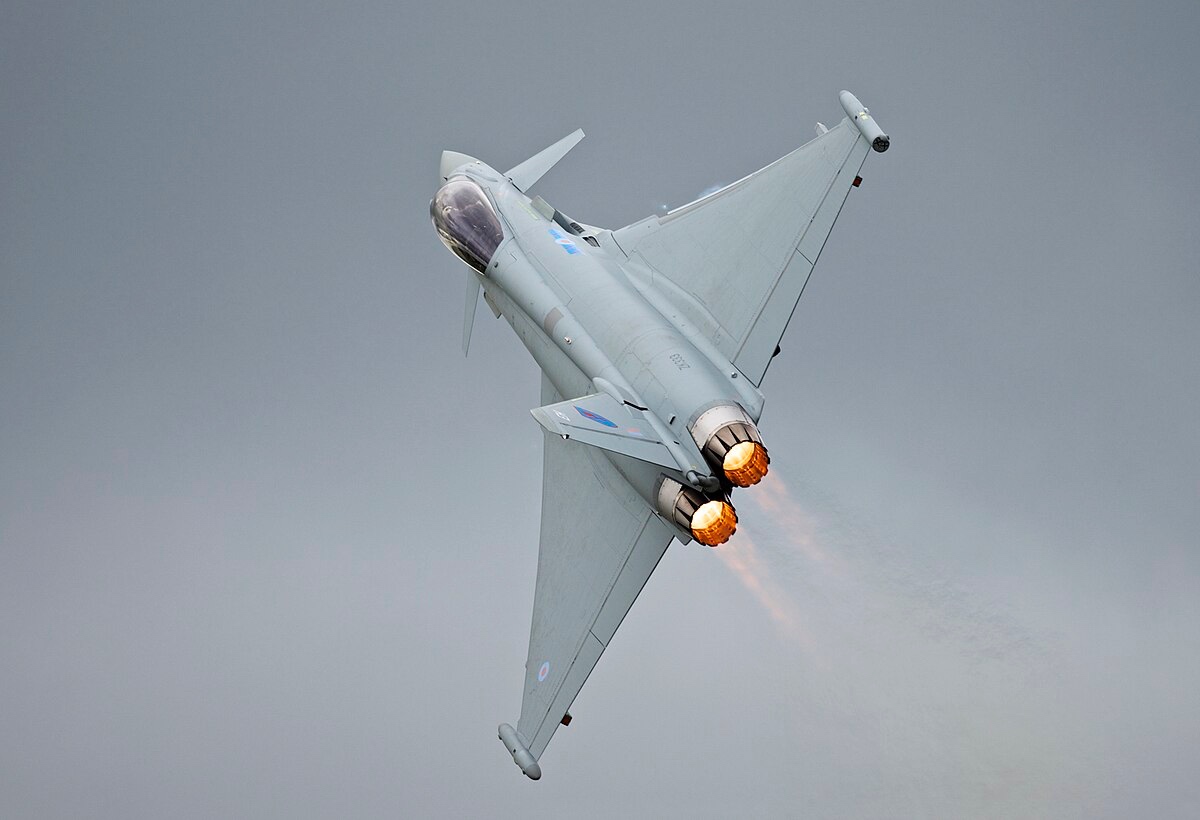
The Typhoon is a twin-engine, canard-delta-wing, multirole fighter, classified by Airbus as the world’s most advanced 4.5th-generation multirole fighter.
The Philippine campaign comes as the Eurofighter consortium experiences a resurgence in sales after years of competition with Lockheed Martin’s F-35 Lightning II. Turkey ordered 20 jets in October 2025, and Bangladesh signed a Letter of Intent in December 2025 to begin talks to acquire the aircraft. Meanwhile, among the consortium members (the UK, Germany, Italy, and Spain), Germany placed an order for 20 Tranche 5 Eurofighters last year, while Spain and Italy ordered 25 and 24 new jets, respectively.
Notably, the Philippines is seeking a new multi-role fighter primarily to strengthen deterrence and safeguard its extensive maritime zones and archipelagic territory amid recurrent confrontations with China in the disputed South China Sea. There has been a significant increase in these encounters at flashpoints in recent years, with Beijing issuing clear warnings to Manila.
The acquisition of a multi-role fighter would allow Manila to build a credible deterrent against the PLAAF.
Typically, true multi-role fighters, such as the Eurofighter Typhoon, offer advanced AESA radars, better beyond-visual-range missiles, electronic warfare suites, and higher performance than existing PAF FA-50s. These features would enable effective air defense, quick-reaction alerts, and the ability to contest airspace over Philippine territory and maritime zones.
Additionally, an advanced fighter jet, such as the Eurofighter, would enable sustained patrols and maritime interdiction, and provide support for naval and coast guard operations with longer endurance, greater payload capacity, and better sensors.
Interestingly, China recently published details of the J-10C’s triumph over the Eurofighter Typhoon in a 2024 mock drill, in what appeared to be an attempt to promote the Chinese fighter jet as a more suitable export alternative to the European fighter jet.
Did J-10C Beat Eurofighter Typhoon?
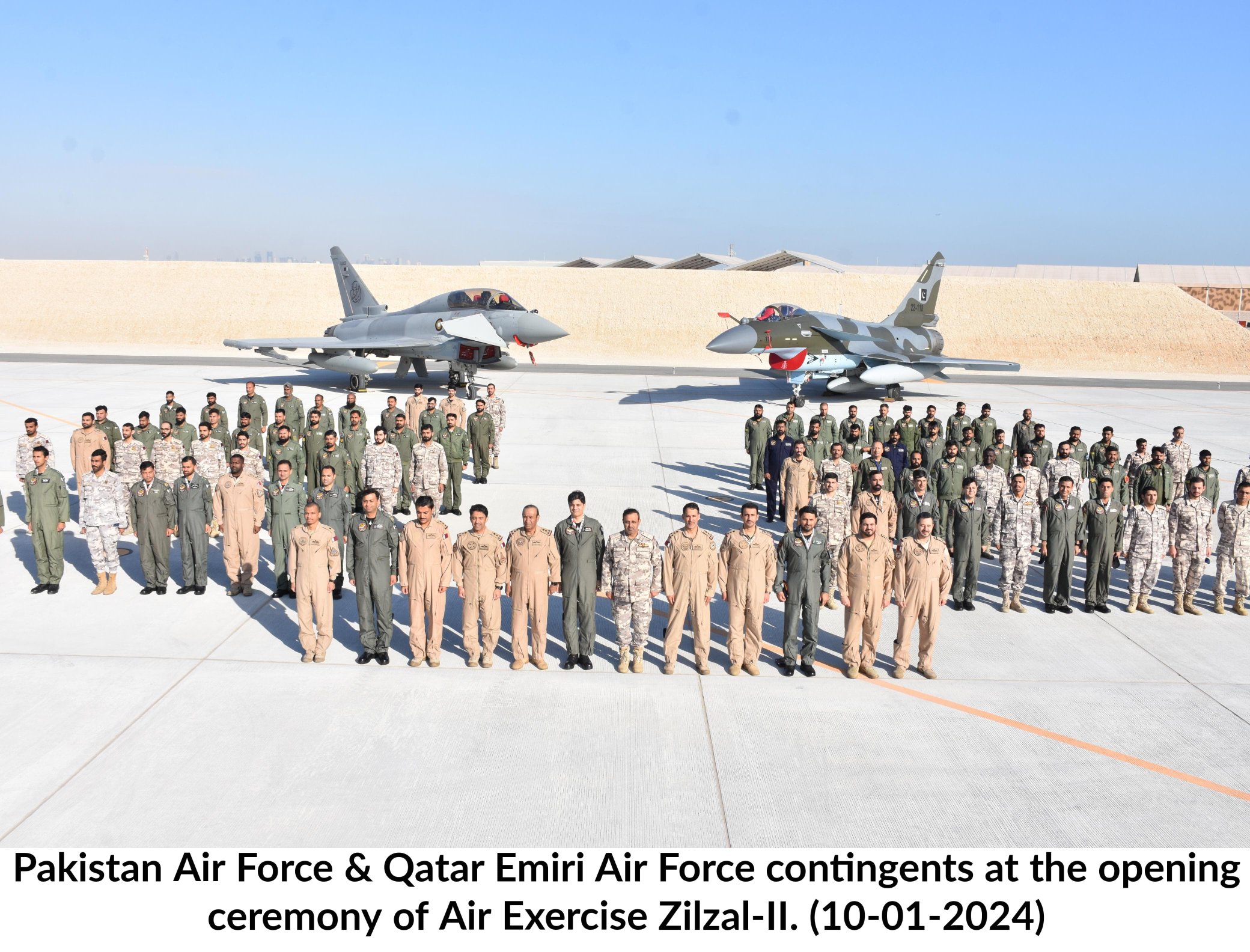
The Chinese state broadcaster CCTV claimed in May 2026 that the J-10CE hammered the Eurofighter Typhoon by winning all 9 engagements in a mock combat in 2024. The mock battles took place during the “Zilzal-II” Pakistan-Qatar joint air exercise in January 2024, in which the J-10CE “defeated” the Eurofighters of the Qatar Emiri Air Force (QEAF).
The J-10CE reportedly beat the Eurofighter Typhoon in four simulated combat scenarios conducted beyond visual range and won all five of its close-range dogfights. The EurAsian Times reported on this mock battle when it took place in 2024.
A well-known Chinese military influencer, Liu Xiaofei, had stated: “If this claim can be confirmed, it shows that China’s previous-generation fighter jets are being continuously improved and have achieved similar, or even superior, ability compared with European fighters.”
“It is certainly within reason. Of course, the usual caveats about DACT [Dissimilar Air Combat Training] parameters and exercise realism and conditions apply, but if one assumes somewhat common sense and equal conditions, the outcome is still within reason,” Rick Joe, a popular PLA analyst, told the EurAsian Times when asked about the feasibility of 9-0 claims.
“From what I’ve gathered in recent years (even before the May 2025 conflict), the J-10C is a fairly impressive aircraft for its category and generation, even by international standards, and the PAF would have been given fairly up-to-date training and tactics from the PLAAF on how to maximize its effectiveness. Couple that with the PAF itself being an air force that has its house in order, I could see them on that occasion being able to achieve a disproportionately favorable outcome on that particular exercise, against that particular air force, at that particular time,” he added.
However, experts have emphasized that this does not automatically mean the J-10C is superior to the Eurofighter, noting that each jet has its own strengths and vulnerabilities. The Eurofighter, for instance, triumphed over the fifth-generation F-22 Raptor in mock drills during the Red Flag air combat exercises over Alaska in 2012.
On its part, Beijing has positioned the J-10CE as ideal for countries looking to upgrade their air forces with an affordable, non-Western and non-Russian 4+-generation combat jet with no operational restrictions.
That said, a potential purchase of Eurofighters is unlikely to significantly alter the region’s security architecture, particularly given China’s superior military power. However, Philippine officials, including PAF Chief Lt. Gen. Arthur Cordura and Defense Secretary Gilberto Teodoro, emphasize that the goal is not to match China’s air power—which is unrealistic in the near term—but to create credible deterrence.
“We cannot be at par with China even 10 to 20 years from now. That’s the reality here,” Cordura said during a media briefing on June 24, ahead of the PAF’s 78th founding anniversary. “But we can project what we call credible deterrence. They will think twice if they intrude into the country.”
For now, it remains to be seen whether the Philippines will be swayed by the Eurofighter, or choose another aircraft on offer.
- Contact the author at sakshi.tiwari13 (at) outlook.com
- Follow EurAsian Times on Google News