

Despite being a treaty ally of the United States, the Philippines appears to be banking on the BrahMos cruise missile—co-developed by India and Russia and based on a Russian anti-ship missile—to bolster its coastal defense against China
Gilberto Teodoro Jr., the Philippines’ Defense Secretary, said on November 4, 2026, that the country is eyeing a purchase of additional BrahMos supersonic cruise missiles and has presented a list of suggested modifications to better suit the nation’s infrastructure and geography.
“We hope to increase the number of BrahMos units we have, and we have also shared a wish list on the BrahMos with the Indian authorities in order to make it more tailor-fitted for the Philippine environment,” Teodoro said in an address to the 3rd Delhi Defense Dialogue. He also reportedly touched upon the logistical difficulties of shipping the missile systems across islands, and the nation’s less durable roads and bridges.
The Philippines could purchase up to five BrahMos systems, or nearly 60 missiles overall, in a contract valued at $700-$800 million.
In 2022, Manila signed a US$375 million deal with India for three batteries of the shore-based, anti-ship variant of the BrahMos missile for its naval forces. The purchase aimed to deter China, which claims almost the entire sea as its sovereign territory, and remains embroiled in tensions with the Southeast Asian country over competing territorial claims.

During his Delhi address, Teodoro emphasized that a potential expansion of BrahMos forms part of a broader effort to bolster the nation’s “external defense.”
Although he did not name China directly, the timing coincides with continued friction between Philippine and Chinese vessels in disputed waters, including around Scarborough Shoal and other regions that Manila insists fall within its exclusive economic zone under the 2016 arbitral ruling.
The Philippine military modernization efforts under successive Horizon programs have prioritized external defense capabilities, including coastal missile batteries, offshore patrol vessels, and fighter aircraft, aimed at building capability against China, as the EurAsian Times has explained in detail in previous reports. The additional BrahMos acquisition fits squarely within this framework.
That said, the acquisition of additional BrahMos missiles highlights an interesting fact: the growing reliance of the Philippines on a weapon whose origins are closely linked to Russia.
Although Manila procures the missile from India rather than directly from Moscow, the BrahMos program reflects decades of Indo-Russian defense cooperation.
India’s Defense Research and Development Organization (DRDO) and Russia’s NPO Mashinostroyeniya launched the BrahMos joint venture in 1998 to develop and produce the BrahMos, which has since become one of the world’s fastest supersonic cruise missiles.
BrahMos draws heavily on the technological foundations of Russia’s P-800 Oniks anti-ship missile, although it now incorporates substantial Indian technology and has evolved into a distinct weapon system deployable from land, sea, and air platforms.
The irony of the Philippines’ growing reliance on a missile of Russian origin is striking given the Philippines’ status as a treaty ally of the United States under the 1951 Mutual Defense Treaty (MDT).
In fact, the two countries have repeatedly reaffirmed their security commitments, including through the 2023 Bilateral Defense Guidelines, which also invokes the treaty against armed attacks against Philippine armed forces, ships or aircraft in the South China Sea.
Indo-Russian Missile, US Strike Plan
Rather than treating BrahMos as an isolated national asset, Manila appears to be embedding it in a broader coastal-defense and long-range strike architecture.
Earlier this year, the US and Philippine Marines conducted maritime-strike training that simulated employment of BrahMos anti-ship missiles. Citing the images released by the Pentagon, the report stated that the two sides rehearsed creating a kill chain against mock maritime targets using drones and ground-based anti-ship missiles.
On August 25, 2026, the United States and the Philippines practiced incorporating mock Air Force Hermes drones to detect and track a simulated Chinese surface action group—including two Type 052D destroyers, one Type 054A frigate, and one Type 901 support ship—and conduct targeting and fire planning for ground-launched BrahMos strikes.
The exercise focused on the critical link between surveillance, target identification, fire planning, and missile employment. This was significant because a long-range missile is only as useful as the information supporting its employment—a country can acquire advanced missiles, but without adequate surveillance, communications, and targeting capabilities, its ability to use those weapons remains constrained.
The joint drill therefore represented a deliberate effort to improve interoperability between Philippine coastal-defense units equipped with Indian-supplied BrahMos and US forces.
Notably, Washington has generally discouraged allies from using Russian-origin systems because of sanctions and supply risks. Therefore, actively helping Manila operationalize BrahMos shows prioritization of countering Chinese maritime power over its reservations on Russian technology.
At the same time, BrahMos is not intended to operate in isolation; it is becoming part of a broader Philippine coastal-defense and long-range strike architecture developed in cooperation with the United States.
The Filipino government has built a BrahMos site at the Philippine Naval Station Leovigildo Gantioqui in Zambales, on the coast of Western Luzon.
Luzon is strategically vital for the Philippines due to its proximity to Taiwan and its position within the “first island chain,” making it a critical maritime chokepoint. China is likely to use the channel in an invasion, which further increases Manila’s vulnerability. Interestingly, besides being a BrahMos site, this location has also been chosen by the US and Filipino forces to demonstrate capability against China.
For example, during the Balikatan 2026 exercises this year, the US deployed the Navy-Marine Expeditionary Ship Interdiction System (NMESIS) to provide mobile anti-ship and coastal-defense fires near the Luzon Strait, alongside HIMARS precision rocket and missile systems. Separately, the Typhon Mid-Range Capability (MRC) launcher—capable of firing Tomahawk and SM-6 missiles—has remained in the Philippines since its initial deployment in 2024, with possible deployment at Luzon.
Against that backdrop, the deployment of BrahMos, along with the rotational deployment of long-range US weapons, signals a broader strategy in which the Philippines seeks to develop the ability to threaten hostile naval forces at considerable distances from its coastline, using a combination of nationally operated and allied missile systems.
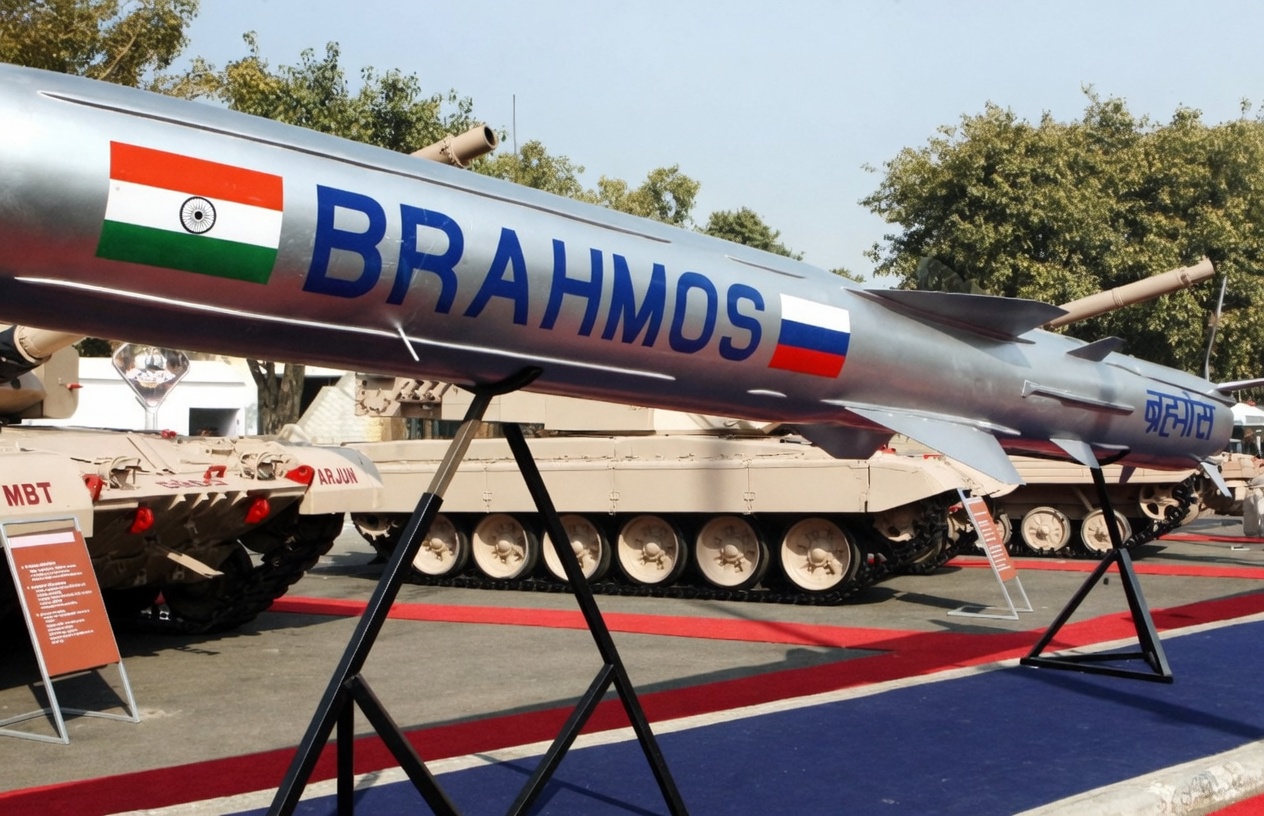
BrahMos Cruise Missile Will Bolster Filipino Defense
The BrahMos is a high-speed, precision, stand-off supersonic cruise missile that can be launched from the ground, sea, and air. It is a two-stage weapon: the missile launches with a solid-fuel booster that detaches after takeoff. A liquid-fuelled ramjet engine then propels it at speeds approaching Mach 3, or more than three times the speed of sound.
It works on a “fire-and-forget” principle, meaning that once launched, it requires no further guidance. Its terrain-hugging trajectories, low radar signatures, and high kinetic energy make it very difficult to intercept.
During the terminal phase, the missile can fly as low as 10 meters above the ground, and in the final phase, it relies on an active radar seeker or inertial guidance.
The original range of the BrahMos supersonic cruise missile, developed under an Indo-Russian Joint Venture, is 290 kilometers. The missile has undergone multiple upgrades, including software and hardware improvements that have enhanced its range over the past few years, as the EurAsian Times detailed in a previous report.
Although the Philippines is militarily outmatched by China, the BrahMos introduces asymmetric deterrence focused on anti-access/area denial (A2/AD) tactics. This Indian missile with Russian ancestry essentially addresses the Southeast Asian state’s military shortcomings and vulnerabilities in coastal and island defensive operations as well as sea control.
Former Philippine Secretary of National Defense Delfin Lorenzana said the missiles “will provide deterrence against any attempt to undermine our sovereignty and sovereign rights” in the West Philippine Sea. Meanwhile, Teodoro Jr. has on occasion highlighted the BrahMos as a “game-changer” for maritime security, emphasizing its role in strengthening the Philippine Marine Corps’ Coastal Defense Regiment.
Over the past two years, the country has repeatedly hinted at making an additional purchase of these lethal missiles.
- Contact the author at sakshi.tiwari13 (at) outlook.com
- Follow EurAsian Times on Google News