A Pakistani navy vessel collided with a frontline Indian destroyer in the Arabian Sea. The high-speed collision caused minor damage to the vessels, but once again emphasized the fragility of ties between the two nuclear-armed states.
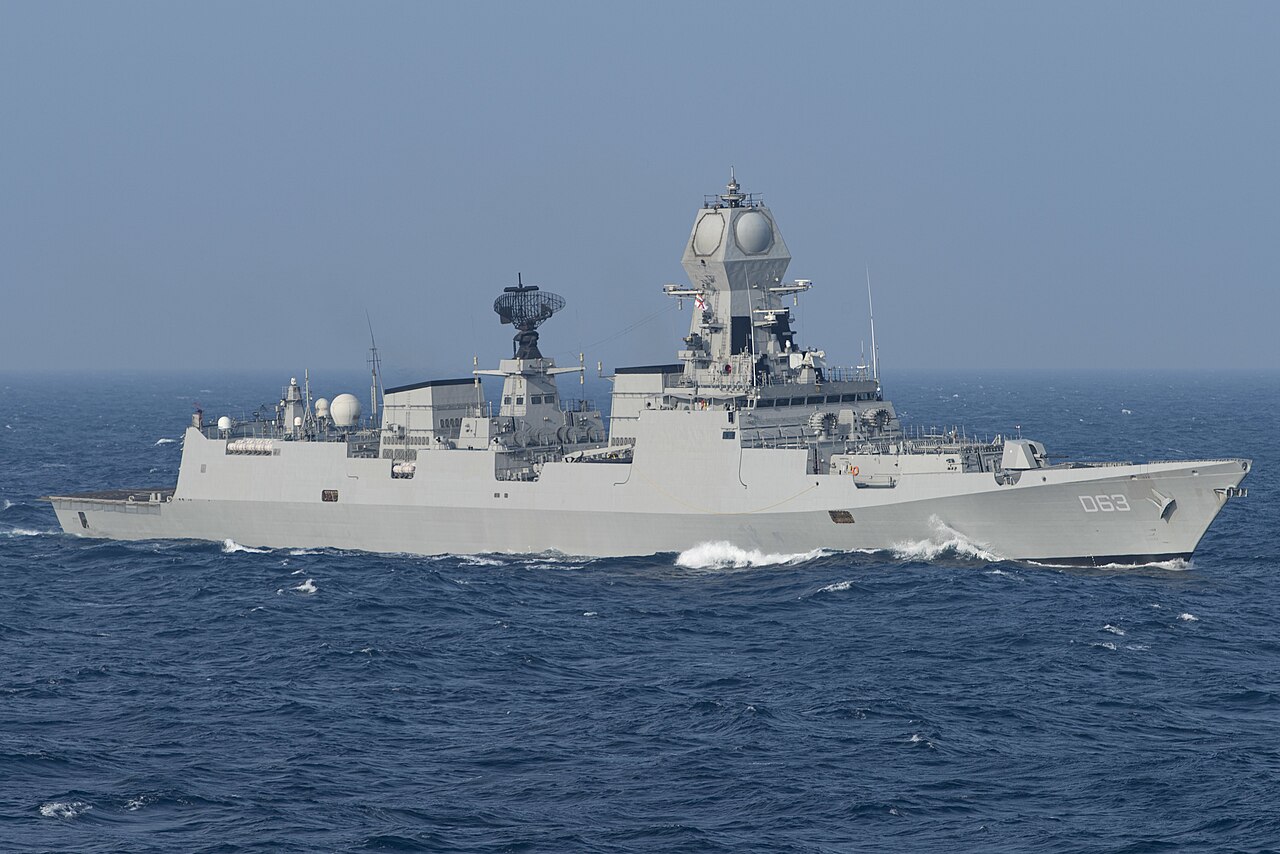
A Pakistan Navy vessel, PNS Hunain, and an Indian Navy warship, INS Kolkata, collided in the North Arabian Sea on September 15.
The collision occurred while the Indian warship was escorting ships from the Gulf of Oman. It was reportedly positioned near Pakistan’s Exclusive Economic Zone (EEZ), where the Pakistani Navy was conducting its biennial “Seaspark-26” naval exercise.
PNS Hunain, a Yarmook-class offshore patrol vessel displacing about 2,600 tonnes, sustained a minor dent (and possible crack) in the collision and returned to the harbor after the incident, while the much larger Indian destroyer, with a displacement of about 7,400 tonnes, reportedly suffered no major structural damage and continued on its mission.
This is the second such incident in more than a decade. Earlier, Pakistani frigate PNS Babur brushed against the Indian frigate INS Godavari in the Gulf of Aden during an anti-piracy escort mission in June, 2011.
Competing Claims
Pakistan’s Foreign Office stated that the Indian vessel conducted “aggressive maneuvers in dangerously close proximity to a Pakistani naval ship, which eventually resulted in contact between the two vessels” while Pakistan was operating inside its EEZ.
Furthermore, reports in Pakistani media claimed that the Indian ship had approached the EEZ and sought to enter the exercise area in the days before the collision, forcing the PNS Hunain to take evasive action and subsequently leading to the collision.
Sources in India’s defense and security establishment refuted these claims, arguing that EEZs are international waters and legitimate routes for both military and commercial ships.

Citing informed sources, reports in the Indian media said PNS Hunain—present in the region for the military exercise—shadowed the INS Kolkata warship, which was deployed to escort ships from the Gulf of Oman on September 15.
The Indian warship issued repeated warnings to PNS Hunain over Channel 16, the maritime radio channel used to convey distress. However, the Pakistani vessel ignored all warnings and suddenly increased speed while attempting to intercept or follow the Indian ship in international waters.
Both sides summoned the other’s Chargé d’Affaires to lodge strong protests over the incident, accusing each other’s ship of irresponsible maneuvers on the high seas. However, the collision endangered not only the vessel but also the crew aboard—the Pakistani vessel has a 60-member crew, while the INS Kolkata typically carries about 300 crew members or more.
A Deliberate Collision?
For one, the Pakistani vessel approached INS Kolkata at high speed while flouting the requirement to maintain a minimum distance between two vessels at sea.
India and Pakistan signed an Agreement on Advance Notice of Military Exercises, Maneuvers and Troop Movements in 1991 as a confidence-building measure that requires advance notice of major exercises and sets distance rules to reduce the risk of miscalculation.
According to Article 10 of this bilateral agreement, “The Naval ships and submarines belonging to the other country are not to come closer than three Nautical Miles (NMs) to each other so as to avoid any accident while operating in international waters.”
Therefore, the Pakistani vessel’s actions directly contravened the agreement, as the Indian Ministry of External Affairs stated in its formal protest to Pakistan.
In addition to the bilateral agreement, COLREG (International Regulations for Preventing Collisions at Sea, 1972) has specific rules to prevent such collisions. Rule 8 on Action to Avoid Collision states that any action “shall be such as to result in passing at a safe distance.” Under the rule, the action must be positive, taken in ample time, readily apparent, and monitored until the other vessel is past and clear. Meanwhile, Rule 6 on Safe Speed requires vessels to proceed at a speed that allows proper and effective action to avoid collision and to stop within a distance appropriate to the conditions, including visibility, traffic density, maneuverability, etc.
The International Maritime Organization (IMO) adopted the COLREGs, and they bind nearly all seagoing vessels, including warships.
By taking high speed and charging straight toward INS Kolkata while flouting the “safe distance” rule, PNS Hunain violated the wide-ranging rules meant to avoid collisions.
PNS Hunain first shadowed the Indian warship before accelerating into the close-quarters maneuver. Although shadowing foreign warships is not illegal, close approaches combined with high-speed maneuvers increase the risk of miscalculation or collision.
Commodore Anil Jai Singh, an Indian Navy Veteran and Vice President of the Indian Maritime Foundation, told the EurAsian Times that the Pakistani vessel’s action could have been deliberate.
“Two ships never come so close at sea. When two vessels are approaching each other, a steady compass bearing means they are on a collision course. PNS Hunain closed in at high speed despite the steady bearing on the Indian ship. It had a clear, continuing obligation to take early and decisive action to avoid closing to a dangerous distance. However, it pressed on, either to deliberately collide or conduct a close-quarters aggressive maneuver. It could very well have been a premeditated action,” he stated.
Moreover, the Pakistani ship wilfully ignored all warnings from the Indian destroyer, further supporting the case of deliberate action.
However, the PNS Hunain may have simply wanted to intimidate INS Kolkata but lost control toward the end of the maneuver and was unable to avoid the Indian vessel in time, leading to the unexpected collision.
Notably, INS Kolkata issued several warnings but stopped short of deploying any countermeasures, showing maximum restraint.
Typically, navies use a graduated response ladder for dangerous close approaches by foreign warships.
The first option is often Channel 16 radio calls, but a ship can switch to flashing lights, illuminate the approaching ship with searchlights, use water cannons or high-pressure hoses, or deploy dazzlers or lasers. And if none of these options work, a ship can “lock on” with fire-control radar and signal that weapons are ready, activate decoys as a warning, or fire warning shots to deter the hostile ship.
For example, in June this year, Russian frigate Admiral Grigorovich fired warning shots near a UK-registered civilian yacht in the English Channel. The shots were reportedly fired as the yacht approached the Russian warship even though it had already sounded its horn multiple times, fired signal flares, and attempted radio contact.
When asked why the Indian ship refrained from a stern countermeasure, the Commodore said, “The Indian ship’s Commander seems to have taken a calibrated and mature decision to avoid any escalation, given that the Indian Navy is a very professional force, but we don’t know whether he was constrained by Rules of Engagement. It is also likely that the Commander didn’t think that the approaching ship would actually hit it due to the major difference in their sizes.”
“The Indian ship probably did not conduct dramatic evasive actions to avoid confusing the approaching ship, since they probably considered they wouldn’t be colliding,” he added.
Are Pakistan’s actions a template from the Chinese “grey zone” warfare tactics in the South China Sea? Commodore Anil Jai Singh refuted the comparison, saying, “Even China does not deploy its warships to conduct those aggressive maneuvers against Filipino vessels, and often uses its Coast Guard vessels and maritime militia boats.”
A High-Speed Collision Could Be Catastrophic
Indian experts argue that PNS Hunain’s actions were not a simple navigational error but an irresponsible or even deliberate breach of safety norms, bilateral agreements, and professional naval practice.
A high-speed collision could damage the smaller Pakistani ship’s hull, causing rapid flooding, fire, or cascading structural collapse. Even the bigger Indian destroyer might sustain major damage to its bow section, radar and sensor arrays, weapon systems, or propulsion machinery if the impact occurred at a poor angle or high velocity.
Such an incident could disable or sink one or both vessels, or kill or wound the crew through the force of the impact itself, fire, flooding, or secondary blasts.
Damage or loss of life at scale could, in turn, trigger rapid military escalation by creating immediate uncertainty about intent and potentially leading to an unprecedented escalation. “Situation develops very fast at sea,” Commodore Anil Jai Singh warned. “Warships can close distances in minutes, sensors and weapons can be locked on, and aircraft or helicopters can be launched almost instantly,” he added.
In that scenario, the collision could be seen as a deliberate aggression by India and prompt it to fire warning shots that could potentially escalate to lethal force, or a full hostile engagement against the Pakistani vessel.
At the same time, Pakistan could claim the Indian ship began aggressive maneuvers and respond with force of its own, setting off a rapid escalation.
In the fog of a real crisis, miscommunication, incomplete information, or the presence of other naval assets could turn a single collision into a broader naval engagement within hours.
All this could prove to be particularly dangerous because both India and Pakistan are nuclear-armed states that fought an intense conflict last year and remain embroiled in tensions. Any significant military clash between them raises the specter of escalation to higher levels of conflict, including the theoretical risk of nuclear signaling or worse.
- Contact the author at sakshi.tiwari13 (at) outlook.com
- Follow EurAsian Times on Google News