For decades, the US has maintained an unassailable lead in aircraft carriers.
The US currently operates 11 flattops, all of them nuclear-powered. China is a distant second with three aircraft carriers, none of them nuclear-powered.
The US operates roughly half of the world’s true aircraft carriers. However, for years, the security analysts in Washington have been wargaming for a nightmarish scenario.
What if the US’s carrier fleet is not a force multiplier, but a strategic vulnerability? Or, to put it another way, can Beijing sink the US Navy’s aircraft carriers?
These questions have assumed significance ever since China claimed to have developed anti-ship ballistic missiles (ASBMs), the DF‑21D and DF‑26B, also known as “carrier-killers.”
These ASBMs are part of China’s broader A2/AD (Anti-Access and Area Denial) architecture intended to push U.S. carrier strike groups (CSGs) beyond the first island chain.
In the last decade, several wargames, research studies, think‑tank reports, and opinion columns have wondered whether carriers are becoming obsolete, the new battleships – large, complex, and expensive systems – but vulnerable to cheap, long‑range missiles.
But a new Center for Strategic & International Studies (CSIS) research paper has flipped the script: if US carriers are vulnerable, why can’t Washington also hold China’s new carriers at risk?
Are Aircraft Carriers Becoming Obsolete?
In 2023, the South China Morning Post reported that researchers at North University of China claimed that it took an average of only 24 hypersonic missiles to sink the USS Gerald R. Ford and its five escort ships across 20 simulated battles.
From an economic point of view, that would imply that for every $1 China spends on new classes of low-cost hypersonic missiles, it could destroy $10,858.59 worth of U.S. capital ships.
A British study published in 2024 found that their carriers – the HMS Queen Elizabeth and HMS Prince of Wales – were similarly at risk.
Not just think tanks, even senior US government figures have expressed similar fears.
US Secretary of War Pete Hegseth said in a recent podcast interview: In wargames against China, ‘We lose every time.”
The secretary went further, linking US defeat to the vulnerability of aircraft carriers: “We know what our real capability [is]…If our whole power projection platform is aircraft carriers and the ability to project power that way strategically around the globe . . . and if 15 hypersonic missiles can take out our 10 aircraft carriers in the first 20 minutes of a conflict, what
does that look like?”
But if US carriers are so vulnerable, why can’t Washington bring China’s expanding carrier fleet within its firing range?
China’s Expanding Carrier Fleet
After the US, China has the world’s second-largest carrier fleet.
Beijing currently operates a fleet of three aircraft carriers. China launched its third carrier, Fujian (Type 003), an 80,000‑ton supercarrier capable of launching a mix of over 50 fourth- and fifth-generation fighters, and key enablers such as KJ-600 airborne early warning and control aircraft.
China also launched Sichuan (Type 076), a 40,000‑ton amphibious assault ship also suspected of serving as a drone carrier capable of using an electromagnetic (EM) catapult to launch GJ-11 stealth unmanned combat aircraft.
A fourth carrier (Type 004) is undergoing construction. Satellite imagery suggests that this will likely be China’s largest and first nuclear-powered carrier.
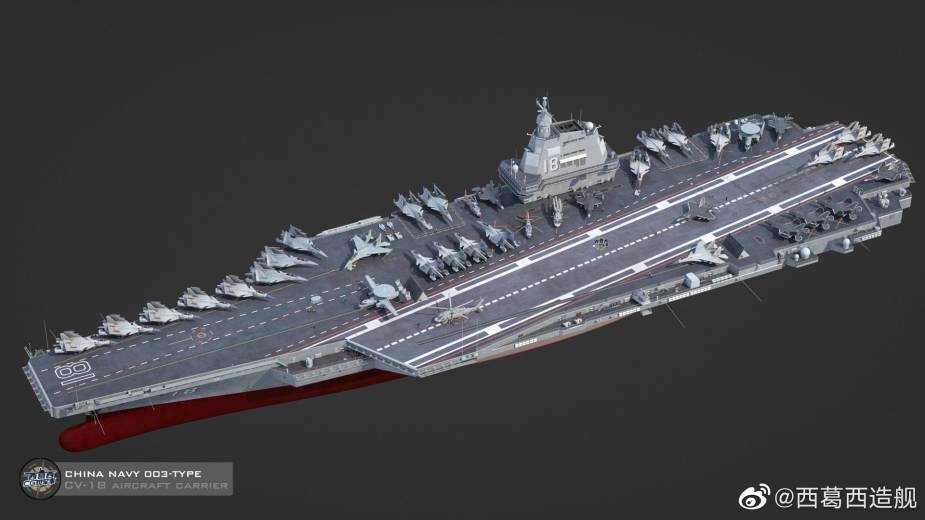
China plans to construct six additional aircraft carriers by 2035, bringing its total carrier force up to nine, according to the Department of War (DOW).
China’s growing carrier fleet is a force multiplier; however, it could also become a strategic vulnerability.
The Vulnerability of the US Aircraft Carriers
China recognized early that the US ability to project force globally rests on its fleet of 11 nuclear-powered aircraft carriers. It also recognized that it would be decades before it could match Washington in carrier fleet strength.
Therefore, China focused its energy on developing weapons systems that could negate the US advantage and developed anti-ship ballistic missiles (ASBMs).
Recent pieces have argued that Chinese hypersonic and ballistic missiles, supported by an increasingly sophisticated space‑ and AI‑enabled “kill web,” could force US and allied carriers so far offshore that their air wings become operationally irrelevant.
For example, the YJ-21 is a Chinese air-launched medium-range ballistic missile specifically designed to strike high-value assets such as carriers. This missile can be launched from fighters and unmanned combat aerial vehicles (UCAVs) and uses redundant guidance systems that make it difficult to jam; a variant can be fired from Type 055 destroyers, though this may have been the YJ-20.
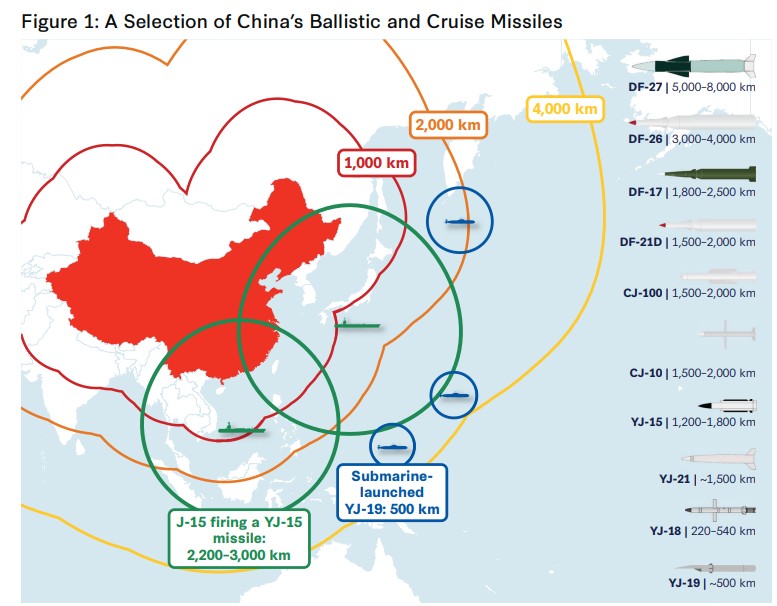
Combined with older missiles such as the DF-26, colloquially known as “carrier-killers” with a range of up to around 4,000 kilometers (km), and the DF-17, which has a shorter range of up to around 2,500 km but is designed to strike high-value assets and evade US interceptors (e.g., THAAD and Patriot), China has an arsenal of systems capable of hypersonic speeds that can hold carriers at risk up to 2,500 miles away.
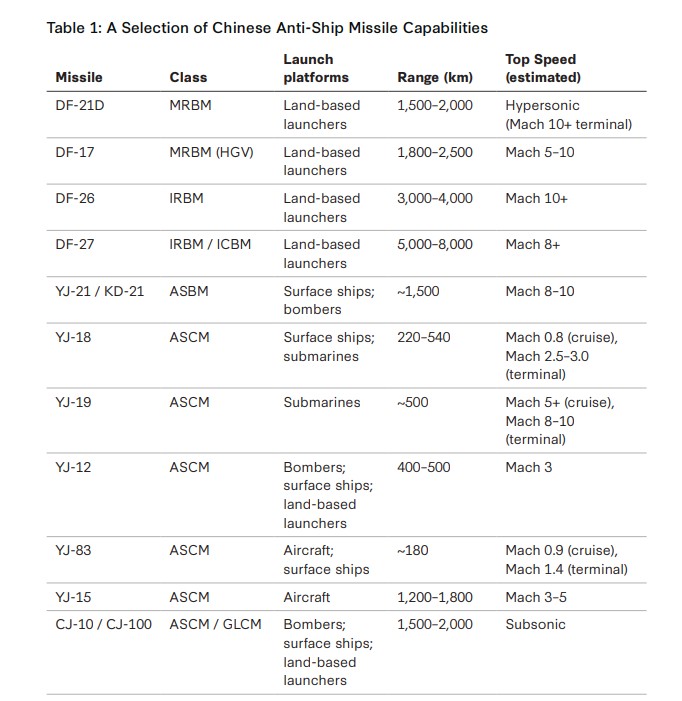
However, the current discussion in Washington often frames carriers as unique to the United States and uniquely vulnerable, while underplaying the fact that China is now building its own large-deck, network‑enabled capital ships that are at least as targetable as the U.S. ships China aims to threaten.
How the U.S. Can Make China’s Carriers Vulnerable?
According to the CSIS paper, Washington could follow a five-pronged strategy to make China’s growing carrier fleet vulnerable.
(1) Subsurface ambush operations: China’s Achilles’ heel at sea remains anti‑submarine warfare (ASW).
“Despite various improvements, PLAN surface ASW, fixed‑wing ASW, and undersea sensing are still patchy compared with U.S. and Japanese capabilities, particularly in noisy littorals and chokepoints,” it said.
A cost‑effective way to threaten China’s carriers is through a layered subsurface screen built around the following assets:
■ U.S. nuclear attack submarines (SSNs) operating at range.
■ Allied diesel-electric submarines from Australia, Japan, South Korea, and potentially the Philippines, including submarines equipped with air-independent propulsion where available.
■ Shared undersea sensing networks and common heavyweight torpedoes, enabling coordinated ambush of PLAN carrier groups in transit corridors rather than near the Chinese coast.
■ Shared unmanned undersea vehicles (UUVs) capable of both conducting intelligence collection and limited strike missions against PLAN ships.
The key is to turn the “undersea domain into a continuous threat envelope that forces Beijing to invest heavily in escorts, ASW aviation, and fixed sensors simply to move carriers out of its home waters.”
Further, this approach also leverages existing areas of production and operational excellence from various U.S. allies, making implementation faster and cheaper than more novel approaches.
(2) Land-based maritime strike networks: China’s A2/AD system is, in part, a land‑based missile problem. The United States and its regional partners can mirror that logic by building a distributed, multinational anti‑ship missile network on land from Japan through the Philippines and, where politically feasible, into the South Pacific and even around key maritime terrain globally, including the following:
■ U.S. Marine Corps and Army units fielding Navy-Marine Expeditionary Ship Interdiction System (NMESIS) missile systems, Mid‑Range Capability (i.e., Typhon batteries), and Precision Strike Missiles (PrSMs) adapted to strike ships and a host of information warfare systems (e.g., cyber, space, electronic warfare, and inform/influence activities) stationed as a
littoral rotational force.
■ Australian, Japanese, and potentially Philippine coastal missile batteries (e.g., upgraded Type 12, BrahMos, and naval strike missiles) integrated into common fire control and ISR architectures.
■ Pre‑negotiated access, dispersal sites, and logistics arrangements to ensure these units can survive Chinese Air Force and Rocket Force (PLAAF/PLARF) strikes and continue to generate maritime fires.
Such a network can threaten PLAN carriers during deployment, not just at the point of conflict.
Moreover, “the mere expectation that upon entering the Philippine Sea, carriers such as the Fujian or Sichuan will face dense, land‑based anti‑ship fires backed by allied ISR raises the perceived risk of using them as front‑line tools of coercion.”
(3) Long-range air and space-enabled fires: The United States and its allies can conduct long-range strikes using a mix of bombers, fighters, and maritime patrol aircraft:
■ U.S. Air Force bombers and Navy aircraft armed with anti-ship missiles, such as LRASM and future hypersonic anti-ship weapons, connected to a complex battle network that both supports the attack and degrades enemy sensors.
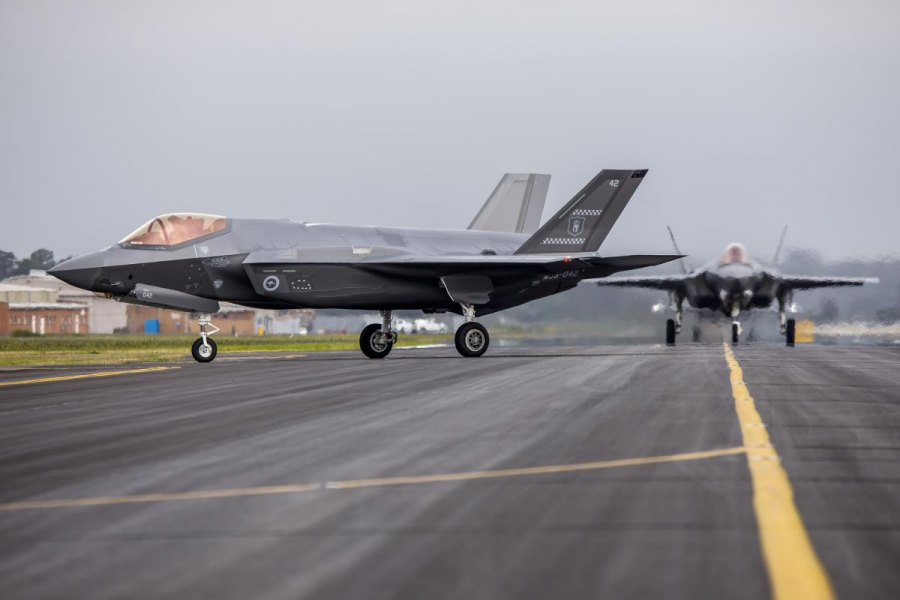
■ Allied F‑35 fleets (from Australia, Japan, and South Korea) using low‑observable sensors to contribute to the maritime picture and deliver their own long‑range anti‑ship munitions.
■ A mix of kinetic and non-kinetic attack vectors with a conscious emphasis on mission kills, specifically by degrading flight‑deck operations, destroying aviation fuel and ordnance handling, or disabling key escorts and logistics ships supporting the carrier, rather than only aiming for catastrophic hull loss.
This approach is particularly suited to large military powers such as the United States but can be partially adopted by states with smaller budgets by investing in a limited number of fifth‑generation or advanced fourth‑generation aircraft plus modern anti‑ship missiles.
(4) Cyber-electromagnetic disruption: PLAN CSGs are nodes within a broader battle network. Their combat value depends on complex links to off‑board ISR, satellite navigation, command networks, and electromagnetic attack and defense platforms.
By disrupting the carriers’ connections to this broader network, the United States and its allies can deny the PLAN access to the enablers that make its forces more combat-capable.
Rather than treating ships solely as physical targets, U.S. and allied planners should prioritize EM and cyber operations.
(5) Unmanned swarm and port-denial campaigns: The Ukraine war has shown how even a state with a modest navy can use unmanned surface vessels (USVs), unmanned aerial vehicles, and shore‑based missiles to attrite a larger fleet.
Ukraine has successfully forced Russia to pull major units out of Sevastopol and turned the Black Sea into a contested battlespace.
While the terrain of the Pacific is not identical to the Black Sea, a similar logic can be applied to PLAN carriers, especially in the first island chain.
Swarms of relatively low‑cost USVs and loitering munitions can attack ships in port, logistic hubs, and fixed defenses, driving carriers to relocate to more distant, less convenient bases.
The central idea is to make a carrier’s routine employment around Taiwan, the South China Sea, or beyond the first island chain appear prohibitively risky.
By following these steps, the U.S. and its allies could blunt the advantage of China’s growing carrier fleet.
While China has for years invested in AA/AD vectors to make the U.S. carriers vulnerable, Washington could flip the script and make Beijing’s own carriers equally vulnerable.
- Sumit Ahlawat has over a decade of experience in news media. He has worked with Press Trust of India, Times Now, Zee News, Economic Times, and Microsoft News. He holds a Master’s Degree in International Media and Modern History from the University of Sheffield, UK.
- He can be reached at ahlawat.sumit85 (at) gmail.com