Ukraine is staring down a new and deeply unsettling threat: a possible North Korean missile unit deployment to western Russia amid a lack of anti-ballistic interceptors in its arsenal.
North Korea is preparing to deploy a missile unit to western Russia, according to a Ukrainian military intelligence official, marking a significant escalation in the conflict.
Andrii Cherniak of Ukraine’s Main Directorate of Intelligence (GUR) told Reuters that the deployment involves Russia’s 112th Guards Missile Brigade and about 90 North Korean personnel based in the Voronezh region, which borders Ukraine.
While the exact composition of missiles will be finalized during senior-level talks next month, Pyongyang has already sent a new batch of 40 KN-23 and KN-24 missiles and personnel to Russia, the GUR official claimed.
Further, he noted that the unit could eventually field up to 120 short-range ballistic missiles along with six launchers.
An informed source reportedly told Reuters that the United States was aware of the plan but did not provide further details.
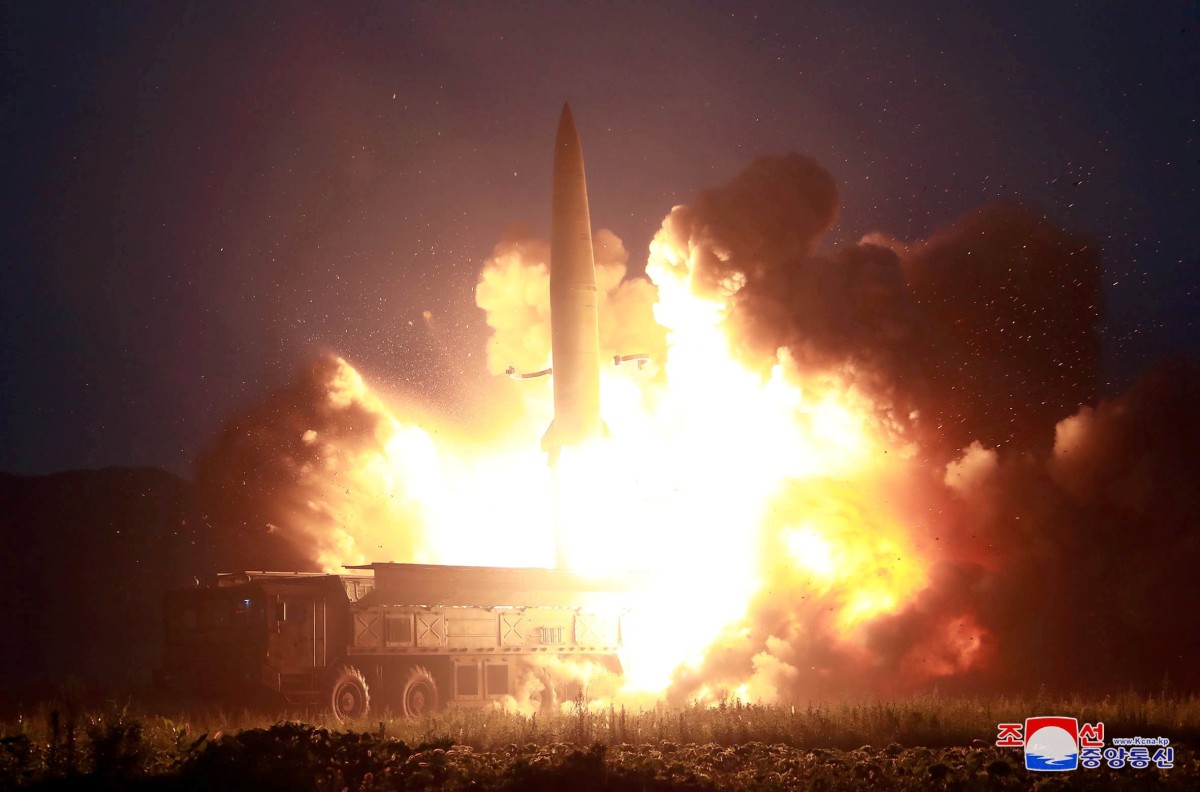
Designed to evade missile defenses by flying on a lower, “depressed” trajectory that reduces radar detection, the KN-23—resembling the Russian Iskander—has a range of 800-900 kilometers.
Previous reports indicated that Moscow had allegedly modified the missile to enhance its accuracy.
Meanwhile, the KN-24 has a comparatively shorter range of about 410 kilometers and employs a quasi-ballistic or depressed trajectory with possible in-flight maneuvers, making it harder to intercept.
GUR’s claims could not be officially verified, and the Pentagon has not made a statement acknowledging any such intelligence reports. Nevertheless, the GUR’s assessment comes days after Ukrainian President Volodymyr Zelenskyy announced Russia used a North Korean missile for a strike on July 30, which killed five members of a family.
Although Russia has previously used North Korean ballistic missiles, the Ukrainian reports hinted that Moscow might have received a fresh supply.
Earlier, Pyongyang had reportedly delivered more than 100 short-range ballistic missiles (primarily KN-23 and KN-24), millions of artillery shells, over 120 long-range self-propelled artillery systems, and more than 120 multiple rocket launch systems. Additionally, it had deployed an estimated 11,000 troops for the Ukraine war, of whom approximately 2,300 were killed in combat.
While the US and NATO are on the ground in Ukraine, studying the realities of modern warfare and using those lessons to develop the next generation of military technology, North Korea, Iran, and China are also closely observing the conflict to refine their own weapons and military doctrines.
Why is Ukraine Alarmed
Russia has been exploiting gaps in Ukraine’s air defenses to launch frequent ballistic and hypersonic missile strikes.
On August 4, Russia conducted a major overnight attack with drones and ballistic missiles that killed 17 people. Ukrainian forces intercepted 98 of 115 drones but failed to shoot down even a single ballistic missile, as recently reported by the EurAsian Times
Having run out of Patriot interceptors, which are the only reliable defense against ballistic missiles, Ukraine is practically left defenseless.
Ukraine has been pleading with its allies to supply more Patriot batteries and interceptors, which remain among the few weapons capable of countering ballistic missile threats such as North Korea’s KN-23 and KN-24 and Russia’s Iskander.
“Ballistic missile interceptors could have saved the lives of those killed today,” Zelenskyy wrote on social media after the August 4 strike. “It is very important that our partners understand that delays in supplying them, or an unwillingness to provide anti-ballistic systems, lead directly to such horrific casualties and destruction.”
Notably, the US has been sending Patriot missiles to Ukraine, among other weapons and munitions—including through the Prioritized Ukraine Requirements List (PURL), a new system wherein NATO nations pay for the transfer of weapons from the US. However, recent reports suggest that the US has expended a massive chunk of its own Patriot interceptors in the Ukraine war, eroding any space to make fresh deliveries to Kyiv.
Meanwhile, other NATO allies remain wary of aiding Ukraine with Patriots amid heightened security threats and long production timelines.
The Patriot shortage has allowed Moscow to use ballistic missiles with near impunity, creating a dangerous “window of vulnerability” for Ukraine that will only expand with North Korea’s deployment. In fact, experts fear that the situation will get increasingly challenging as winter approaches, which is when Russia intensifies attacks on Ukraine’s power grids.
The expanding Russia-North Korea partnership also carries broader geopolitical implications for Ukraine after nearly five years of war.
“Kyiv is rattled not because North Korean missiles are more advanced than Russia’s Iskander, but because they signal a deeper, more dangerous geopolitical alignment—and their sheer volume and indiscriminate use are overwhelming Ukraine’s already strained defenses. This isn’t just about weapons—it’s about the normalization of new military collaboration and geopolitical alignment. Russia’s use of North Korean missiles also suggests Pyongyang has replenished Moscow’s arsenal, enabling intensified bombardments as Russia seeks to break Ukrainian morale. For Kyiv, each KN-23/24 impact is both a physical and symbolic blow,” Air Marshal G.S. Bedi (retd) told the EurAsian Times.
Notably, North Korea’s short-range ballistic missiles (SRBMs) are believed to be less accurate compared to their Russian counterparts. A previous Ukrainian state prosecutor’s report stated that about half of the KN-23s launched by Russia between late December 2023 and late February 2024 veered off course and sometimes exploded midair.
Moreover, strikes launched using these missiles have caused large-scale civilian casualties.
Nonetheless, the deployment of North Korean missiles will give Russia what it needs to overwhelm and batter Ukraine: volume.
This allows Moscow to reserve more precise systems such as the Iskander for high-value targets while using KN-23 and KN-24 missiles against population centers and infrastructure to increase pressure on Kyiv.
Interestingly, during a meeting of Ukraine’s National Security and Defense Council, President Volodymyr Zelenskyy reportedly announced that his country will destroy Russian missile launchers to reduce attacks on Ukrainian cities.
“Our military knows they must destroy the enemy’s launchers to reduce strikes on Ukraine, its critical infrastructure, and civilians. They are working on this and will continue to do so,” Zelenskyy said.
- Contact the author at sakshi.tiwari13 (at) outlook.com
- Follow EurAsian Times on Google News