Trump-class battleships, a commemorative “Patriot Passport” featuring his image, President Donald J. Trump International Airport, the Donald J. Trump U.S. Institute of Peace, and the Trump Gold Card are among the federal assets and programs the U.S. government has named or branded in honor of the sitting president.
Now the U.S. Navy is reportedly considering taking the practice even further by renaming an aircraft carrier still under construction after President Donald Trump.
However, the move could be highly controversial, as no carrier has ever been named after a sitting president.
Furthermore, the vessel has already been named, and the U.S. Navy is considering renaming it.
It was originally set to become the first U.S. aircraft carrier named after an African American, honoring a Black sailor celebrated for his heroic actions during the Japanese attack on Pearl Harbor.
If the plan succeeds, it would mark the first time an aircraft carrier has ever been renamed.
The aircraft carrier in question is the future Gerald R. Ford-class carrier currently designated CVN-81.
The ship was initially named USS Doris Miller, after sailor Doris “Dorie” Miller, in January 2020, during President Trump’s first term, by then-Acting Secretary of the Navy Thomas Modly.
Notably, this would have been the first U.S. aircraft carrier named after an African-American and the first named after an enlisted sailor for actions performed while serving in the ranks.
It’s unclear what the Navy is seeking to rename the carrier to, though two of the sources told CNN there have been internal conversations about renaming it to honor Trump. This would be an unprecedented step, as no US carrier has ever been named after a sitting President.
The Navy is instead looking to rename another warship after Miller, according to one source, and is recommending him for the Medal of Honor, the highest decoration for military valor. Congress and Trump’s approval must authorize the award.
The effort to rename the USS Doris Miller has been underway since earlier this year, the sources said.
Incidentally, whether or not the carrier is named after Trump, the President has already left an imprint on the vessel, as a recent White House executive order has tasked the Secretary of Defense and Secretary of the Navy to report back with a plan to replace the ship’s electromagnetic aircraft launch system with steam and hydraulic systems.
From 900 NUKES to ZERO: How Trump’s Pressure Could Push South Korea to Build Its Own Nuclear Bomb
While no renaming has occurred, the Navy, in its internal documents, and the White House, in its official communications, have stopped referring to the ship as USS Doris Miller and now refer to it only as CVN-81.
For instance, the recent White House executive order on shipbuilding also referred to the ship only as CVN-81.
The Extraordinary Life of Doris “Dorie” Miller
The name USS Doris Miller was announced by the former Acting Secretary of the Navy, Thomas Modly, in January 2020 during a Martin Luther King, Jr. Day ceremony at Pearl Harbor.
“Dorie Miller was the son of a sharecropper,” Modly, a Trump nominee who had Navy leadership positions from 2017 to 2020, said at the ceremony, according to a Navy release. “And, he was an American sailor – so designated by the uniform that he wore — the same uniform all sailors wore, and still wear, regardless of race, ethnic background, or political persuasion.”
According to the National Museum of the Pacific War, Doris Miller was born to sharecroppers in Waco, Texas, on 12 October 1919.
In 1939, just before his 20th birthday, he enlisted in the United States Navy, and after training in Norfolk, Virginia, Miller became a Mess Attendant, one of the few positions open to African Americans in the Navy. He was assigned to the USS West Virginia, which soon left to join the rest of the Pacific Fleet at Pearl Harbor in response to increasing Japanese aggression.
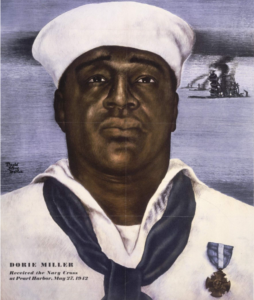
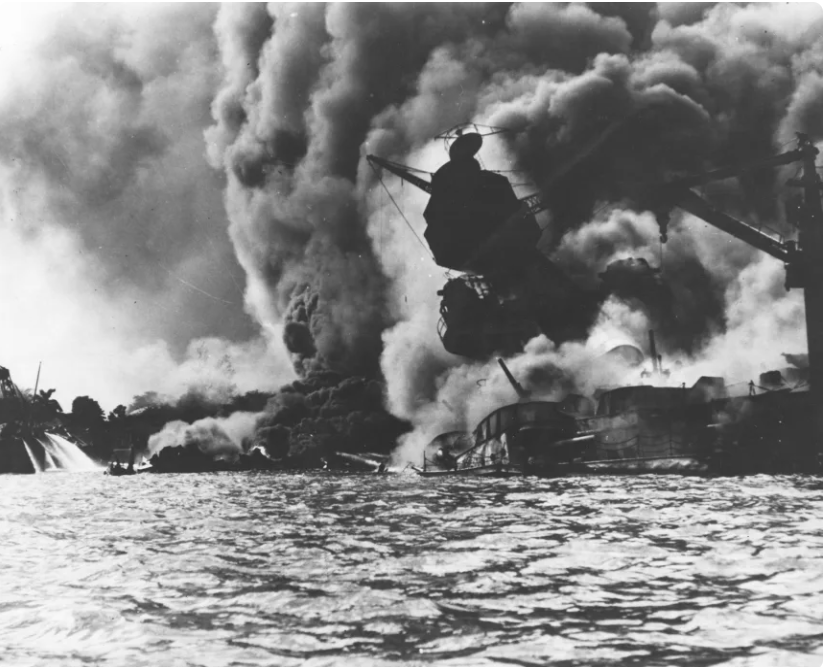
On December 7, 1941, Mess Attendant Third Class Doris Miller was retrieving laundry when the Japanese bombs fell on Pearl Harbor. He arrived on deck, where he encountered his mortally wounded commanding officer and carried him to safety. He proceeded to one of the machine guns, and although black sailors never received training on the anti-aircraft guns, he opened fire on the Japanese planes overhead.
After the gun ran out of ammunition, Miller assisted in evacuating sailors after the order to abandon ship and was one of the last three men to leave the vessel as it sank. Even after leaving the ship, he helped numerous sailors to safety.
In May of 1942, Miller was presented with the Navy Cross by Admiral Chester W. Nimitz, Commander in Chief of the Pacific Fleet and Pacific Ocean Areas, making Miller the first black sailor to receive such an honor. Miller’s image was used for recruitment posters, and he was even recalled to the United States for a war bonds tour before returning to active service in the Pacific.
Doris Miller continued to serve in the Navy as a mess attendant until 24 November 1943, when his carrier, USS Liscome Bay, was hit by a torpedo during the Gilbert Islands Campaign and its bomb magazine exploded, and most of the crew were killed. Miller was “presumed dead,” and although his body was never recovered, he was declared killed in action after a year. He was 24 years old.
Although Miller’s actions and service did not immediately break down the barriers of racial segregation within the US military, they certainly paved the way for further steps toward equality and, along with the civil rights movement in the 1950s and 60s, eventually led to desegregation in the military.
The United States christened the destroyer escort USS Miller in June 1973.
In 2020, the United States Navy announced its intention to name the future Ford-class aircraft carrier after Doris Miller.
However, according to the sources, the U.S. Navy is now considering renaming the vessel to Trump.
Tight Timeline and Broader Naming Context
The US Navy has only a few months left to decide on the renaming of the vessel, as the ship’s keel-laying ceremony is expected at the end of this year. The ship is not expected to be delivered until 2032-2034.
The US currently has 11 aircraft carriers, the largest in the world. Many US carriers are named after former US presidents, such as USS Abraham Lincoln, USS George H.W. Bush, USS Ronald Reagan, USS Dwight D. Eisenhower, USS Theodore Roosevelt, USS Harry S. Truman, USS Gerald R. Ford and USS George Washington.
However, till now, no carrier has been named after a sitting President.
Not all carriers are named after presidents. The USS Nimitz, for example, is named after the admiral who commanded the US Pacific Fleet during World War II. The USS Carl Vinson is named after a Georgia congressman who chaired the House Naval Affairs and Armed Services Committee.
USS John C. Stennis has been named after Senator John C. Stennis, who is also known as “Father of America’s Modern Navy.”
Notably, the US Navy convened a renaming commission in 2025 under former Secretary of the Navy John Phelan to review the naming of ships and other military assets.
The Navy commission came amid broader efforts in the Pentagon under Defense Secretary Pete Hegseth to remove names selected for what the administration considers diversity, equity, and inclusion purposes.
It remains to be seen whether the U.S. Navy will take the unprecedented step of renaming a vessel after its commissioning and naming one after a sitting President.
- Sumit Ahlawat has over a decade of experience in news media. He has worked with Press Trust of India, Times Now, Zee News, Economic Times, and Microsoft News. He holds a Master’s Degree in International Media and Modern History from the University of Sheffield, UK.
- He can be reached at ahlawat.sumit85 (at) gmail.com