Even as President Donald Trump fights a protracted war in the Middle East to stop Iran from pursuing nuclear weapons, his own policies might be pushing South Korea, a close US ally and a signatory to the Non-Proliferation of Nuclear Weapons (NPT) treaty, towards Nukes.
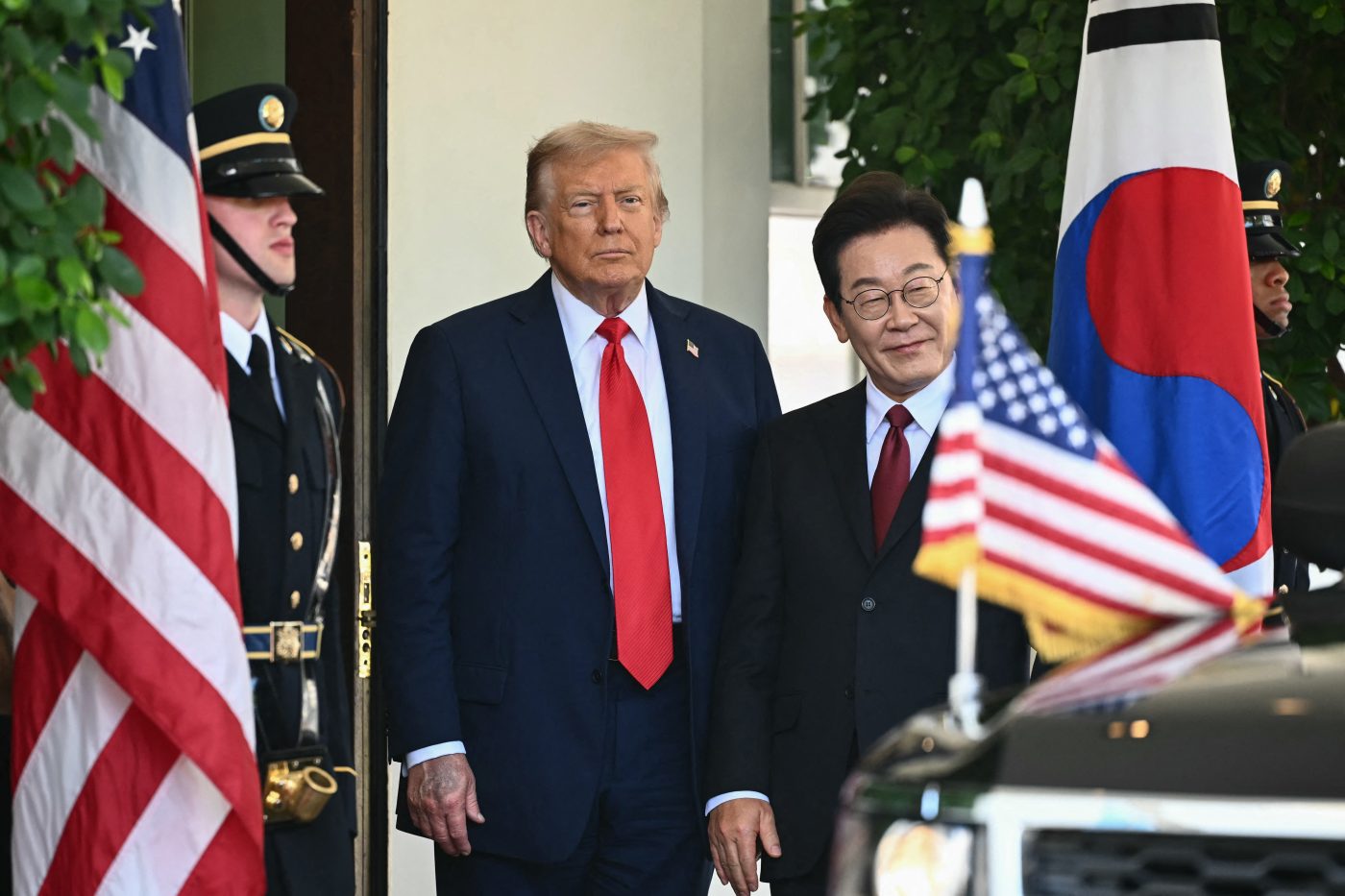
On Sunday, Trump ordered the Pentagon to scale back planned joint military exercises with South Korea, saying it declined to help denuclearize Iran and citing his good relationship with North Korea’s Kim Jong Un.
On Tuesday, Trump said that Seoul should pay Washington US$10 billion annually for the presence of U.S. troops in the country.
Trump is punishing South Korea for its failure to contribute towards denuclearization of Iran; tragically, his own policy might lead to nuclearization of South Korea.
South Korea had been here before. Nearly half a century ago, in the 1970s, Seoul pursued a clandestine nuclear weapons program for over a decade. Ironically, even then, the circumstances were very similar, if not identical.
Over the last seven decades, South Korea had had a complicated relationship with Nukes.
At one point, when North Korea had no nuclear warheads, Seoul hosted over 900 U.S. nuclear warheads. And yet, now that North Korea has nearly 60 nuclear warheads, as per SIPRI data, and has signed a mutual defense treaty with Russia, South Korea has none.
Trump’s decision to scale back joint military drills with South Korea, his pressure tactics to make Seoul pay nearly 10 times what it is currently paying for hosting US troops in the country, and his threats to cut a deal with North Korea might leave South Korea with no other option but to pursue a nuclear program of its own.
South Korea and Nukes
During the Cold War, the United States deployed nuclear weapons in South Korea continuously for 33 years, from 1958 to 1991.
In 1953, the Korean War ended with an armistice, leaving a divided peninsula and a great deal of uncertainty. At that time, North Korea had no nukes of its own; however, it was supported by the Soviet Union, which was already a nuclear power, and by China.
Against that backdrop, Washington looked for a way to deter another invasion from the North without stationing an impossibly large conventional army in Asia.
Washington concluded that the only possible solution was stationing nuclear warheads in South Korea along with as many as 60,000 U.S. soldiers.
The first nuclear weapons arrived in South Korea by 1958.
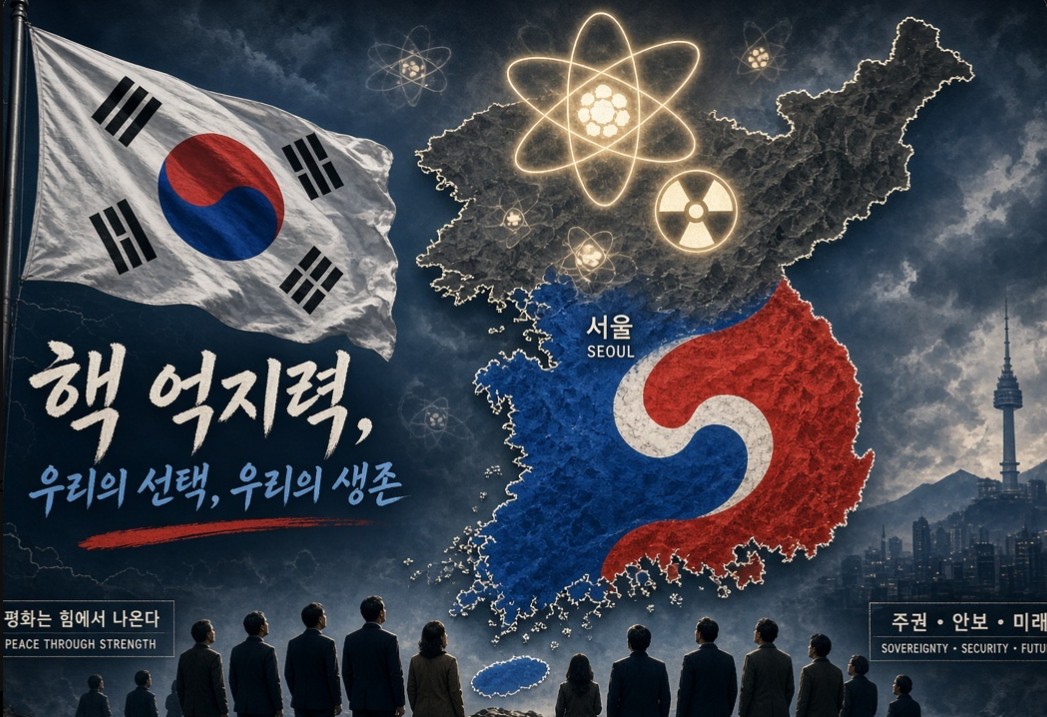
The South Korean-based nuclear arsenal peaked at an all-time high of approximately 950 warheads in 1967.
One year later, in 1968, South Korea signed the Nuclear Non-Proliferation Treaty (NPT). South Korea was one of the earliest signatories to the NPT treaty.
Ironically, after the U.S. nuclear warheads peaked in South Korea and it signed the NPT, soon after Seoul started a clandestine nuclear program of its own.
Even then, South Korea’s pursuit of nuclear weapons was triggered by its insecurities that Washington was retreating from its security commitments to Seoul.
Things changed quite significantly around 1969, when President Nixon gave a notorious speech now known as the Nixon Doctrine, in which he asked the US’ allies to do more to defend themselves.
“As far as the problems of internal security are concerned, as far as the problems of military defense…the United States is going to encourage and has a right to expect that this problem will be increasingly handled by, and the responsibility for it taken by, the Asian allies themselves.”
The Nixon Doctrine coincided with the Vietnam War, when suddenly the US had to deploy thousands of soldiers into South Vietnam.
Nixon’s rhetoric became reality when, in July 1970, US officials notified the South Korean government that US forces in the Republic of Korea (ROK) would be reduced.
Furthermore, in the early 1970s, the US reached a détente with China, following which Washington withdrew its forces from Taiwan and also downgraded its relations with Taipei.
The withdrawal of US troops from Vietnam in 1973 and the subsequent failure of the United States to prevent the fall of Saigon in 1975 further cast doubt on the credibility of US security commitments on the Korean peninsula once US troops were removed.
This further increased South Korean insecurities.
In response to this shift in US policy, South Korean President Park Chung-hee launched a program of military self-reliance and armed forces modernization. This plan, titled “Yulgok,” sought to import modern defense weapons along the lines of the Israeli national defense system.
Also, like Israel’s, this defense reform included the clandestine exploration of nuclear weapons.
Toward this end, South Korea, in 1971, established the Agency for Defense Development and the Weapons Exploitation Committee under whose auspices the South Korean armed forces could secretly develop nuclear weapons.
Although South Korea had begun construction of a light-water reactor in 1970, in 1975 Seoul also contracted to purchase a plutonium reprocessing plant from France and a heavy-water reactor from Canada.
Though U.S. troops remained stationed in South Korea throughout this time, the insecurities triggered in South Korea due to statements by the U.S. President and an impression that Washington might not fulfill its security commitments to Seoul were enough to make it pursue a secret nuclear program.
However, once South Korea’s secret nuclear program became known to the US, Washington pressured Seoul to immediately halt its nuclear program.
It promised to delay the withdrawal of its troops from South Korea for another five years, so that Seoul could modernize its armed forces. Washington also threatened to remove its nuclear warheads placed inside South Korea.
At the same time, the US State Department also pressured France and Canada to cancel their nuclear reactor contracts
with Seoul.
The prospect of losing the US nuclear umbrella before the South Koreans could develop an indigenous capability compelled President Park to accede to US demands. In 1975, Park ordered the termination of the nuclear weapons program, and South Korea ratified the Nuclear Non-Proliferation Treaty (NPT), which it had signed in 1968.
However, some analysts warn that South Korea did not fully terminate its nuclear program even in 1975. Instead, a nuclear hide-and-seek game unfolded between Seoul and Washington, in which most South Korean nuclear programs were simply renamed and reorganized.
In fact, in 1976, Seoul restarted its nuclear program as Jimmy Carter, during his presidential campaign, had promised to withdraw U.S. troops from South Korea.
It was the assassination of the South Korean dictator Park in 1979 that ultimately ended its nuclear weapons program.
According to a research paper by the United States Air Force Academy scholar Joseph W. Brown, Park’s successor, Chun Doo Hwan, in need of national legitimacy and US support, ended South Korea’s suspect nuclear activity and committed the country to civilian nuclear development.
Ronald Reagan’s election on a hardline anti-communist platform in 1980 reinforced US commitment to South Korea. As a result, U.S. troops remained in South Korea.
However, the last US nuclear weapons were withdrawn from South Korea in 1991 after the disintegration of the Soviet Union and the end of the Cold War.
Nevertheless, the US protects South Korea and Japan under a “nuclear umbrella.”
North Korea conducted its first underground nuclear test on October 9, 2006, marking the point when it effectively proved its capability as a nuclear-armed state, further complicating Seoul’s commitment not to pursue nuclear weapons.
However, the presence of nearly 30,000 U.S. troops and the protection of the U.S. “nuclear umbrella” acted as a strong deterrent.
Notably, the number of U.S. troops stationed in South Korea has been decreasing continuously since 2004. In the last two decades, the number of American troops in South Korea has declined from over 41,000 to less than 23,000.
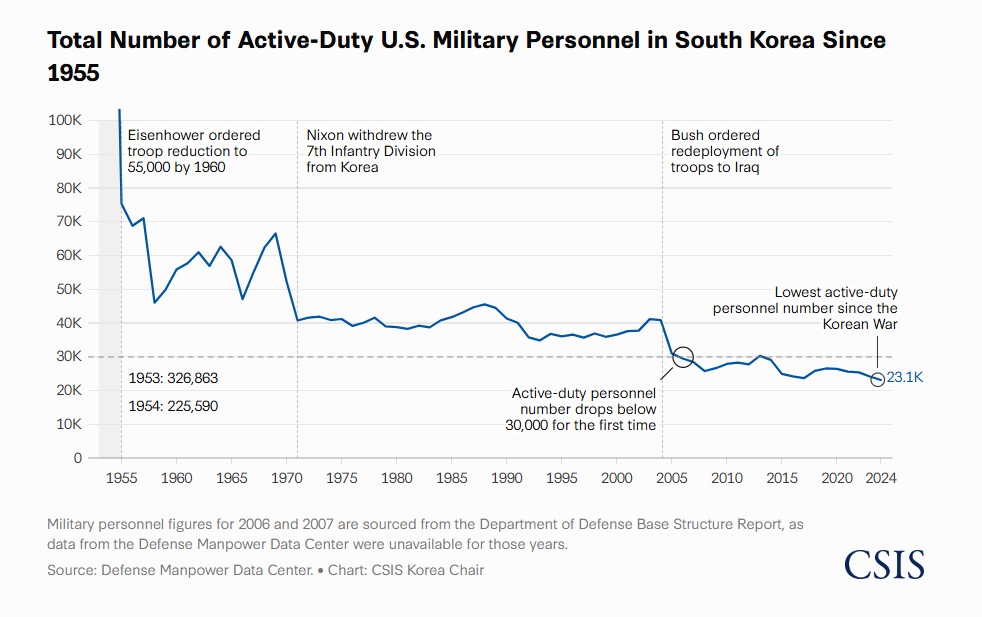
Now, President Trump’s decision to scale back joint military exercises with South Korea and threats to cut a deal with North Korea are further triggering insecurities in Seoul.
Notably, at this time, North Korea has nearly 60 nuclear warheads, as well as a mutual defense treaty with Russia. Similarly, China is expanding aggressively in the South China Sea.
The question is: will these insecurities revive the South Korean nuclear program the way they did in the 1970s?
As Karl Marx said: “History repeats itself, first as tragedy, second as farce.”
- Sumit Ahlawat has over a decade of experience in news media. He has worked with Press Trust of India, Times Now, Zee News, Economic Times, and Microsoft News. He holds a Master’s Degree in International Media and Modern History from the University of Sheffield, UK.
- He can be reached at ahlawat.sumit85 (at) gmail.com