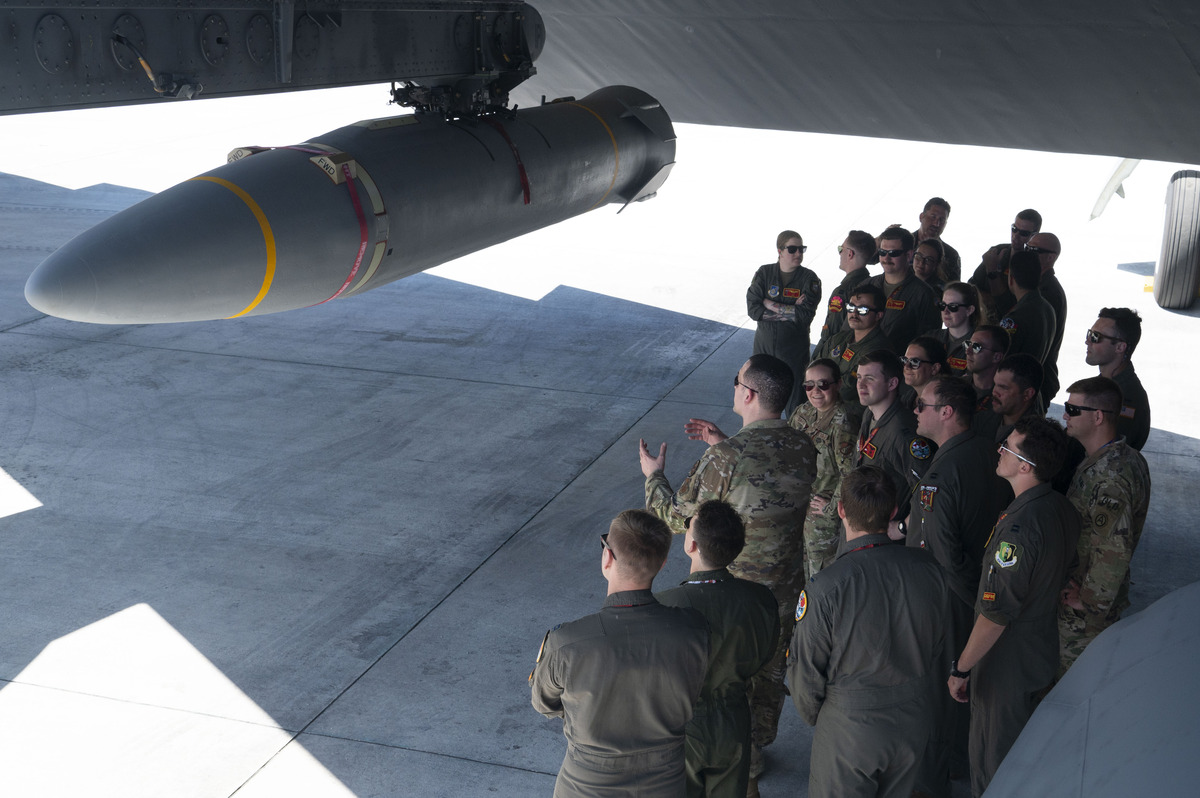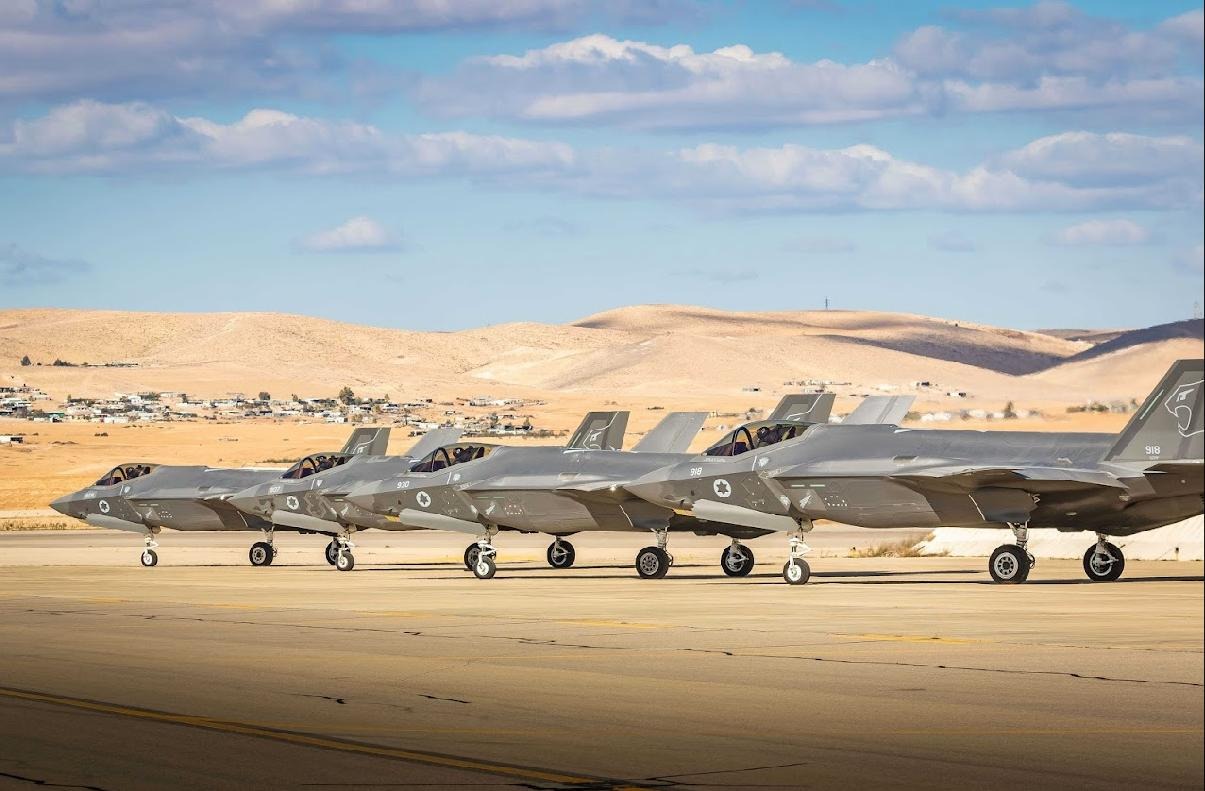
The F-15EX fighter jet achieved a major milestone by dropping live bombs for the first time amid reports that Strike Eagles of the US Air Force (USAF) continue to face fire in the Middle East.
In a first, the F-15EX Eagle II jets of the Oregon Air National Guard’s 142nd Wing dropped live bombs, marking what the service called “a historical milestone.” The event took place during a three-week deployment to Nellis Air Force Base in late August and early September in support of the US Air Force Weapons Instructor Course.
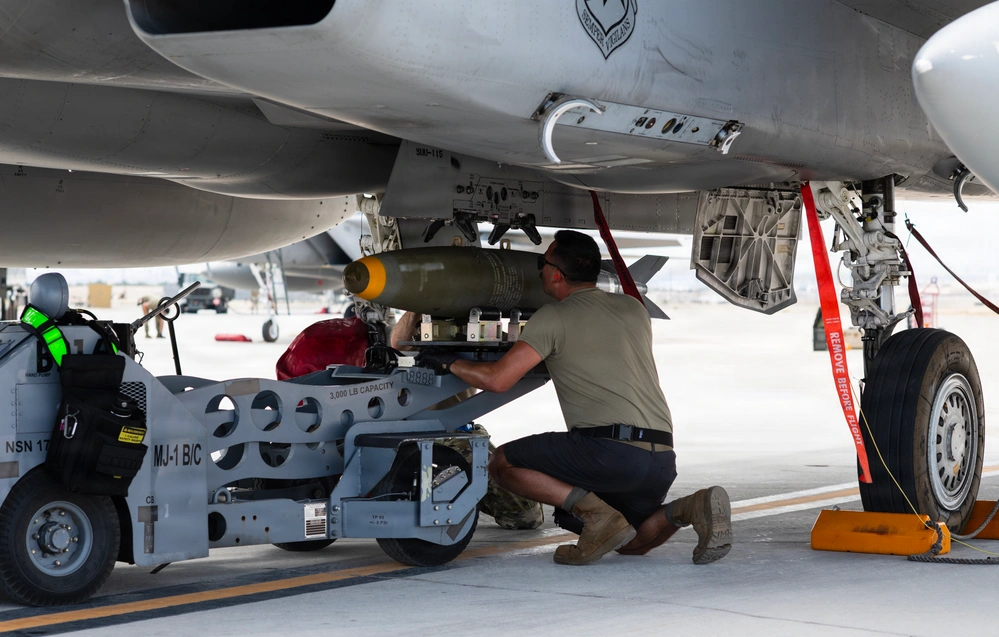
The Air National Guard released photos on 9 September 2026 showing the aircraft carrying ordnance, although the images themselves were taken in August. The aircraft appeared to carry a single 500-pound Mk 82 free-fall bomb on the fuselage centerline in the photos, although spotters also photographed the F-15EXs with 2,000-pound Mk 84 free-fall bombs.
The development comes months after the same operational 142nd Wing unit dropped inert BDU-50 and BDU-56 training bombs—mimicking the size and weight of 500-pound-class Mk 82-series and 2,000-pound-class Mk 84-series bombs—over the Mountain Home range complex in May 2026, as noted in a press release published in July.
The test successfully demonstrated the F-15EX’s operational air-to-ground capability and verified the entire process, from weapons loading by operational maintainers through aircraft systems integration, pilot delivery tactics, safety procedures, and scoring.
The event has been hailed as historic because the 142nd Wing has been transitioning from the F-15C Eagles, which only had air-to-air capability. Therefore, the live bomb drops marked concrete progress toward turning the new and advanced F-15EX into a true multi-role fighter rather than keeping it focused on air superiority.
Since it began as a pure air-to-air F-15C unit, the 142nd Wing has worked tirelessly to develop the expertise needed for a multi-role aircraft.
Only three pilots in the wing already had prior air-to-ground experience. However, those three completed a full nine-month course covering the science, tactics, and procedures of dropping bombs. Then, they returned and built a condensed training program to bring the rest of the wing’s pilots up to the necessary standard in a much shorter time.
In addition to teaching pilots how to release a weapon, the wing had to create a completely new air-to-ground training pipeline for pilots, maintainers, and weapons personnel at a unit that had never flown an aircraft with an operational bombing mission.
Nonetheless, the overall approach allowed the unit to progress from zero organic air-to-ground expertise to successfully employing ordnance far faster.
The F-15EX can take on air-to-ground work because it inherits the F-15E’s range and payload potential, with newer avionics and electronic warfare. That does not make the conversion simple.
Operational jets with the 142nd appear to have been delivered without conformal fuel tanks, which add fuel and extra weapons stations on the Strike Eagle. Official photographs from Nellis show a live bomb or a Sniper targeting pod on the centreline, not a dense Strike Eagle-style load. Extra tanks would matter more if the Air Force pushes the Eagle II into long-range strike with heavy weapons.
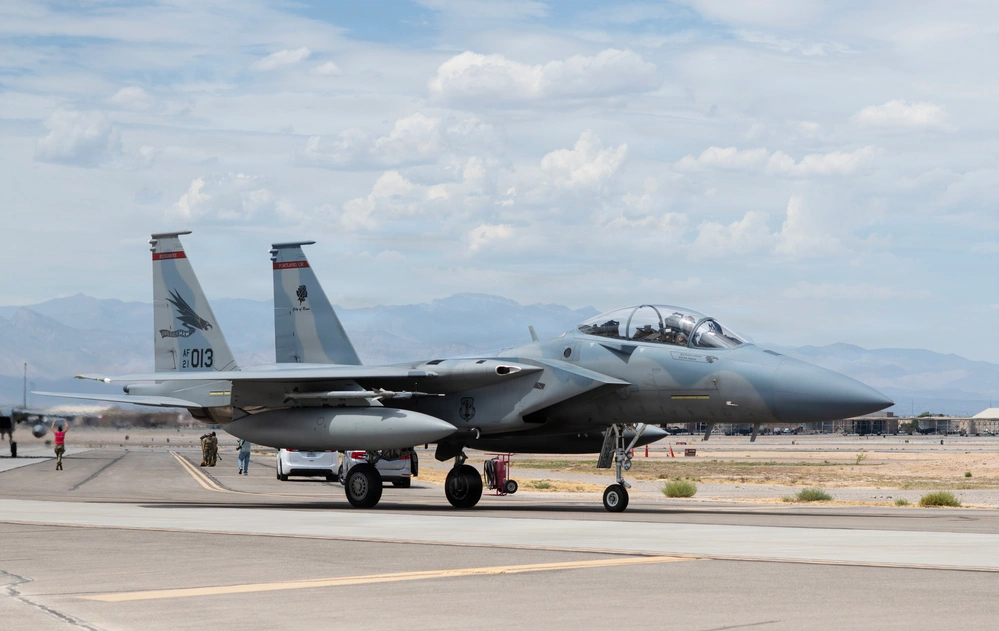
The F-15EX will also carry the conformal fuel tanks used by the F-15E, which can supply extra fuel and weapons stations, although the operational jets appear to have been delivered to the 142nd without them. Nonetheless, we know that the role of CFTs would become more significant if the USAF goes toward more difficult air-to-ground missions for the Eagle II, especially those needing significant weapons loads and long-range operations.
The recent milestone coincides with the USAF expanding the F-15EX’s role and nearly doubling its planned order from 129 to 267 aircraft in the coming years, as outlined in the fiscal 2027 budget documents. The service already fields more than 200 F-15 fighters, including roughly 40 F-15C/Ds and over 100 combat-coded F-15Es.
As deliveries of the new F-15EX begin, the Air Force will progressively phase out the older F-15C/D and F-15E variants.
However, it is pertinent to highlight that while the 142nd Wing’s recent live bomb drops are a meaningful milestone, they remain part of an ongoing training and development process rather than a declaration of full multi-role readiness equivalent to the Strike Eagle community. Thus, it would indeed be premature to describe the F-15EX as an operational replacement for the F-15E Strike Eagle in the air-to-ground role at this stage.
Even so, the F-15E fighters—the major workhorse and primary strike platform in the USAF—have been under fire in West Asia as the US fights an unending war against Iran.
F-15Es Under Fire in Middle East
Earlier this week, multiple American military aircraft were damaged in an Iranian strike on the Muwaffaq Salti Air Base in Jordan amid intensifying hostilities between Tehran and Washington after a brief lull. Citing an informed US official, CBS News reported on September 10 that Iran’s strike damaged about eight F-15s and an A-10 Warthog aircraft.
Meanwhile, the IRGC (Islamic Revolutionary Guard Corps) said in a statement that missiles “struck the maintenance, preparation, and deployment sites of F-35, F-16, and F-15 fighter jets, as well as their shelters, inflicting heavy damage on the enemy.”
Dozens of U.S. warplanes, including F-15Es, operate from the base, which functions as a key airpower hub for operations against Iran. Located near the Jordanian town of Azraq, the facility has come under repeated attack by Tehran since the conflict started in February.
Fortunately for the USAF, the eight F-15Es were only lightly damaged and returned to service after minor repairs, unidentified sources told CBS.
However, the F-15E Strike Eagles of the US and allied forces have borne the brunt of “Operation Epic Fury,” launched by the US more than six months ago, with many damaged while others were permanently destroyed.
One F-15E belonging to the 48th Fighter Wing from RAF Lakenheath was downed by ground-based fire from Iran’s Islamic Revolutionary Guard Corps (IRGC) on April 3, 2026, while conducting a combat mission over southwestern Iran. At the time, the US President Donald Trump claimed that a shoulder-launched missile had hit the aircraft. These weapons, commonly referred to as man-portable air defense weapons, or “MANPADS,” offer a low-cost, efficient way to detect low-flying aircraft.
This shootdown triggered a 36-hour search-and-rescue operation for the missing Weapon Systems Officer (WSO). The USAF incurred additional losses during that operation, including the self-destruction of aircraft that became defunct, to deny sensitive material to the IRGC. Subsequently, Iran recovered the canopy and a nearly intact ACES II ejection seat, and put both of them on exhibition as war trophies.

Before that, three F-15E Strike Eagles were shot down in Kuwaiti airspace in a suspected case of friendly fire by Kuwaiti air defenses during the opening days of Operation Epic Fury, on March 1, 2026. The jets were likely downed by an F/A-18C/D Hornet of the Kuwaiti Air Force.
All six aircrew, including three fighter pilots and three weapons systems officers (WSOs), who successfully ejected using their ACES II seats, were recovered and were said to be in good condition after the incident. However, this was a major attrition for the USAF during the opening of the conflict.
A May 2026 Congressional Research Service report revealed that the USAF lost or da,maged 42 aircraft, with F-15Es recording the third-highest losses after the MQ-8 Reaper and the KC-135 Stratotanker refueling aircraft.
- Contact the author at sakshi.tiwari13 (at) outlook.com
- Follow EurAsian Times on Google News