Determined to field an advanced capability to offset the vacuum left by the collapse of the FCAS manned fighter (Future Combat Air System) sixth-generation fighter program, France is now accelerating work on the Rafale F5 variant.
The French Directorate General of Armament (DGA) announced on September 9, 2026, that it had notified the first upstream development contracts for the Rafale F5 to Dassault Aviation, missile manufacturer MBDA, sensor supplier Thales, and M88 engine manufacturer Safran.
These are risk-reduction awards, not the formal launch of the aircraft. They are meant to de-risk long-lead technologies ahead of a full development contract, expected by the end of 2026, and before qualification of the F5 standard around 2033.
The contracts cover the inertial unit, the engine, the radar, the aircraft’s self-protection suite, and collaborative-combat connectivity, among other items. The DGA said the F5 standard would be qualified around 2033, then enter service first with the French Air and Space Force and later with the Navy. Qualification in 2033 should not be read as full operational service that year.
“With a resolute commitment to collaborative combat and the ability to strike first, the F5 standard represents a profound mid-life upgrade of the Rafale, essential for preparing it to face the challenges of the next decade and beyond,” the DGA stated in its announcement. “It integrates improvements to address the evolution of threats: responsiveness in adapting to the operational context thanks to greater openness of its architecture and more particularly of its mission system, providing greater autonomy to the forces.”
Rafale F5—a major mid-life upgrade of the Dassault Aviation Rafale multirole fighter—was initially envisioned as a technological bridge to the Next Generation Fighter (NGF), the manned sixth-generation aircraft at the heart of the Franco-German-Spanish FCAS (Future Combat Air System) program. Meanwhile, the NGF was to gradually replace the Rafales.
S’engageant résolument vers le combat collaboratif et la capacité d’entrer en premier, le standard F5 constitue une profonde rénovation à mi-vie du Rafale, indispensable pour le préparer à affronter les défis de la prochaine décennie et au-delà
⤵️— Direction générale de l'armement 🇫🇷 (@DGA) September 9, 2026
However, the FCAS collapsed in June 2026 amid irreconcilable differences between Dassault and Airbus over issues ranging from work-sharing to design and supplier selection.
In July 2026, Dassault chief Eric Trappier said France could develop a next-generation combat jet alone or with other partners, indicating it plans to fly a demonstrator by 2031. However, experts believe Paris will need time to recover from the recent FCAS debacle, and the NGF could be delayed by years— making the F5 more important than ever.
Without a new fighter, France faces a big gap because the current Rafales would start to get outdated in the 2030s, even with the F4 upgrade. Therefore, France is accelerating work on a version of the Rafale (the Rafale F5) that will carry much of the nation’s advanced combat-air capability well into the next decade and possibly beyond, rather than treating it as a technological bridge to an entirely different generation of aircraft.
Instead of treating the F5 as just a normal mid-life update, France is turning it into a major workhorse of the future by equipping it with stronger engines, better radar and electronic warfare, advanced data links so it can work with drones, the ability to carry the new nuclear missile, and other modern combat features.
In fact, France is looking to incorporate some of the concepts envisaged for the NGF into the upcoming F5.
Rafale F5 is Coming
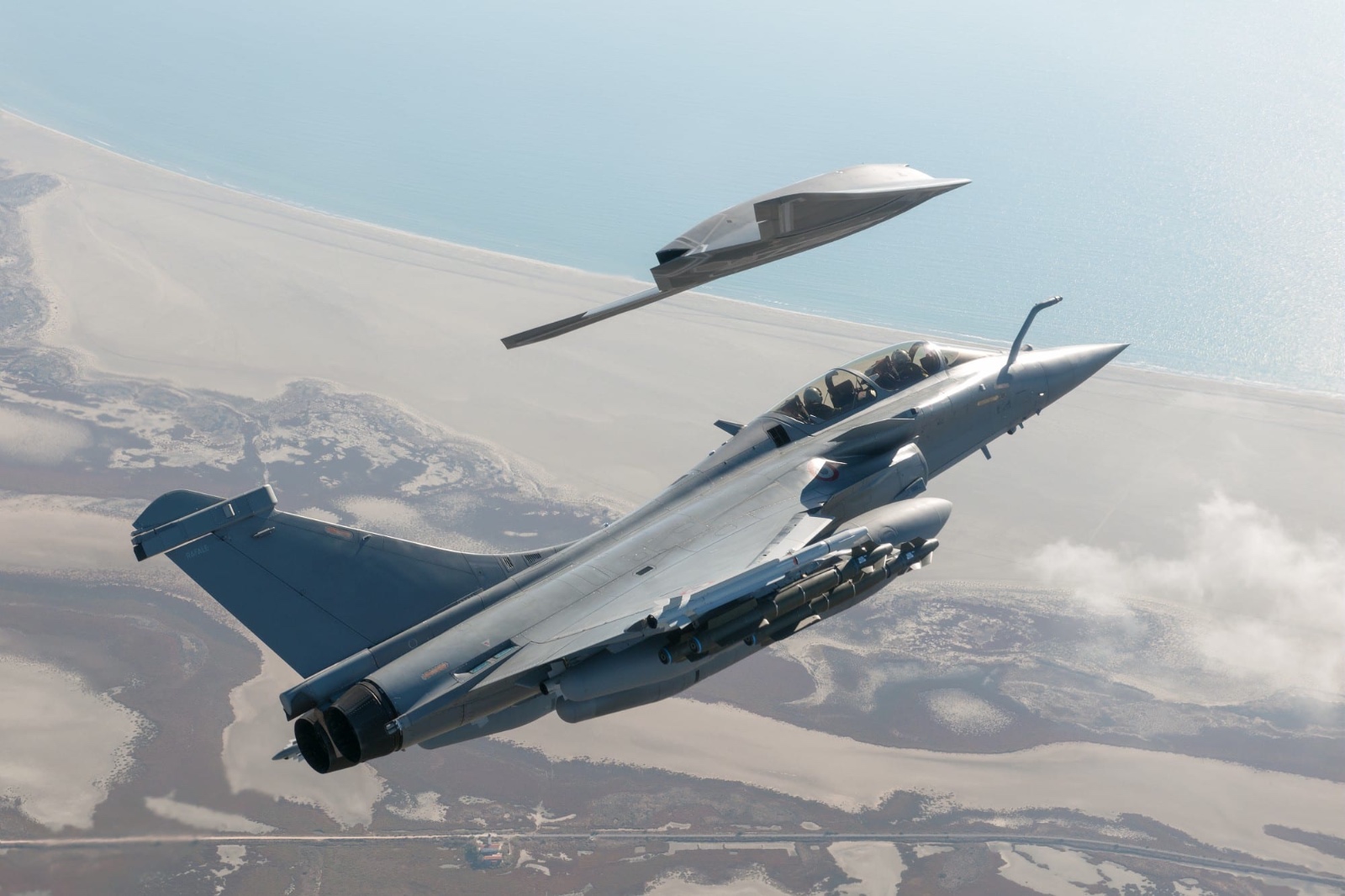
The Rafale F5 variant, which goes by the moniker Super Rafale, “will have more powerful engines, improved survivability and data links, and will be accompanied by an unmanned combat air vehicle (UCAV) weighing more than 10t,” Eric Trappier said in an interview.
For one, the Rafale F5 will be powered by the M88 T-REX, an advanced, higher-thrust military turbofan engine developed by Safran.
Officially unveiled at the Paris Air Show in June 2025, it is expected to deliver about 20% more thrust than the standard M88 engine that powers existing Rafales.
It will also be fitted with the Thales RBE2-XG radar, expected to incorporate gallium nitride (GaN) semiconductors, which should improve the radar’s power output without increasing its size. “This new radar will benefit from a substantial increase in power, and consequently in detection range, as well as improvements in the identification of targets with an extremely low radar cross-section (RCS). Its computing capabilities will also be enhanced to facilitate the integration of artificial intelligence,” the DGA had stated.
The Rafale F5 is intended to operate in a manned-unmanned teaming configuration with a loyal wingman drone, a concept pursued by other next-generation fighter programs. Trappier has said the unmanned combat air vehicle would weigh more than 10 tonnes and build on the nEUROn program, which produced Europe’s first stealth UCAV, but at more than twice that aircraft’s size. “We will go to more than double that to carry weapons and get a certain range. It’s going to be a big one,” he said earlier.
Additionally, the stealthy loyal wingman drone will incorporate autonomous control (with man-in-the-loop capability) and an internal weapons bay. The French Ministry of Armed Forces has stated that the combat drone “will allow it to act with discretion as an extension of the Rafale F5 to produce decisive network effects” and that, “with these characteristics,” it “should be a cornerstone in the treatment of modern medium- and long-range anti-aircraft systems.”
This manned-unmanned teaming capability is a core element of the collaborative combat concept underpinning the F-5 standard.
Additionally, the aircraft will have a much better electronic warfare suite, with advanced Suppression or Destruction of Enemy Defenses (SEAD/DEAD) capabilities, including the latest jamming systems and anti-radiation weapons. In addition to creating a “defensive bubble” around the aircraft, it will improve on the current SPECTRA EW and jamming system.
DGA said the SPECTRA self-protection suite will greatly enhance detection and jamming capabilities “through a fully digital approach, enabling a complete overhaul of the core electronic warfare system to counter the increasing density and broadening of the threat spectrum, as well as the growing complexity of threat waveforms, expected by 2035.”
Additionally, the F5 will introduce fiber-optic wiring. In a contested environment, these upgrades will significantly enhance its ability to penetrate defended airspace. Moreover, with advanced data fusion and processing capabilities that allow it to function as a tactical airborne command post, the Rafale F5 will also serve as a sensor platform.
More importantly, France’s airborne nuclear deterrent is a central driver of the F5 timeline.
In June this year, the DGA notified MBDA on June 2, 2026, about the framework agreement for the implementation and development contract for the ASN4G. The DGA set a target of 2035 for the missile’s induction, adding that it will be carried by the Rafale F5 and integrated into both the French Air and Space Force’s Strategic Air Forces (FAS) and the Navy’s Nuclear Air Force component, as the EurAsian Times reported at the time.
The Rafale F5 is essentially a deep modernization, transforming the existing airframe into a more powerful, better-connected, and more survivable combat system optimized for high-intensity warfare and nuclear deterrence.
However, as with the NGF, France would have to develop the Rafale F5 without external assistance. Earlier this year, the United Arab Emirates was considering contributing about EUR 3.5 billion to the F5 EUR 5 billion project before it unceremoniously walked away in April 2026 due to France’s reluctance to share technologies, particularly those involving optronics, ie, technologies that detect and control light.
Indian defense experts have argued for India’s acquisition of the F5 variant as part of its imminent order for 114 Rafales. Additionally, India has reportedly been examining the possibility of joining the FCAS as a partner alongside France.
nevertheless, the Rafale F5, accelerated by the failure of the European sixth-generation fighter project, serves as France’s essential bridge capability for the next decade and a half, while preserving industrial sovereignty and laying the groundwork for a future national combat aircraft.
- Contact the author at sakshi.tiwari13 (at) outlook.com
- Follow EurAsian Times on Google News