The US Air Force’s B-2 ‘Spirit’ stealth bombers — renowned for their ability to deliver devastating long-range strikes against heavily defended targets — are now expanding their role as a powerful maritime strike platform capable of hunting carrier strike groups and other vessels from standoff distances.
For the first time, a US Air Force B-2 bomber fired an AGM-158C LRASM during a live-fire sinking exercise (SINKEX) during Exercise Valiant Shield, expanding America’s long-range maritime strike options against adversaries like China, the Pacific Air Forces (PACAF) announced in an official statement on June 29, 2026.
“With the deployment of the LRASM from the B-2 Spirit, the Pacific Air Forces takes a major step forward in countering maritime threats. This milestone showcased impressive high-end innovation, reinforcing the US military’s commitment to safeguarding national interests and maintaining global security,” the service said in the statement. However, it stopped short of divulging further information about SINKEX or plans to integrate LRASM with the B-2.
Notably, this is the first time the integration of the AGM-158C onto the B-2 bomber has been publicly announced.
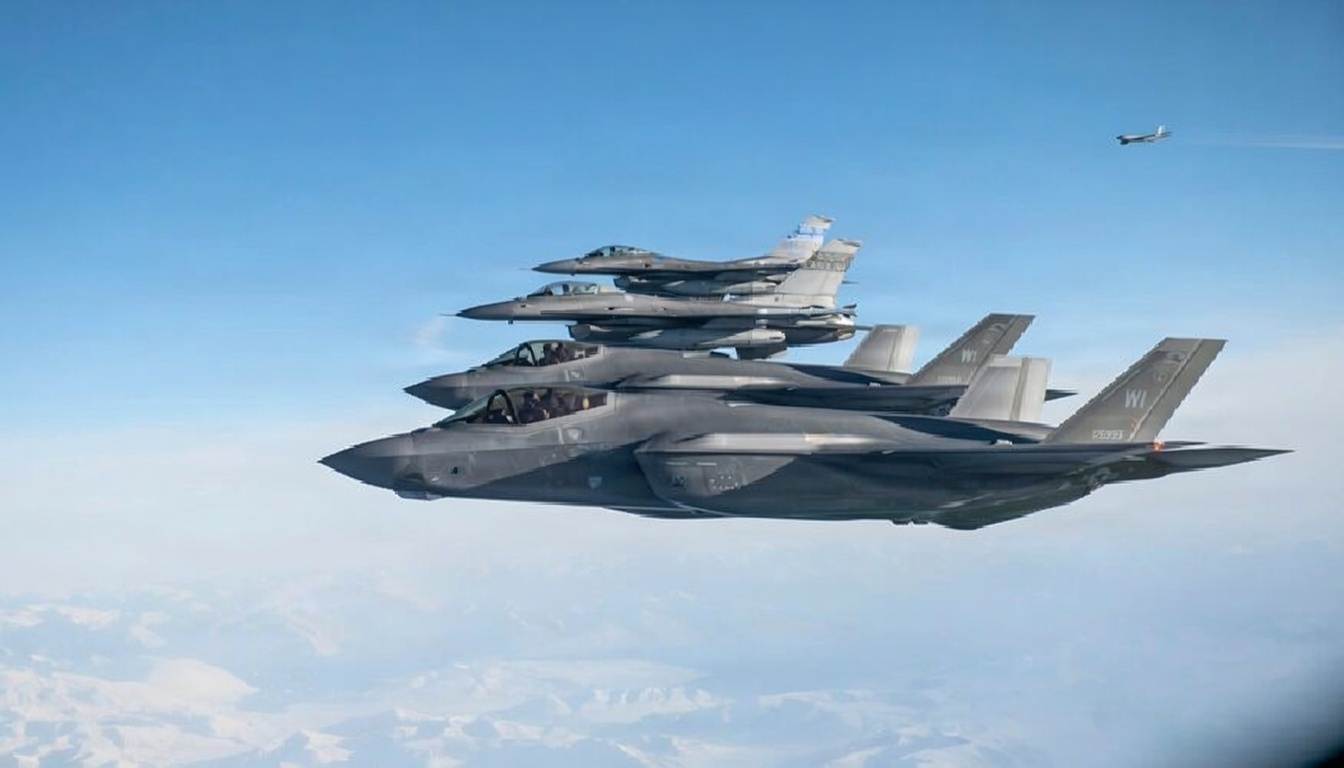
Earlier, the B-1 and the F/A-18E/F Super Hornet were designated as official launch platforms, and efforts were being made to integrate the missile with a variety of other warplanes, including the F-35, F-16 Viper, F-15E, F-15EX, and P-8A Poseidon maritime surveillance aircraft. The B-52 is also expected to get the capability.
The B-2 is the mainstay of the USAF’s bomber fleet and has unarguably remained in the headlines since it dropped the GBU-57 Massive Ordnance Penetrator (MOP) on Iran’s nuclear facilities as part of “Operation Midnight Hammer” in June 2025. The bomber also struck military assets in Iran during Operation Epic Fury earlier this year, as previously reported by the EurAsian Times.
The @PACAF successfully conducted a live-fire Sinking Exercise using the B-2 Spirit north of the Mariana Islands. Deploying the Long Range Anti-Ship Missile – demonstrating enhanced ability to achieve strategic objectives within range of potential threats.https://t.co/8PPP7bT3Pb pic.twitter.com/t2c0XTjfeo
— Air Force Global Strike Command (@AFGlobalStrike) June 29, 2026
The stealth bomber is expected to play a crucial role in any potential conflict with China in the Indo-Pacific or the Western Pacific.
“The B-2’s impressive performance underscores the US military’s commitment to adaptability and flexibility in the face of emerging security challenges,” General Kevin B. Schneider, Commander, Pacific Air Forces, was quoted as saying. “By prioritizing counter-maritime strike operations, we can maintain a decisive edge over adversaries, protect our national interests, and ensure the free and open Pacific that underpins our global security.”
Before the LRASM, the B-2 bomber was deployed to fire the low-cost QUICKSINK missile to sink the decommissioned warship USS Tarawa during Rim of the Pacific (RIMPAC) in 2024, as EurAsian Times reported at the time. The test was deemed “very significant” because it could be employed in a potential conflict with China, much like the LRASM.
LRASM & B-2 Bombers
“Derived from the combat-proven Joint Air-to-Surface Standoff Missile (JASSM), LRASM is a precision-guided intelligent anti-ship missile devised to interdict a variety of surface threats at very long range, navigating semi-autonomously to the target, and delivering a precise payload from safe, standoff range,” states the manufacturer, Lockheed Martin.
The LRASM is a long-range anti-ship missile designed with advanced autonomous targeting capabilities. It offers improved performance over the aging Harpoon missile, which is increasingly considered outdated for operations in contested environments.
With a range of over 200 nautical miles (370 kilometers), the LRASM can target hostile ships, aircraft, drones, land-based targets, and even shallow-water submarines, according to the manufacturer. Notably, the anti-ship missile has a stealthy, or low-observable, design, making it very hard for hostile air defenses to detect and intercept.
The LRASM initially navigates to a predetermined target location using GPS-assisted Inertial Navigation System (INS) guidance. However, it achieves a high degree of autonomy owing to an integrated route-planning feature linked to an onboard electronic support measures (ESM) package.
The advanced guidance operation eventually eliminates the need for GPS navigation, network links, and ISR (intelligence, surveillance, and reconnaissance) platforms by using gross target cueing data to locate and destroy predetermined targets in hostile electronic warfare (EW) environments. The missile employs a passive infrared imaging sensor during its terminal phase, which is impervious to jamming.
The missile can adjust its trajectory in response to interceptors’ radio-frequency emissions and use those signals to more accurately identify potential targets. It can carry a 450-kilogram high-explosive blast-fragmentation penetrator, effective against large surface warships.
Additionally, it has a datalink that enables it to receive threat updates while in flight. It can also cooperate with other LRASMs during coordinated strikes.
The AGM-158C is derived from the AGM-158 Joint Air-to-Surface Standoff Missile (JASSM) family of land-attack cruise missiles, which is a key munition in the B-2’s arsenal. Since the bomber can carry 16 AGM-158As, it is highly likely capable of carrying an equivalent number of LRASMs, as both munitions share the same form factor and size.
The integration of a long-range stealth bomber with a long-range stealth anti-ship missile would be instrumental in a conflict with China, which has meticulously built a highly sophisticated anti-access/area denial (A2/AD) network along the First Island Chain.
In the event of a possible conflict involving Taiwan, Beijing’s expansive posture within the first island chain could present a serious obstacle to Washington’s response. Chinese aircraft carriers are regularly deployed in the Western Pacific for military drills and missions as part of Beijing’s “blue sea” ambitions.
This is where the “stealth-on-stealth” combination of B-2 bombers and AGM-158C comes into the picture.
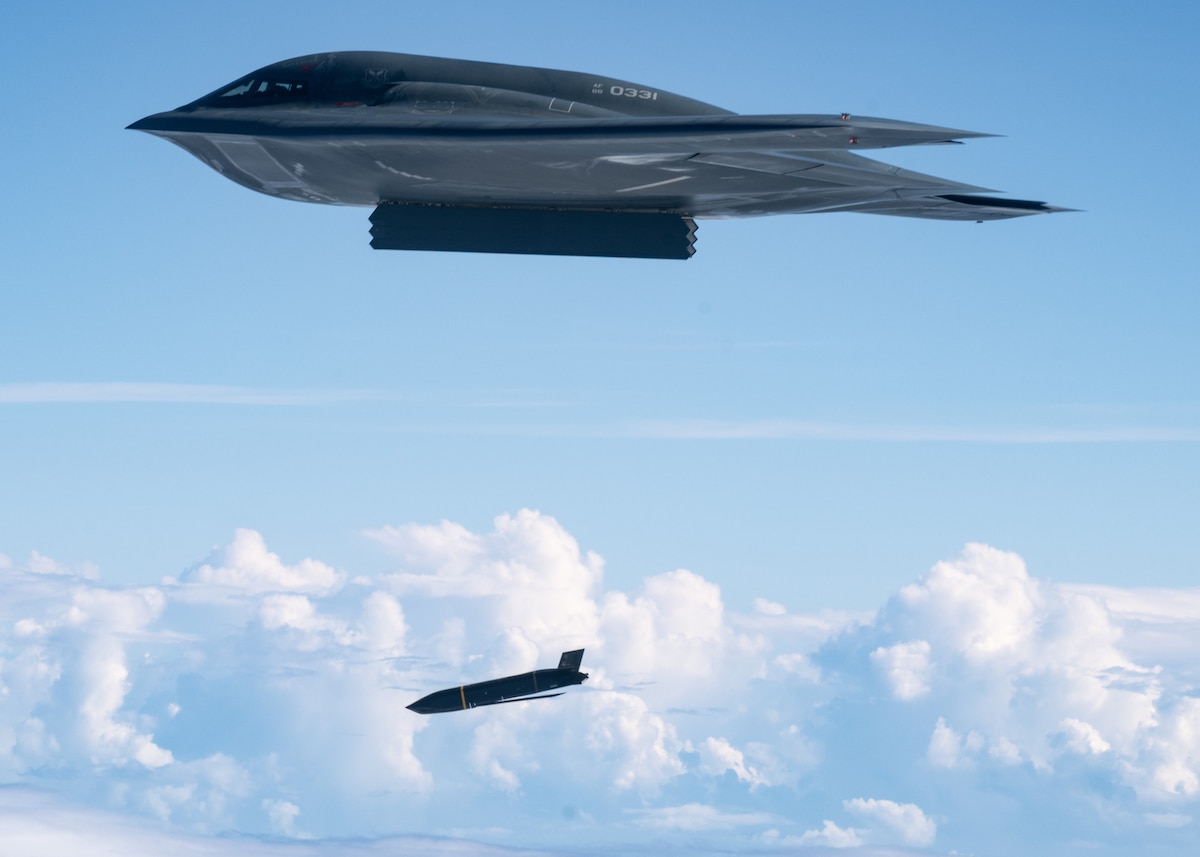
The stealthy B-2 bomber can operate at high altitudes with minimal risk of detection, enabling it to penetrate heavily defended airspace. When armed with an anti-ship stealth missile, it can strike well-defended surface targets from long standoff ranges.
Previous simulations have highlighted that launching standoff anti-ship ordnance is one of the most efficient ways to blunt a Taiwan invasion.
The combination of B-2 and AGM-158C is specifically designed for Pacific scenarios against near-peer adversaries like China and represents the US’s asymmetric advantages in stealth and precision strike. It would likely play a major role in disrupting Chinese naval operations in the First Island Chain, potentially shifting the advantage to Washington despite Beijing’s home-field advantage.
- Contact the author at sakshi.tiwari13 (at) outlook.com
- Follow EurAsian Times on Google News