

Swedish defense manufacturer Saab is deepening collaboration with Portuguese industry partners to produce parts for the Gripen E/F fighter jet. The move signals that Saab is actively pitching its aircraft against the Rafale, Eurofighter Typhoon, and F-35.
On November 11, Saab announced a long-term cooperation with Portuguese aerospace supplier Vangest to produce eight complex components for Gripen E/F jets.
The Portuguese company, which has been growing in the aerospace sector and is best known for making molds and precision plastic parts for multiple industries, will carry out the work at its facilities in Marinha Grande, Portugal.
The pact covers eight different components rather than a production batch of eight parts. However, Saab has not disclosed which specific components will be produced, the contract value, production volumes, or delivery schedule.
The cooperation initially focuses on industrializing these eight components, with potential for expansion in the coming years, Saab has signaled.
Saab stated that it expects the work to create new skilled jobs in the Marinha Grande region and contribute to the development of Portugal’s aerospace sector. “With Vangest, we are expanding our manufacturing network and strengthening production capacity, while at the same time giving Portuguese industry a concrete role in the Gripen program,” Johan Segertoft, head of Saab’s Gripen business unit, stated.
The agreement will expand Saab’s international supply chain and strengthen the overall production capacity. At the same time, it will give Portuguese industry a concrete role in the Gripen program as Lisbon prepares to replace its aging F-16 fleet with a new fighter jet and seeks industry participation from interested export partners.
After initially favoring the F-35A to replace its obsolete F-16A/B fleet, Portugal backtracked in March 2025, saying it would not proceed with the purchase. The decision came amid growing cracks in the relationship between the US and Europe, and fears of uncertainty under President Donald Trump, as the EurAsian Times reported earlier.
Although Portugal has yet to float a formal contest, Saab has been courting the country with its Gripen-E/F fighter jets for more than a year. For example, the Swedish company has already pursued other Portuguese partners, including OGMA, linked to Embraer, Critical Software, and the AED Cluster Portugal, positioning local industry participation as a key part of its Gripen-E/F offer.
In modern fighter competitions, industrial participation and technology transfer often carry as much weight as the aircraft’s capabilities. Saab is seeking to demonstrate tangible benefits ahead of any formal tender rather than merely promising future offsets by placing real production work in Portugal.
For Saab, its new partnership with Vangest serves dual purposes: it helps meet rising demand for Gripen E/F aircraft and firmly positions the company as a partner if Lisbon formally chooses the Gripen.
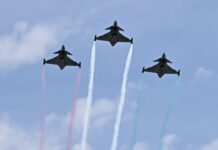
Saab describes Gripen-E as “Designed to defeat any adversary. Made for forward-thinking air forces, Gripen E incorporates cutting-edge technologies, the latest systems, sensors, weapons, and pods to ensure combat advantage, delivering air superiority in highly contested environments. Silent networking and total sensor fusion across a tactical air unit to blind and confuse the enemy. One aircraft is active, the others go passive.”
Portugal’s F-16 replacement program is rapidly turning into a multi-cornered contest, with the Dassault Rafale, Eurofighter Typhoon, and the Lockheed F-35 Lightning II also in the fray.

Gripen Faces Competition in Portugal
Dassault Aviation and Airbus, two of Europe’s biggest aviation giants, are also vying to replace Portugal’s F-16M fighter jets.
In September 2026, Airbus said it intends to submit an unsolicited proposal to Portugal for the Eurofighter Typhoon in late October or early November.
At the time, Ivan Gonzalez Exposito, the Eurofighter campaign manager for Portugal, told reporters that the proposal would include “public and private financing solutions for Portugal to alleviate the payment plan,” along with military cooperation and industrial engagement.
However, he did not explicitly state whether the proposal would also include an offer for local manufacturing, as the EurAsian Times earlier noted.
Gonzalez contended that the Typhoon better matches Portugal’s mission profile than the stealthy F-35, especially since the Portuguese Air Force’s primary missions center on air policing, NATO quick-reaction alert duties, and defending national airspace and waters rather than deep-strike offensive operations. “For that, the Eurofighter is the ideal solution,” he said, adding that the aircraft is “the best air superiority fighter in the world.”
Airbus has been courting Portugal’s defense industry for almost a year. In October 2025, for example, it inked a Memorandum of Understanding with the Portuguese Cluster for Aeronautics, Space and Defense Industries (AED) to collaborate on an “industrial proposition” for the fighter replacement program.
In a time when European sovereignty and industrial autonomy are at the forefront of our strategy, Airbus strongly believes that the Eurofighter is the best option for this replacement,” Jose Luis de Miguel, Head of Airbus Defense & Space for Europe, said at the time.
Airbus has been actively trying to leverage its existing relationship with Portugal, since the latter already operates 11 Airbus C295 military transport aircraft.
Another aircraft that is in the fray is the French Dassault Rafale. In September 2026, Dassault Aviation signed a memorandum of understanding (MoU) with Portuguese industry.
“Dassault Aviation, representing its RAFALE partners, Thales and Safran, signed with AED Cluster Portugal, Portugal’s association for the aeronautics, space and defense industries, a Memorandum of Understanding (MoU) to explore potential areas of cooperation between RAFALE partners and the Portuguese industrial sector, in the context of the Portuguese Air Force’s F-16 fleet renewal,” the French behemoth said in a statement at the time.
The MoU reportedly came months after France revealed in July that it had formally submitted Dassault’s Rafale to the F-16 replacement competition. The proposal’s specifications, such as the number of aircraft, unit cost, weapons/sensors, training, support, funding, or offsets, are currently unknown. However, it likely outlines a long-term evolution path, including ongoing F4 upgrades and the F5.
In a March 2025 interview with Le Journal du Dimanche, Dassault CEO Éric Trappier stated that the company was prepared and happy to offer the Rafale to Portugal as an F-35 alternative, following Portugal’s announcement that it was shelving the F-35.
“We really want to offer our aircraft to Portugal… It would have the same interoperability capabilities that we have within the Alliance, so it seems logical,” the chief asserted at the time.
If the contest was already not crowded enough, Portugal said last month that it was seriously considering F-35 stealth jets to replace its F-16 fighters.
“The Portuguese state will always decide in accordance with the national interest. There is one point that is also clear: we are seriously considering the F-35 proposal, just as we are considering others,” Foreign Minister Paulo Rangel said after a meeting with US Secretary of State Marco Rubio.
This means the Lockheed F-35 Lightning II, which swept much of Europe’s fighter jet contracts over the past decade, is still in the running.

This may complicate Gripen’s prospects, especially since several European countries have opted for a fifth-generation stealth fighter. According to some reports, internal Portuguese Air Force assessments have ranked the F-35A first among the candidates, using around 20 technical criteria, with the Gripen E reportedly coming second.
The Gripen E is a very capable 4.5-generation fighter, equipped with a modern AESA radar, advanced electronic warfare capabilities, low operating costs, short-field performance, and strong network-centric features. However, the F-35 comes with stealth, sensor fusion, and deep integration into the wider US and NATO ecosystem.
For now, Saab’s strongest assets are the fighter’s lower operating costs, proven industrial partnership models, and the ability to offer a modern European alternative with real local content. However, whether it can convince Portugal that the Gripen-E/F offers the best value remains to be seen.
- Contact the author at sakshi.tiwari13 (at) outlook.com
- Follow EurAsian Times on Google News