Vadim Badekha, General Director of the United Aircraft Corporation (UAC), told TASS on June 2, “The work on Checkmate is already at the stage of building a prototype.”
According to Badekha, Russia is developing the medium-weight fifth-generation fighter for both Russian forces and international customers. Badekha noted that the single-engine (Su-75) Checkmate has a cost advantage over heavy twin-engine fighters such as the Su-57.
Earlier, in January, the Izvestia newspaper reported that the first flight of the Russian fifth-generation Su-75 single-engine fighter could take place in 2026.
On November 18, 2025, during an interview on Russia’s state-run Channel One television station, Sukhoi chief test pilot Sergei Bogdan stated that the Su-75’s first flight would take place in 2026.
“The aircraft is already on the shop floor, it is already being finalized, and there are already certain timelines. Therefore, with God’s help, it should take place soon enough.”
Su-75 Journey So Far
Russia’s Sukhoi company first unveiled the company-funded, low-observable (LO), supermaneuverable, optionally manned, single-engine, lightweight (18-tonne), Mach 2 fighter at MAKS 2021.
The Checkmate was reportedly developed based on an analysis of the use of strike aircraft in Syria, which revealed that, for most tasks, the capabilities of heavy twin-engine aircraft are excessive.
The aircraft is reportedly being developed using digital twin technology, reducing development time by 5 years.
The USPs of the fighter, designed using electronic modeling, include:
- Low acquisition and operating costs
- AI assistance for single-pilot operations
- Ease of maintenance
Timeline Slippages Due to Redesign
On the eve of Dubai Airshow 2023, Rostec told RIA Novosti that preparations had begun in Russia for the production of the first examples of the light stealth fighter.
As per the timeline announced at Dubai Airshow 2021, the first prototype of the aircraft was expected to fly by the end of 2023.
A statement released by Rostec’s press service explained that the timeline had slipped to accommodate design changes. The redesign, it said, “has significantly increased the competitiveness and commercial attractiveness of the domestic single-engine aircraft and reduced the technical risks of its development.”
First Deputy Chairman of the Federation Council Defense and Security Committee, Viktor Bondarev, confirmed that, following the redesign, the documentation for the Checkmate fighter had been transferred to the manufacturing plant and preparations for the production of the first examples had begun.
“The pilot batch of Checkmate fighters is planned to be produced in 2026,” he said.
Deputy Prime Minister and Minister of Industry and Trade Denis Manturov said, “I can say that over these two years we have collected requests, including making certain adjustments to the project so that it is maximally adapted to the requirements of customers interested in a single-engine aircraft. This applies to the layout, control systems, and aviation weapons. A great deal of work was done on the basis of the Checkmate originally presented here.”
In February 2024, Rostec stated in a statement to TASS: “Under the Checkmate program, the United Aircraft Corporation of Rostec received feedback from potential customers. In addition to collecting additional requirements from potential buyers, work was carried out to optimize costs and analyze individual technical solutions. This made it possible to significantly increase competitiveness and commercial attractiveness, while also reducing technical risks in the creation of a domestic single-engine aircraft.”
Prototype Development
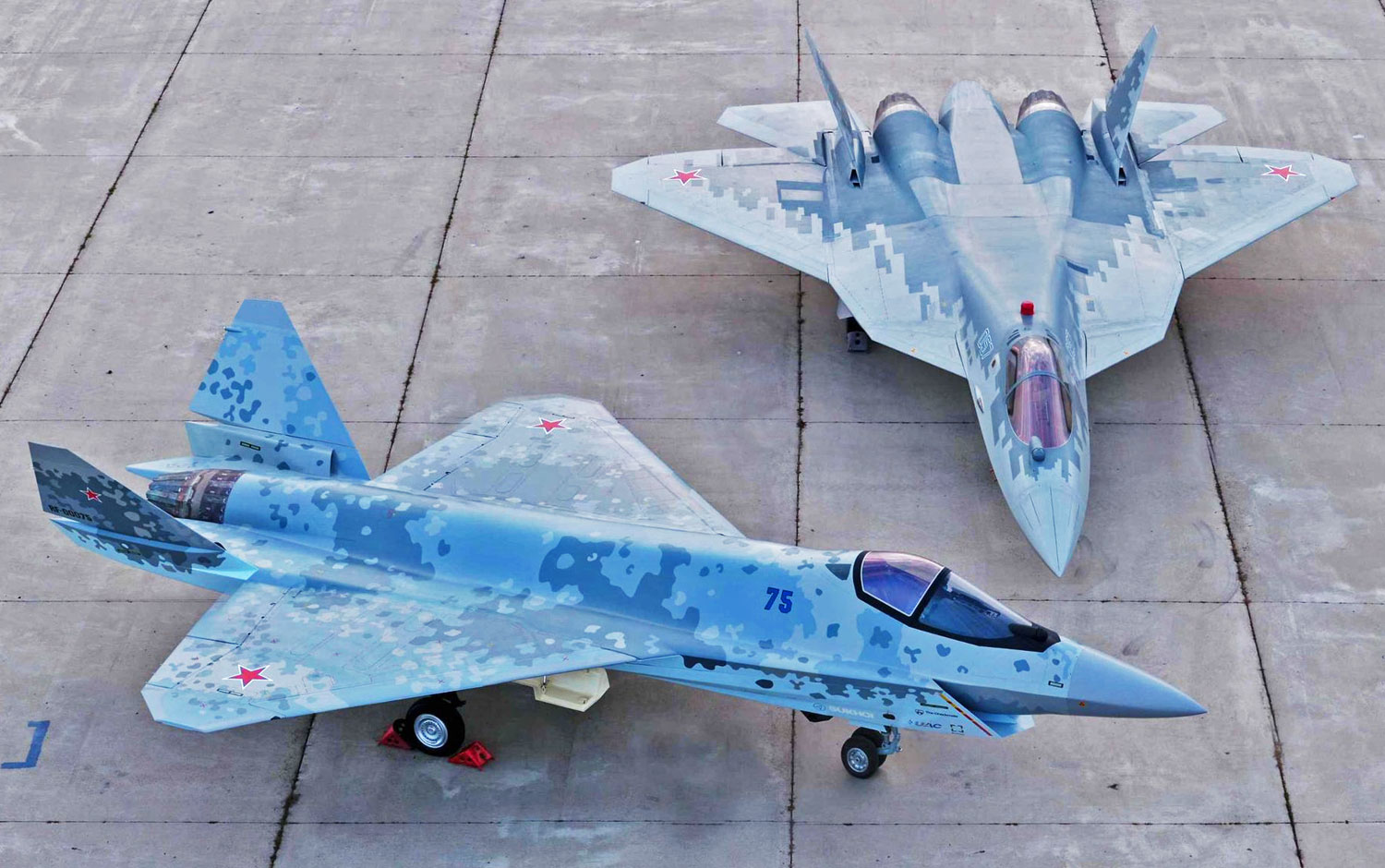
In February 2025, Russian media reported that KnAAZ (Komsomolsk-on-Amur Aviation Plant named after Y.A. Gagarin) planned to assemble two prototypes of the Su-75 Checkmate light tactical aircraft (LTA), one for static testing and one for flight testing.
Three Variants
At Dubai Airshow 2025, as if to reiterate its commitment to the Su-75 project despite the war in Ukraine and unconfirmed interest from potential foreign customers, Sukhoi unveiled a model of an unmanned variant of the fighter alongside the model of the manned variant.
The unmanned variant featured a reworked wing and a revised rear fuselage.
As of now, the Su-75 is proposed in three variants: single-seat, twin-seat, and unmanned.
In the past, Russian media, quoting the Federal Service for Military-Technical Cooperation (FSMTC), reported that Russia and Belarus were working together on the Checkmate project.
The Checkmate has been estimated to cost $30 million. For comparison, the basic version of the F-35 costs $80 million or more.
Indian Interest?
In February 2026, responding to a query from TASS, a HAL official said the company was ready to work with Russia to produce new warplane models.
“We are very comfortable working with Russia. There are no problems on our part,” said the HAL representative.
In the past, HAL collaborated with Russian aircraft manufacturers to assemble and locally produce fighter aircraft for the IAF, including the MiG-21, MiG-27, and Su-30MKI. However, joint development had never previously been considered.
Joint development offers the advantage of Indian ownership. Beyond securing IPR for the weapon system and fostering self-reliance, it ensures that projects are not subject to sanctions-related import restrictions.
However, it may now be too late for HAL to participate in the aircraft’s design and initial production. The design is frozen, and Russian officials have confirmed that the initial batch of Su-75 fighters will be manufactured in Russia to meet the requirements of Russian forces.
U.S. Not Ready for Prolonged Conflicts — 39-Day Iran War Exposed Biggest Chink in American Armor?
The Su-75 Checkmate Option
The TASS report was nonspecific, but it may have alluded to a specific project, such as the development of the Su-75 stealth fighter. Russia has previously indicated that it is open to joint-venture production of the Su-75 in a partner country. Such a venture would align perfectly with India’s Make in India and Atmanirbhar Bharat initiatives.
Alongside helping to plug the emerging stealth gap, local manufacture of the Su-75 in India could generate billions of dollars in export revenue, much like the BrahMos missile program and potentially the Su-30MKI modernization program.
India’s manufacture of the Su-75 would in no way compromise the AMCA program. The AMCA is a twin-engine medium-weight stealth fighter, whereas the Su-75 is a single-engine lightweight stealth fighter.
The two serve distinct operational roles. A single-engine fighter is cheaper to acquire and operate, and the Su-75 would remain relevant to the IAF’s requirements well beyond the induction of the AMCA.
- Vijainder K Thakur is a retired IAF Jaguar pilot, author, software architect, entrepreneur, and military analyst.
- This is an Opinion Article. Views Personal of the Author
- Follow the author @vkthakur